
Catalogue Search | MBRL


Are you sure you want to remove the book from the shelf?

{{itemTitle}}
21,697
result(s) for
"media ethics"
Sort by:

Learning about plagiarism
\"Introduces readers to the media literacy skills needed to understand plagiarism. Includes a hands-on activity related to media literacy\"-- Provided by publisher.
Book

Media codes of ethics for health professionals and media professionals: a qualitative study
Media is an opportunity for health professionals; however, it is not free of threats. Fixing the threats requires professional systematization through developing practical guidelines, which brings us to the goal this study was designed to achieve. The study was conducted qualitatively through literature review, semi-structured interviews, and a focus group discussion with health and media experts, as a result of which 486 codes were extracted and classified into 4 groups. The first group was addressed to media professionals and contained 126 codes in 5 categories: seeking and reporting the truth, harm minimization, integrity, independence, and respect for the rights of others. The second and third groups were addressed to health professionals, the former (150 codes) dealing with formal media, and the latter (190 codes) dealing with cyberspace. These groups were both categorized into 6 categories: scientific demeanor, beneficence, harm minimization, integrity, maintaining the dignity of the profession and professionals, and respect for the rights of others. The fourth group was addressed to the public audience and contained 20 codes categorized into 2 categories: ethics of belief, and ethics of (re-)publishing. Since the study was conducted during the pandemic/infodemic, the proposed codes can help reduce possible conflicts in similar future situations.
Journal Article

Celebrity and fame
Examines the media treatment of celebrities and famous people worldwide, including issues of media pressure, privacy, discrimination, and scandals.
Book

Virtual Boundaries: Ethical Considerations for Use of Social Media in Social Work
In real life, we often use physical cues to help us identify our role and put the appropriate boundaries in place, but online it is more difficult to determine where our boundaries lie. This article provides and overview of various social media tools and uses along with personal and professional considerations to help in guiding the ethical use of social media tools. As the use of social media continues to grow, the importance of virtual boundaries will also rise. Therefore, proactive considerations that include policies and guidelines that encourage responsible and ethical use of social media are needed to help social workers mediate personal and professional boundaries.
Journal Article

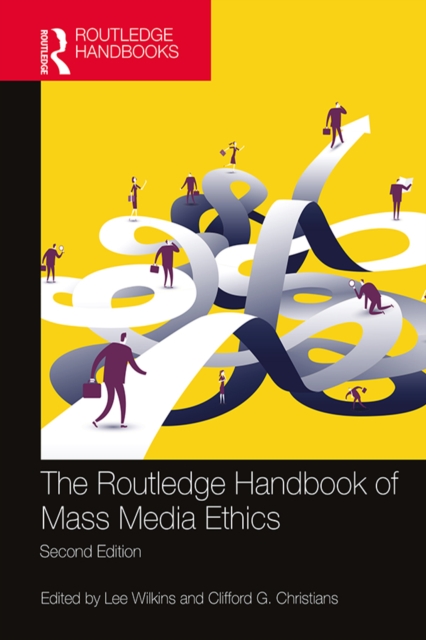
The Routledge Handbook of Mass Media Ethics
This fully updated second edition of the popular handbook provides an exploration of thinking on media ethics, bringing together the intellectual history of global mass media ethics over the past 40 years, summarizing existing research and setting future agenda grounded in philosophy and social science.
This second edition offers up-to-date and comprehensive coverage of media ethics, including the ethics of sources, social media, the roots of law in ethics, and documentary film. The wide range of contributors include scholars and former professionals who worked as journalists, public relations professionals, and advertising practitioners. They lay out both a good grounding from which to begin more in-depth and individualized explorations, and extensive bibliographies for each chapter to aid that process.
For students and professionals who seek to understand and do the best work possible, this book will provide both insight and direction. Standing apart in its comprehensive coverage, The Routledge Handbook of Mass Media Ethics is required reading for scholars, graduate students, and researchers in media, mass communication, journalism, ethics, and related areas.
eBook


Misinformation in and about science
Humans learn about the world by collectively acquiring information, filtering it, and sharing what we know. Misinformation undermines this process. The repercussions are extensive. Without reliable and accurate sources of information, we cannot hope to halt climate change, make reasoned democratic decisions, or control a global pandemic. Most analyses of misinformation focus on popular and social media, but the scientific enterprise faces a parallel set of problems—from hype and hyperbole to publication bias and citation misdirection, predatory publishing, and filter bubbles. In this perspective, we highlight these parallels and discuss future research directions and interventions.
Journal Article


Toward an Ethics of Algorithms: Convening, Observation, Probability, and Timeliness
Part of understanding the meaning and power of algorithms means asking what new demands they might make of ethical frameworks, and how they might be held accountable to ethical standards. I develop a definition of networked information algorithms (NIAs) as assemblages of institutionally situated code, practices, and norms with the power to create, sustain, and signify relationships among people and data through minimally observable, semiautonomous action. Starting from Merrill's prompt to see ethics as the study of \"what we ought to do,\" I examine ethical dimensions of contemporary NIAs. Specifically, in an effort to sketch an empirically grounded, pragmatic ethics of algorithms, I trace an algorithmic assemblage's power to convene constituents, suggest actions based on perceived similarity and probability, and govern the timing and timeframes of ethical action.
Journal Article