
Catalogue Search | MBRL


Are you sure you want to remove the book from the shelf?

{{itemTitle}}
3,937
result(s) for
"medical ethics/bioethics"
Sort by:

Choosing children : genes, disability, and design
Progress in genetic and reproductive technology now offers us the possibility of choosing what kinds of children we do and don't have. Should we welcome this power, or should we fear its implications? There is no ethical question more urgent than this: we may be at a turning-point in the history of humanity. This book shows us how we might try to answer this question, and examines other provoking and disturbing questions. Surely parents owe it to their children to give them the best life they can? Increasingly we are able to reduce the number of babies born with disabilities and disorders. But there is a powerful new challenge to conventional thinking about the desirability of doing so: this comes from the voices of those who have these conditions. They call into question the very definition of disability. How do we justify trying to avoid bringing people like them into being? In 2002 a deaf couple used sperm donated by a friend with hereditary deafness to have a deaf baby: they took the view that deafness is not a disability, but a difference. Starting with the issues raised by this case, this book examines the emotive idea of ‘eugenics’, and the ethics of attempting to enhance people, for non-medical reasons, by means of genetic choices. Should parents be free, not only to have children free from disabilities, but to choose, for instance, the colour of their eyes or hair? This is no longer a distant prospect, but an existing power which we cannot wish away. What impact will such interventions have, both on the individuals concerned and on society as a whole? Should we try to make general improvements to the genetic make-up of human beings? Is there a central core of human nature with which we must not interfere?
eBook

Choosing Tomorrow's Children
To what extent should parents be allowed to use selection technologies (such as preimplantation genetic diagnosis) to determine the characteristics of their children? And is there something morally wrong with parents who wish to do this? Choosing Tomorrow's Children provides answers to these questions. In particular, the book applies the techniques of philosophical bioethics to address issues raised by selective reproduction, the practice of choosing between different possible future persons by selecting or deselecting (for example) embryos, eggs, and sperm. It offers answers to questions including the following. Do children have a ‘right to an open future’ and, if they do, what moral constraints does this place upon selective reproduction? Under what circumstances (if any) should sex selection be allowed? Should we ‘screen out’ as much disease and disability as possible before birth, or would that be an objectionable form of eugenics? Is it acceptable to create or select a future person (a ‘saviour sibling’) in order to provide life-saving tissue for an existing relative? Is there a moral difference between selecting to avoid disease and selecting to produce an ‘enhanced’ child? And should we allow deaf parents to use reproductive technologies to ensure that they have a deaf child? The book does not provide one overarching conclusion but rather assesses each argument-type on its merits. Insofar as it is possible to generalise though, Choosing Tomorrow's Children concludes that most of the arguments usually provided against selective reproduction are flawed in one way or another.
eBook

Research Misconduct Policy in Biomedicine
Federal regulations that govern research misconduct in biomedicine have not been able to prevent an ongoing series of high-profile cases of fabricating, falsifying, or plagiarizing scientific research. In this book, Barbara Redman looks critically at current research misconduct policy and proposes a new approach that emphasizes institutional context and improved oversight. Current policy attempts to control risk at the individual level. But Redman argues that a fair and effective policy must reflect the context in which the behavior in question is embedded. As journalists who covered many research misconduct cases observed, the roots of fraud \"lie in the barrel, not in the bad apples that occasionally roll into view.\" Drawing on literature in related fields -- including moral psychology, the policy sciences, the organizational sciences, and law -- as well as analyses of misconduct cases, Redman considers research misconduct from various perspectives. She also examines in detail a series of clinical research cases in which repeated misconduct went undetected and finds laxity of oversight, little attention to harm done, and inadequate correction of the scientific record. Study questions enhance the book's value for graduate and professional courses in research ethics. Redman argues that the goals of any research misconduct policy should be to protect scientific capital (knowledge, scientists, institutions, norms of science), support fair competition, contain harms to end users and to the public trust, and enable science to meet its societal obligations.
eBook
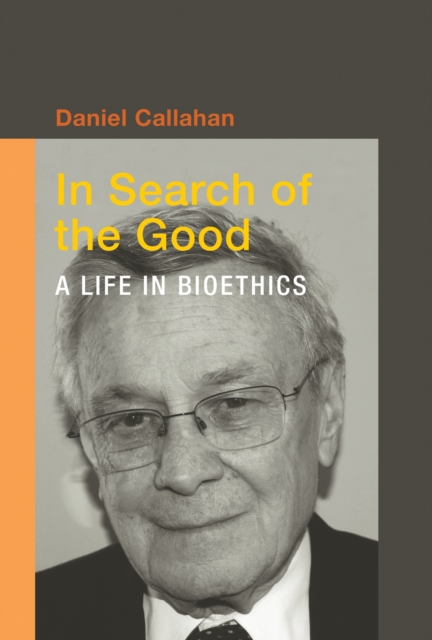
In Search of the Good
Daniel Callahan helped invent the field of bioethics more than forty years ago when he decided to use his training in philosophy to grapple with ethical problems in biology and medicine. Disenchanted with academic philosophy because of its analytical bent and distance from the concerns of real life, Callahan found the ethical issues raised by the rapid medical advances of the 1960s--which included the birth control pill, heart transplants, and new capacities to keep very sick people alive--to be philosophical questions with immediate real-world relevance. In this memoir, Callahan describes his part in the founding of bioethics and traces his thinking on critical issues including embryonic stem cell research, market-driven health care, and medical rationing. He identifies the major challenges facing bioethics today and ruminates on its future. Callahan writes about founding the Hastings Center--the first bioethics research institution--with the author and psychiatrist Willard Gaylin in 1969, and recounts the challenges of running a think tank while keeping up a prolific flow of influential books and articles. Editor of the famous liberal Catholic magazine Commonweal in the 1960s, Callahan describes his now-secular approach to issues of illness and mortality. He questions the idea of endless medical \"progress\" and interventionist end-of-life care that seems to blur the boundary between living and dying. It is the role of bioethics, he argues, to be a loyal dissenter in the onward march of medical progress. The most important challenge for bioethics now is to help rethink the very goals of medicine.
eBook

Human Subjects Research Regulation
The current framework for the regulation of human subjects research emerged largely in reaction to the horrors of Nazi human experimentation, revealed at the Nuremburg trials, and the Tuskegee syphilis study, conducted by U.S. government researchers from 1932 to 1972. This framework, combining elements of paternalism with efforts to preserve individual autonomy, has remained fundamentally unchanged for decades. Yet, as this book documents, it has significant flaws -- including its potential to burden important research, overprotect some subjects and inadequately protect others, generate inconsistent results, and lag behind developments in how research is conducted. Invigorated by the U.S. government's first steps toward change in over twenty years,Human Subjects Research Regulationbrings together the leading thinkers in this field from ethics, law, medicine, and public policy to discuss how to make the system better. The result is a collection of novel ideas -- some incremental, some radical -- for the future of research oversight and human subject protection.After reviewing the history of U.S. research regulations, the contributors consider such topics as risk-based regulation; research involving vulnerable populations (including military personnel, children, and prisoners); the relationships among subjects, investigators, sponsors, and institutional review boards; privacy, especially regarding biospecimens and tissue banking; and the possibility of fundamental paradigm shifts.ContributorsAdam Braddock, Alexander Morgan Capron, Ellen Wright Clayton, I. Glenn Cohen, Susan Cox, Amy L. Davis, Hilary Eckert, Barbara J. Evans, Nir Eyal, Heidi Li Feldman, Benjamin Fombonne, Elisa A. Hurley, Ana S. Iltis, Gail H. Javitt, Greg Koski, Nicole Lockhart, Holly Fernandez Lynch, Michael McDonald, Michelle N. Meyer, Osagie K. Obasogie, Efthimios Parasidis, Govind Persad, Rosamond Rhodes, Suzanne M. Rivera, Zachary M. Schrag, Seema K. Shah, Jeffrey Skopek, Laura Stark, Patrick Taylor, Anne Townsend, Carol Weil, Brett A. Williams, Leslie E. Wolf
eBook

The case of Terri Schiavo : ethics, politics, and death in the 21st century
The case of Terri Schiavo, a young woman who spent 15 years in a persistent vegetative state, has emerged as a watershed in debates over end-of-life care. While many observers had thought the right to refuse medical treatment was well established, this case split a family, divided a nation, and counfounded physicians, legislators, and many of the people they treated or represented. In renewing debates over the importance of advance directives, the appropriate role of artificial hydration and nutrition, and the responsibilities of family members, the case also became one of history's most extensively litigated health care disputes. The Case of Terri Schiavo assembles a team of first-hand participants and content experts to provide thoughtful and nuanced analyses. In addition to a comprehensive overview, the book includes contributions by Ms. Schiavo's guardian ad litem, a neurologist and lawyer who participated in the case, and scholars who examine issues related to litigation, faith, gender, and disability. The volume also includes a powerful dissent from the views of many scholars in the bioethics community. The book is intended for students, health care professionals, policy makers, and other in search of carefully reasoned analyses of the case that will shape our view of death and end-of-life medical care for decades.
eBook
The future of bioethics
Bioethics, born in the 1960s and 1970s, has achieved great success, but also has experienced recent growing pains, as illustrated by the case of Terri Schiavo. In The Future of Bioethics, Howard Brody, a physician and scholar who dates his entry into the field in 1972, sifts through the various issues that bioethics is now addressing--and some that it is largely ignoring--to chart a course for the future. Traditional bioethical concerns such as medical care at the end of life and research on human subjects will continue to demand attention. Brody chooses to focus instead on less obvious issues that will promise to stimulate new ways of thinking. He argues for a bioethics grounded in interdisciplinary medical humanities, including literature, history, religion, and the social sciences. Drawing on his previous work, Brody argues that most of the issues concerned involve power disparities. Bioethics’ response ought to combine new concepts that take power relationships seriously, with new practical activities that give those now lacking power a greater voice. A chapter on community dialogue outlines a role for the general public in bioethics deliberations. Lessons about power initially learned from feminist bioethics need to be expanded into new areas--cross cultural, racial and ethnic, and global and environmental issues, as well as the concerns of persons with disabilities. Bioethics has neglected important ethical controversies that are most often discussed in primary care, such as patient-centered care, evidence-based medicine, and pay-for-performance. Brody concludes by considering the tension between bioethics as contemplative scholarship and bioethics as activism. He urges a more activist approach, insisting that activism need not cause a premature end to ongoing conversations among bioethicists defending widely divergent views and thcories.
eBook
Global bioethics : issues of conscience for the twenty-first century
Medical care and biomedical research are rapidly becoming global. Ethical questions that once arose only in the narrow context of the physician-patient relationship in relatively prosperous societies are now being raised across societies, cultures, and continents. For example, what should be the \"standard of care\" for clinical trials of medical innovations in poorer countries? Are researchers obligated to compare new therapies or drugs with the best known ones available, or can they use as a benchmark the actual treatments (or lack of treatments) available to poor people? Should pharmaceutical companies seeking to lower the costs of new drug trials be allowed to enrol citizens of less developed countries in them even when those individuals cannot afford and will not be eligible for the resulting drugs? More generally, should the norms of medicine and research be the same across cultures or can they adapt to local social, economic, or religious conditions? Global Bioethics gathers some of the world's leading bioethicists to explore many of the new questions raised by the globalization of medical care and biomedical research. Among the topics covered are the impact of globalization on the norms of medical ethics, the conduct of international research, the ethics of international collaborations, challenges to medical professionalism in the international setting, and the relation of religion to global bioethics.
eBook
How safe is safe enough? : obligations to the children of reproductive technology
This book offers a comprehensive roadmap for determining when and how to regulate risky reproductive technologies on behalf of future children. First, it provides three benchmarks for determining whether a reproductive practice is harmful to the children it produces. This framework synthesizes and extends past efforts to make sense of our intuitive, but paradoxical, belief that reproductive choices can be both life-giving and harmful. Next, it recommends a process for reconciling the interests of future children with the reproductive liberty of prospective parents. The author rejects a blanket preference for either parental autonomy or child welfare and proposes instead a case-by-case inquiry that takes into account the nature and magnitude of the proposed restrictions on procreative liberty, the risk of harm to future children, and the context in which the issue arises. Finally, he applies this framework to four past and future medical treatments with above average risk, including cloning and genetic engineering. Drawing lessons from these case studies, Peters criticizes the current lack of regulatory oversight and recommends both more extensive pre-market testing and closer post-market monitoring of new reproductive technologies. His moderate pragmatic approach will be widely appreciated.
eBook