
Catalogue Search | MBRL


Are you sure you want to remove the book from the shelf?

{{itemTitle}}
704
result(s) for
"medieval speech"
Sort by:

Ecofeminist subjectivities : Chaucer's talking birds
\"This book analyzes the interaction between gender and species in Chaucer's poetry and strives to understand his adaptation of medieval discourse through an ecofeminist lens. Works that either speak of animals, or more pertinently those with animals speaking, offer fruitful results in the attempt to understand the medieval textual handling of the 'others' of society\"-- Provided by publisher.
Book
The Fifteenth Century XV
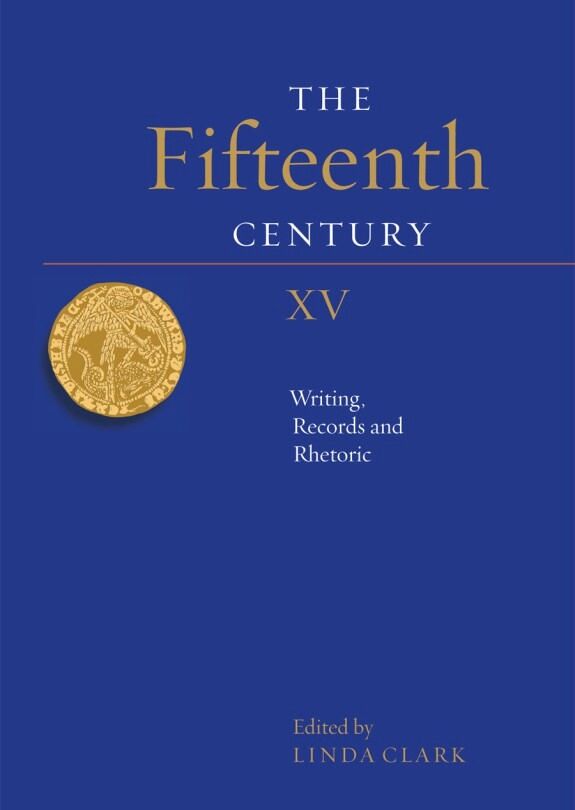
The focus of this volume may be summed up as \"The Word\". Its essays examine the contents and provenance of manuscripts which were written for polemical purposes, treasured by the duchess of York, and through the new medium of print introduced to a wider public topics of historical interest and illustrations of the geography of the known world. The essays here also consider official records of forest administration, expressed in arcane language; documents preserved in the papal curia which reveal significant facts about the lives of Scottish bishops; archives produced by the English chancery noting the movements of a royal councillor; and letters, poems and songs exposing the political strategy of a German prince. Nor is the spoken word neglected, whether employed in speeches delivered at the start of parliaments, using as their themes scriptures and classical texts to set a political agenda; or as sermons to open-air congregations gathered at St. Paul's Cross, where the oratory of Bishop Alcock stirred his listeners in different ways. Contributors: Michael Bennett, Julia Boffey, Paul Cavill, J.M. Grussenmeyer, Tom Johnson, J.L. Laynesmith, John Milner, Ben Pope, Dan E. Seward, Sarah Thomas
eBook
Complete writings
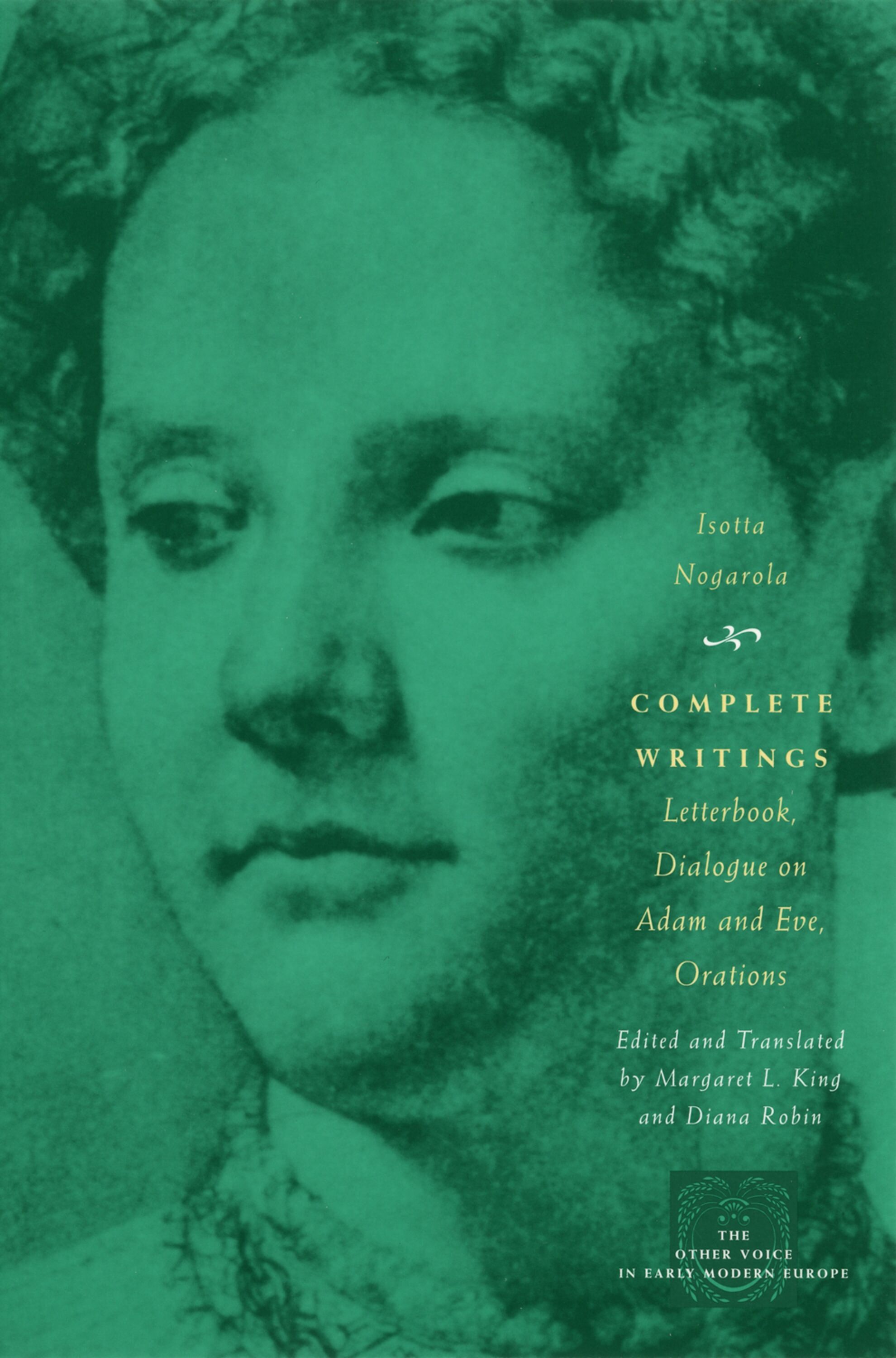
Renowned in her day for her scholarship and eloquence, Isotta Nogarola (1418-66) remained one of the most famous women of the Italian Renaissance for centuries after her death. And because she was one of the first women to carve out a place for herself in the male-dominated republic of letters, Nogarola served as a crucial role model for generations of aspiring female artists and writers. This volume presents English translations of all of Nogarola's extant works and highlights just how daring and original her convictions were. In her letters and orations, Nogarola elegantly synthesized Greco-Roman thought with biblical teachings. And striding across the stage in public, she lectured the Veronese citizenry on everything from history and religion to politics and morality. But the most influential of Nogarola's works was a performance piece, Dialogue on Adam and Eve, in which she discussed the relative sinfulness of Adam and Eve—thereby opening up a centuries-long debate in Europe on gender and the nature of woman and establishing herself as an important figure in Western intellectual history. This book will be a must read for teachers and students of Women's Studies as well as of Renaissance literature and history.
eBook
Letters and orations
By the end of the fifteenth century, Cassandra Fedele (1465-1558), a learned middle-class woman of Venice, was arguably the most famous woman writer and scholar in Europe. A cultural icon in her own time, she regularly corresponded with the king of France, lords of Milan and Naples, the Borgia pope Alexander VI, and even maintained a ten-year epistolary exchange with Queen Isabella and King Ferdinand of Spain that resulted in an invitation for her to join their court. Fedele's letters reveal the central, mediating role she occupied in a community of scholars otherwise inaccessible to women. Her unique admittance into this community is also highlighted by her presence as the first independent woman writer in Italy to speak publicly and, more importantly, the first to address philosophical, political, and moral issues in her own voice. Her three public orations and almost all of her letters, translated into English, are presented here for the first time.
eBook
Martini Dorpii Naldiceni Orationes IV
The Bibliotheca Teubneriana, established in 1849, has evolved into the world's most venerable and extensive series of editions of Greek and Latin literature, ranging from classical to Neo-Latin texts. Some 4-5 new editions are published every year. A team of renowned scholars in the field of Classical Philology acts as advisory board: Gian Biagio Conte (Scuola Normale Superiore di Pisa)Marcus Deufert (Universität Leipzig)James Diggle (University of Cambridge)Donald J. Mastronarde (University of California, Berkeley)Franco Montanari (Università di Genova)Heinz-Günther Nesselrath (Georg-August-Universität Göttingen)Dirk Obbink (University of Oxford)Oliver Primavesi (Ludwig-Maximilians Universität München)Michael D. Reeve (University of Cambridge)Richard J. Tarrant (Harvard University) Formerly out-of-print editions are offered as print-on-demand reprints. Furthermore, all new books in the Bibliotheca Teubneriana series are published as eBooks. The older volumes of the series are being successively digitized and made available as eBooks.If you are interested in ordering an out-of-print edition, which hasn't been yet made available as print-on-demand reprint, please contact us: Tessa.Jahn@degruyter.com All editions of Latin texts published in the Bibliotheca Teubneriana are collected in the online database BTL Online.
eBook

Letters and Orations
By the end of the fifteenth century, Cassandra Fedele (1465-1558), a learned middle-class woman of Venice, was arguably the most famous woman writer and scholar in Europe. A cultural icon in her own time, she regularly corresponded with the king of France, lords of Milan and Naples, the Borgia pope Alexander VI, and even maintained a ten-year epistolary exchange with Queen Isabella and King Ferdinand of Spain that resulted in an invitation for her to join their court. Fedele's letters reveal the central, mediating role she occupied in a community of scholars otherwise inaccessible to women. Her unique admittance into this community is also highlighted by her presence as the first independent woman writer in Italy to speak publicly and, more importantly, the first to address philosophical, political, and moral issues in her own voice. Her three public orations and almost all of her letters, translated into English, are presented here for the first time.
eBook

NESTING IN PIERS PLOWMAN
While this nidifaction may be a minor detail in an extensive account, I should think the context indicates that Langland (and thus, his intelligent reader) had this passage in mind. Rather than becoming godlike, as speech should render him, he is estranged. [...]like the animals who so impress him, the dreamer here imitates his natural subjects, in Quintilian's account, capable of intellectus or cogitatio, faculties that resemble reason, but are called irrational. Keble College Oxford RALPH HANNA NOTES 1 Verbal altercation, quite in contrast to the expected authoritative addresses that mark most dream-visions, was identified as the poem's ground-form in Anne Middleton's 'Narration and the invention of experience: episodic form in Piers Plowman', in The Wisdom of Poetry: Essays in Early English Literature in Honor of Morton W- Bloomfield, ed. The commonplace use of Peter of Blois as a model for dictamen is revealed in the enormous circulation of his letter-collection; see Lena Wahlgren, The Letter Collections of Peter of Blois: Studies in the Manuscript Tradition (Gothenberg, 1993); and R. W. Southern, \"Towards an edition of Peter of Blois's letter-collection', English Historical Review, 110 (1995), 925-37.
Journal Article

The Marketplace of Ideas and the Agora: Herodotus on the Power of Isegoria
Popular discourse about freedom of speech tends to default to the metaphor of the marketplace of ideas, notwithstanding empirical evidence undermining this concept. Its persistence illustrates the profound attachment freedom of speech inspires, despite the difficulty of justifying it in epistemic terms. I suggest that the ancient Greek historian Herodotus offers a compelling alternative to the marketplace metaphor with his account of isegoria at Athens. In Herodotus’s telling, Athenian equal right of speech is worthwhile not because of its effects on speech but because of its effect on political culture; equal speech energizes the Athenians and Athens. He thus offers a nonepistemic defense of the right to speak, defending it instead in terms of power and belonging. Yet his account also highlights how Athenian equal speech unleashes political harms and therefore offers a way to defend free speech without minimizing its dangers. Herodotus thus helps us productively reframe contemporary free speech debates.
Journal Article

‘Each way means loneliness—and communion’: reading anchoritic literature with T.S. Eliot
This essay examines the medievalist theme of the solitary recluse in the later poetry and plays of T.S. Eliot and considers the resonances between this image as a locus of Eliot’s model of ecclesial communion and comparable elements in medieval reclusive texts themselves. It argues that when read together, these texts suggest a kind of encounter with the past which is not primarily affective or erotic in form, but rather kenotic, a theologically-derived term meaning ‘self-emptying.’ In other words, these texts set up a paradigm requiring abnegation of the self for communion to be possible. The essay investigates three instances: an allusion to an anchorite in the pageant-play The Rock, the theme of withdrawal to the desert in several plays, and the quotation of Julian of Norwich in Four Quartets. Alongside each it examines medieval conceptualisations of solitary life, which speak to similar concerns and commitments, and concludes that Eliot’s medievalism posits a mode of transhistorical encounter that offers a challenge to existing approaches.
Journal Article