
Catalogue Search | MBRL


Are you sure you want to remove the book from the shelf?

{{itemTitle}}
2,642
result(s) for
"metoda"
Sort by:
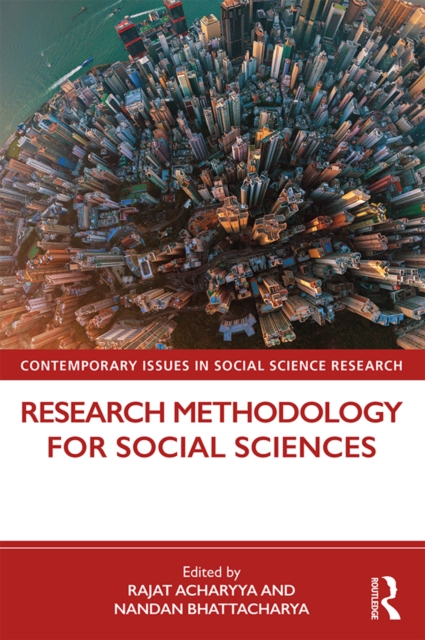
Research Methodology for Social Sciences
Research Methodology for Social Sciences provides guidelines for designing and conducting evidence-based research in social sciences and interdisciplinary studies using both qualitative and quantitative data. Blending the particularity of different sub-disciplines and interdisciplinary nature of social sciences, this volume:
Provides insights on epistemological issues and deliberates on debates over qualitative research methods;
Covers different aspects of qualitative research techniques and evidence-based research techniques, including survey design, choice of sample, construction of indices, statistical inferences and data analysis;
Discusses concepts, techniques and tools at different stages of research, beginning with the design of field surveys to collect raw data and then analyse it using statistical and econometric methods.
With illustrations, examples and a reader-friendly approach, this volume will serve as a key reference material for compulsory research methodology courses at doctoral levels across different disciplines, such as economics, sociology, women’s studies, education, anthropology, political science, international relations, philosophy, history and business management. This volume will also be indispensable for postgraduate courses dealing with quantitative techniques and data analysis.
eBook

IoT-Based Multi-Sensor Environmental Monitoring and Intelligent Control in Automated Warehouses Using Fuzzy Logic and Deep Learning
Logistics companies are automating facilities, increasing demand for advanced environmental monitoring and control solutions. Manual inspections and static criteria cannot manage modern warehouses' dynamic environments. This study proposes an automated warehouse environmental monitoring and intelligent control approach using IoT technology to improve warehouse environmental management efficiency, energy consumption, and cargo storage quality. A multi-sensor network-based system measures temperature, humidity, and gas concentration in real time. Strategic sensor placement and strong data preparation methods like filtering, outlier detection, and dimensionality reduction improve data quality and reliability. Fuzzy logic control with deep learning algorithms can forecast environmental changes and automatically alter control parameters, making environmental regulation more effective and adaptive. Experimental results reveal that the system can dynamically modify warehouse temperature, humidity, and gas concentration to reduce energy consumption and operating expenses and increase environmental monitoring real-time and accuracy. The system monitors temperature, humidity, carbon dioxide content, and light intensity with 50 multipurpose environmental sensors. The system was compared to a baseline rule-based control strategy without adaptive environmental feedback. Comparing our method to the baseline, environmental regulatory accuracy improved by 12.4%, and energy consumption decreased by 18.7%. The training and evaluation dataset had 36,000 hourly records from 30 days. Predefined environmental parameters (20-25°C, 40-60% humidity, <1000 ppm CO₂) were used to annotate data for supervised learning and performance evaluation. By comparing it with traditional methods, the intelligent control system based on the Internet of Things performs well in optimizing energy management, can effectively reduce operating costs, and ensures the stability of the cargo storage environment. The results of this study provide technical support for the intelligent environmental management of automated warehouses, which can not only improve the efficiency and economic benefits of warehouse management, but also have broad application prospects and can be extended to other fields with high environmental requirements, such as smart factories, cold chain logistics and medical storage.
Journal Article

Semiclassical standing waves with clustering peaks, for nonlinear Schrödinger equations
We study the following singularly perturbed problem
eBook

Introduction to finite element analysis : formulation, verification and validation
When using numerical simulation to make a decision, how can its reliability be determined? What are the common pitfalls and mistakes when assessing the trustworthiness of computed information, and how can they be avoided?
Whenever numerical simulation is employed in connection with engineering decision-making, there is an implied expectation of reliability: one cannot base decisions on computed information without believing that information is reliable enough to support those decisions. Using mathematical models to show the reliability of computer-generated information is an essential part of any modelling effort.
Giving users of finite element analysis (FEA) software an introduction to verification and validation procedures, this book thoroughly covers the fundamentals of assuring reliability in numerical simulation. The renowned authors systematically guide readers through the basic theory and algorithmic structure of the finite element method, using helpful examples and exercises throughout.
* Delivers the tools needed to have a working knowledge of the finite element method
* Illustrates the concepts and procedures of verification and validation
* Explains the process of conceptualization supported by virtual experimentation
* Describes the convergence characteristics of the h-, p- and hp-methods
* Covers the hierarchic view of mathematical models and finite element spaces
* Uses examples and exercises which illustrate the techniques and procedures of quality assurance
* Ideal for mechanical and structural engineering students, practicing engineers and applied mathematicians
* Includes parameter-controlled examples of solved problems in a companion website ( www.wiley.com/go/szabo )
eBook

ANSYS mechanical APDL for finite element analysis
ANSYS Mechanical APDL for Finite Element Analysis provides a hands-on introduction to engineering analysis using one of the most powerful commercial general purposes finite element programs on the market.
eBook
Multi-Density Datasets Clustering Using K-Nearest Neighbors and Chebyshev’s Inequality
Density-based clustering techniques are widely used in data mining on various fields. DBSCAN is one of the most popular density-based clustering algorithms, characterized by its ability to discover clusters with different shapes and sizes, and to separate noise and outliers. However, two fundamental limitations are still encountered that is the required input parameter of Eps distance threshold and its inefficiency to cluster datasets with various densities. For overcoming such drawbacks, a statistical based technique is proposed in this work. Specifically, the proposed technique utilizes an appropriate k-nearest neighbor density, based on which it sorts the dataset in ascending order and, using the statistical Chebyshev’s inequality as a suitable means for handling arbitrary distributions, it automatically determines different Eps values for clusters of various densities. Experiments conducted on synthetic and real datasets have demonstrated its efficiency and accuracy. The results indicate its superiority compared with DBSCAN, DPC, and their recently proposed improvements.
Journal Article

Handbook for Monte Carlo methods
\"The purpose of this handbook is to provide an accessible and comprehensive compendium of Monte Carlo techniques and related topics. It contains a mix of theory (summarized), algorithms (pseudo and actual), and applications. Since the audience is broad, the theory is kept to a minimum, this without sacrificing rigor. The book is intended to be used as an essential guide to Monte Carlo methods to quickly look up ideas, procedures, formulas, pictures, etc., rather than purely a monograph for researchers or a textbook for students. As the popularity of these methods continues to grow, and new methods are developed in rapid succession, the staggering number of related techniques, ideas, concepts and algorithms makes it difficult to maintain an overall picture of the Monte Carlo approach. This book attempts to encapsulate the emerging dynamics of this field of study\"-
eBook

Optimization algorithms on matrix manifolds
Many problems in the sciences and engineering can be rephrased as optimization problems on matrix search spaces endowed with a so-called manifold structure. This book shows how to exploit the special structure of such problems to develop efficient numerical algorithms. It places careful emphasis on both the numerical formulation of the algorithm and its differential geometric abstraction--illustrating how good algorithms draw equally from the insights of differential geometry, optimization, and numerical analysis. Two more theoretical chapters provide readers with the background in differential geometry necessary to algorithmic development. In the other chapters, several well-known optimization methods such as steepest descent and conjugate gradients are generalized to abstract manifolds. The book provides a generic development of each of these methods, building upon the material of the geometric chapters. It then guides readers through the calculations that turn these geometrically formulated methods into concrete numerical algorithms. The state-of-the-art algorithms given as examples are competitive with the best existing algorithms for a selection of eigenspace problems in numerical linear algebra.
eBook

Researching Life Stories
Researching Life Stories critically and pragmatically reflects upon the use of life stories in social and educational research. Using four life stories as examples, the authors apply four different, practical approaches to demonstrate effective research and analysis. As well as examining in detail the four life stories around which the book is written, areas covered include: * Method and methodology in life story research * Analysis * Reflections on analyses * Craft and ethics in researching life * Policy, practice and theory in life story research. Throughout the book the authors demystify the issues surrounding life story research and demonstrate the significance of this approach to understanding individual and social worlds. This unique approach to life story research will be a valuable resource for all social science and education researchers at undergraduate and postgraduate level.
Dan Goodley, Peter Clough and Michelle Moore are all based at the Inclusive Education and Equality Research Centre at the University of Sheffield's School of Education. Rebecca Lawthorn is Senior Lecturer in Psychology at Manchester Metropolitan University.
eBook

Uporabnost novejših metod deformacije miokarda pri vsakdanji ultrazvočni preiskavi srca
Slikovna preiskava deformacije miokarda s sledenjem ultrazvočnega vzorca (ang. speckle tracking imaging-STI) je novejša metoda v ehokardiografiji, ki omogoča vpogled v mehaniko delovanja srčne mišice in se vse pogosteje uporablja pri vsakdanjem kliničnem delu. S to metodo se je uveljavil tudi nov globalni kazalec deformacije levega prekata v longitudinalni smeri (angl. global longitudinal strain-GLS), ki se je izkazal kot bolj občutljiv kazalec za odkrivanje zgodnje okvare miokarda kot klasični ehokardiografski kazalci sistolične funkcije. Kazalci deformacije imajo tako diagnostično kot prognostično vrednost pri številnih bolezenskih stanjih. Značilne spremembe, ki jih lahko zaznamo s STI pri ishemični bolezni srca so znižanje deformacije v sistoli, raztezanje miokarda v zgodnji sistoli in skrajšanje miokarda po koncu sistole. Metoda STI nam je v pomoč pri odkrivanju zgodnje okvare sistolične funkcije pri bolnikih s hipertrofijo miokarda in pri razlikovanju vzrokov hipertrofij. S STI lahko prepoznamo subklinično okvaro miokarda po kemoterapiji, zato ji dajejo evropska priporočila prednost pred klasičnimi ehokardiografskimi kazalci pri nadaljnjem kliničnem odločanju. Pri asimptomatičnih bolnikih z zmerno do hudo boleznijo srčnih zaklopk znižane vrednosti GLS kažejo na prikrito okvaro miokarda in napovedujejo večje tveganje za po-operativne zaplete. Pri bolnikih z miokarditisom s STI zaznamo znižane vrednosti segmentne deformacije in odražajo fokalno prizadetost levega prekata. Prav tako pa kazalniki deformacije miokarda tudi dobro napovedujejo uspešnost zdravljenja pri bolnikih z resinhronizacijskim spodbujevalnikom. V prispevku želimo predstaviti osnove analizo GLS po posameznih korakih, ki veljajo ne glede na vrsto ultrazvočnega aparata ali programske opreme, ter predstaviti primere uporabe STI pri posameznih bolezenskih stanjih, za katere obstaja največ dokazov klinične uporabnosti.
Journal Article