
Catalogue Search | MBRL


Are you sure you want to remove the book from the shelf?

{{itemTitle}}
705
result(s) for
"mexican american activism"
Sort by:

Agent of Change
The essayist Adela Sloss-Vento (1901-1998) was a powerhouse of
activism in South Texas's Lower Rio Grande Valley throughout the
Mexican American civil rights movement beginning in 1920 and the
subsequent Chicano movement of the 1960s and 1970s. At last
presenting the full story of Sloss-Vento's achievements, Agent
of Change revives a forgotten history of a major female Latina
leader.
Bringing to light the economic and political transformations
that swept through South Texas in the 1920s as ranching declined
and agribusiness proliferated, Cynthia E. Orozco situates
Sloss-Vento's early years within the context of the Jim Crow/Juan
Crow era. Recounting Sloss-Vento's rise to prominence as a public
intellectual, Orozco highlights a partnership with Alonso S.
Perales, the principal founder of the League of United Latin
American Citizens. Agent of Change explores such
contradictions as Sloss-Vento's tolerance of LULAC's
gender-segregated chapters, even though the activist was an
outspoken critic of male privilege in the home and a decidedly
progressive wife and mother. Inspiring and illuminating, this is a
complete portrait of a savvy, brazen critic who demanded reform on
both sides of the US-Mexico border.
eBook
The Chicano generation
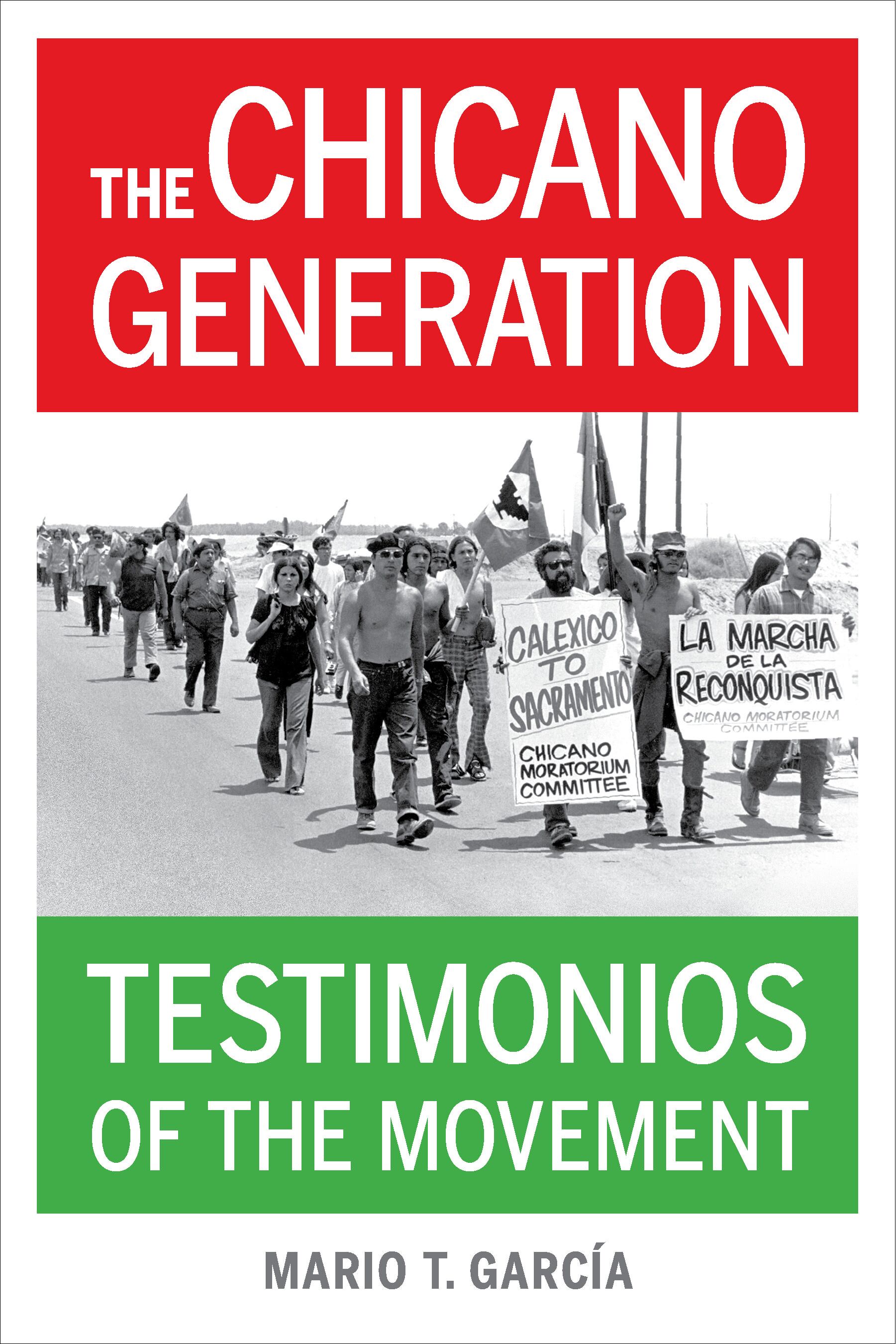
In The Chicano Generation, veteran Chicano civil rights scholar Mario T. García provides a rare look inside the struggles of the 1960s and 1970s as they unfolded in Los Angeles. Based on in-depth interviews conducted with three key activists, this book illuminates the lives of Raul Ruiz, Gloria Arellanes, and Rosalio Muñoz—their family histories and widely divergent backgrounds; the events surrounding their growing consciousness as Chicanos; the sexism encountered by Arellanes; and the aftermath of their political histories. In his substantial introduction, García situates the Chicano movement in Los Angeles and contextualizes activism within the largest civil rights and empowerment struggle by Mexican Americans in US history—a struggle that featured César Chávez and the farm workers, the student movement highlighted by the 1968 LA school blowouts, the Chicano antiwar movement, the organization of La Raza Unida Party, the Chicana feminist movement, the organizing of undocumented workers, and the Chicano Renaissance. Weaving this revolution against a backdrop of historic Mexican American activism from the 1930s to the 1960s and the contemporary black power and black civil rights movements, García gives readers the best representations of the Chicano generation in Los Angeles.
eBook

Early Identity, Environment, and Experience
Josefina Fierro de Bright served as a political and social activist in the 1930s and 1940s through her participation in the Mexican Defense Committee, El Congreso (the National Congress of Spanish-Speaking Peoples), and the Sleepy Lagoon Defense Committee, as well as her important efforts to end the violent attacks on ethnic Mexicans in Los Angeles during the Zoot Suit Riots. Fierro participated in organizations focused on human, civil, women’s, and labor rights. She contributed to a cross-cultural “politics of opposition” determined to create a world where true equality might flourish. She used American nationalist and transnationalist approaches. In the United States, Fierro networked with activists, celebrities, and political leaders who supported many of the same causes that she did. Her transnational approach materialized in the form of collaboration with the Mexican consulate, which also sought to secure the human rights of ethnic Mexicans living in the United States during a time of strong anti-Mexican sentiment. In order to understand why and how Fierro emerged as a leader willing to challenge the racism undergirding the segregation and mistreatment of ethnic Mexicans in California in the 1930s and 1940s, this study examines her family’s history of social activism, the fluid sociocultural environment of an American Left in which women played central roles, and her bold and charismatic leadership style.
Journal Article

Introduction
This introduction provides a general overview of the history of Mexican American women’s political activism in Los Angeles from the postwar period through the Chicano movement. It introduces the history of this movement and the women who shaped its transformations for over more than thirty years, foregrounding an alternative approach that highlights different movement dynamics and the ways L.A. Chicanas continuously bridged different realms of politics and approaches to activism to create generational, organizational, ideological, and transnational interlinkages that enabled them to effectively advocate for Chicanas as Mexican Americans and as women.
Book Chapter
Forging a Chicana Feminist Praxis
Chapter two explores the early years (1970-1976) of one of the first Chicana feminist organizations in the nation, the Comisión Femenil Mexicana Nacional (CFMN) (National Mexican Women’s Commission). The CFMN provides an illuminating example of the ways in which a stand-alone women’s organization brought together ethnic Mexican women from varying political experiences and ideologies. The chapter highlights the ways in which the Comisión Femenil utilized governmental agencies to establish institutions they believed essential for Mexican American women to gain economic independence. This set the groundwork for important bridges to be built between community activists and the formal political realm.
Book Chapter
We Would Go There and Be Part of a Great Audience
Chapter Three explores the various ways in which Chicanas saw themselves and their place in the world, from the local to the international realms. Focusing on the experiences of Chicanas who traveled to the International Women’s Year Conference in Mexico City in 1975, many of whom belonged to the Comisión Femenil, this chapter engages the international representation of Chicana feminism and issues of identity, ethnicity, national belonging. For the women who attended, the conference inspired new bridges across and within national borders, leading to Chicana participation at the Houston International Women’s Conference in 1977.
Book Chapter

Civil rights in black and brown : histories of resistance and struggle in Texas
2022 Best Book Award, Oral History Association Hundreds of stories of activists at the front lines of the intersecting African American and Mexican American liberation struggle Not one but two civil rights movements flourished in mid-twentieth-century Texas, and they did so in intimate conversation with one another. Far from the gaze of the national media, African American and Mexican American activists combated the twin caste systems of Jim Crow and Juan Crow. These insurgents worked chiefly within their own racial groups, yet they also looked to each other for guidance and, at times, came together in solidarity. The movements sought more than integration and access: they demanded power and justice. Civil Rights in Black and Brown draws on more than 500 oral history interviews newly collected across Texas, from the Panhandle to the Piney Woods and everywhere in between. The testimonies speak in detail to the structure of racism in small towns and huge metropolises—both the everyday grind of segregation and the haunting acts of racial violence that upheld Texas's state-sanctioned systems of white supremacy. Through their memories of resistance and revolution, the activists reveal previously undocumented struggles for equity, as well as the links Black and Chicanx organizers forged in their efforts to achieve self-determination.
eBook

Becoming Mexipino
Becoming Mexipinois a social-historical interpretation of two ethnic groups, one Mexican, the other Filipino, whose paths led both groups to San Diego, California. Rudy Guevarra traces the earliest interactions of both groups with Spanish colonialism to illustrate how these historical ties and cultural bonds laid the foundation for what would become close interethnic relationships and communities in twentieth-century San Diego as well as in other locales throughout California and the Pacific West Coast.Through racially restrictive covenants and other forms of discrimination, both groups, regardless of their differences, were confined to segregated living spaces along with African Americans, other Asian groups, and a few European immigrant clusters. Within these urban multiracial spaces, Mexicans and Filipinos coalesced to build a world of their own through family and kin networks, shared cultural practices, social organizations, and music and other forms of entertainment. They occupied the same living spaces, attended the same Catholic churches, and worked together creating labor cultures that reinforced their ties, often fostering marriages. Mexipino children, living simultaneously in two cultures, have forged a new identity for themselves. Their lives are the lens through which these two communities are examined, revealing the ways in which Mexicans and Filipinos interacted over generations to produce this distinct and instructive multiethnic experience. Using archival sources, oral histories, newspapers, and personal collections and photographs, Guevarra defines the niche that this particular group carved out for itself.
eBook

Mexico and its Diaspora in the United States
In the past two decades, changes in the Mexican government's policies toward the 30 million Mexican migrants living in the US highlight the importance of the Mexican diaspora in both countries given its size, its economic power and its growing political participation across borders. This work examines how the Mexican government's assessment of the possibilities and consequences of implementing certain emigration policies from 1848 to 2010 has been tied to changes in the bilateral relationship, which remains a key factor in Mexico's current development of strategies and policies in relation to migrants in the United States. Understanding this dynamic gives an insight into the stated and unstated objectives of Mexico's recent activism in defending migrants' rights and engaging the diaspora, the continuing linkage between Mexican migration policies and shifts in the US-Mexico relationship, and the limits and possibilities for expanding shared mechanisms for the management of migration within the NAFTA framework.
eBook

Migra!
This is the untold history of the United States Border Patrol from its beginnings in 1924 as a small peripheral outfit to its emergence as a large professional police force. To tell this story, Kelly Lytle Hernández dug through a gold mine of lost and unseen records stored in garages, closets, an abandoned factory, and in U.S. and Mexican archives. Focusing on the daily challenges of policing the borderlands and bringing to light unexpected partners and forgotten dynamics,Migra!reveals how the U.S. Border Patrol translated the mandate for comprehensive migration control into a project of policing Mexicans in the U.S.-Mexico borderlands.
eBook