
Catalogue Search | MBRL


Are you sure you want to remove the book from the shelf?

{{itemTitle}}
504
result(s) for
"michel houellebecq"
Sort by:

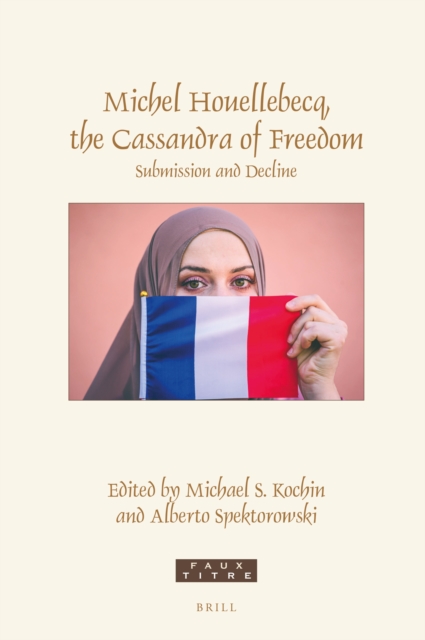
Michel Houellebecq, the Cassandra of freedom : submission and decline
When fiction and reality meet: Probably no contemporary novel has shaped reality as powerfully Houellebeck's Submission. No previous analysis of Submission is as deep and encompassing as this volume written by experts on politics and literature.
eBook

Without God : Michel Houellebecq and materialist horror
\"Addresses the religious, metaphysical, and existential dimensions of French novelist Michel Houellebecq's work. Argues that Houellebecq is the foremost contemporary chronicler of the spiritual anxieties of Western and specifically French modernity\"--Provided by publisher.
BOOK
Pathos, Poetry and Politics in Michel Houellebecq's Fiction
In Pathos, Poetry and Politics, Russell Williams examines the literary style in the work of Michel Houellebecq. This book underlines the extent to which the author's notorious provocations are key to the texture of his novels.
eBook


Neoliberalism, Real Estate and Environmental Capital in the Contemporary French Novel
[...]dramatic increases in housing costs have enabled, and in turn been enabled by, massive interventions by private equity into the housing market, which have drastically furthered inequality, ballooned household debt, and caused exponential growth in homeless populations, with countries like Canada and New Zealand leading the way in terms of extremity, but with the United States, France, Australia, and Ireland trailing not far behind. France, in particular, has seen a shift away from social housing, and subsidised construction, a strategy of \"national embedding of so-called 'free-market players'\" who aim to maximize profits as part of a broader \"'financialization' of everyday life\" (Pollard, 2009, 173, 171). [...]these recent novels, produced by authors of very different political orientations, Michel Houellebecq and Francois Roux, offer insight into the cultural understanding and representation of an economic reality that appears to be \"everywhere\" (Peck & Tickell, 2002, 380) and \"nowhere\" (Venugopal, 2015, 165). Through the articulations of characters, as well as the economic situations in which the authors place them, inductive analysis can contribute to an understanding of these effects, both broad and deep.
Journal Article
Money, hierarchy and neofeudalism in the fictional futures of Michel Houellebecq
Drawing on recent theories of neo-feudalism and evolutionary psychology, we employ the concept of hierarchy to understand the human impulse to participate in a societal organization that leads to competition for status and resources, as well as showing how money underpins the creation and maintenance of the neo-feudal hierarchies in both works. Cnossen et al. assert that \"the very function of his novels is to analyse the current society we live in and this social scientific approach is clearly rooted in [an] economic worldview\" (2017, 301). Highlighting the incompatibility of economic liberalism with human need and, more so, the brutality underpinning this system, Maris argues that Houellebecq's authorial success can be attributed to his ability to depict the suffering of living under capitalism \"[qui] naÎt de la violence perpétuelle du marché\" (2014, 29). [...]with reference to Houellebecq's fictional projections into future life, we show the natural culmination of this hierarchization to be a stratification of society into the two tiers of an all-powerful new aristocracy and an indigent underclass: in other words, an emergent neo-feudal society.
Journal Article

Particules Flottantes: Mutable Identity and Postmodern 'Schizophrenia' in the Works of Michel Houellebecq
Michel Houellebecq's representations of selfhood, both in his theoretical works and literary oeuvre, depict the self as unstable, decentered or fluid, evoking postmodern theory about the dissociative nature of the self. In his essay \"Approaches to Distress\" (1997), he posits the notion of the \"mutable self,\" and, for the unmoored protagonists of his novels, self-identity becomes increasingly fractured and fluid as they are engulfed by what the author terms \"the market society.\" Herein, the individual is enjoined to adapt and change (in consonance with market forces, consumer tastes, social trends) while fixed values and identities are swept away by the mutability of capitalism. In his representations of selfhood, Houellebecq evokes the theories of Baudrillard and Jameson concerning postmodern schizophrenia, the latter eschewing clinical definitions of the term to offer a diagnosis of the subject's fractured psychical apparatus and loss of subjectivity in postmodernity.
Journal Article
Houellebecq's Platform: The Detective Novel and Its Infinite Boundary
Michel Houellebecq's Platform is a novel that intentionally provokes and disturbs through creative engagement with the detective novel. The novel highlights the versatility of detective fiction and how through subversion and the intentional breaking of the genre's rules and boundaries the author can construct a form of resistance. Thus, an investigation into the intention and effect of Houellebecq's use of the detective novel will help us see how this particular genre shapes his narration and themes. Traditionally, detective fiction is known for its coherence and narrative closure; however, it is apparent that Houellebecq's Platform undermines these conventions and instead focuses on ambiguity and disorientation and, in the end, offers no resolution. Through the employment and subversion of the detective tropes, the novel highlights controversial perspectives and beliefs and forces the reader to confront their own assumptions about genre, narration, and resistance.
Journal Article

Planet YouPorn: Pornography, Worlding, and Banal Globalization in Michel Houellebecq’s Work
This article studies mediated erotic content, especially pornography, as a form of worlding in Michel Houellebecq’s work. Whereas love creates a space of alterity, pornography paradoxically combines the most intimate spatiality of the body with ever-expanding technological systems and global forms of mediation. This short-circuiting of space points to a new sense of being in the world, which is studied in selected passages from the novels La Possibilité d’une île and Soumission, as well as in the essay “Prise de contrôle sur Numéris.” With reference to Ulrich Beck’s description of “banal cosmopolitanism,” I argue that otherness is either reduced to free-floating objects of consumption or to an experience of absence in these texts. Furthermore, this duality is refracted as two “reflexively” interwoven discourses or voices in the work. One is associated with prose and with the bringing of the world to the body of the subject, and the other with poetry and the dissolution of the body into the space of the world.
Journal Article