
Catalogue Search | MBRL


Are you sure you want to remove the book from the shelf?

{{itemTitle}}
4,267,408
result(s) for
"military"
Sort by:


States, Citizens and the Privatisation of Security
Recent years have seen a growing role for private military contractors in national and international security. To understand the reasons for this, Elke Krahmann examines changing models of the state, the citizen and the soldier in the UK, the US and Germany. She focuses on both the national differences with regard to the outsourcing of military services to private companies and their specific consequences for the democratic control over the legitimate use of armed force. Tracing developments and debates from the late eighteenth century to the present, she explains the transition from the centralized warfare state of the Cold War era to the privatized and fragmented security governance, and the different national attitudes to the privatization of force.
eBook

Military machines
Readers discover how the wheels of history have been pushed along with the help of some impressive military machines. Includes drawing instructions.
Book

Forging Napoleon's Grande Armée : motivation, military culture, and masculinity in the French army, 1800-1808
The men who fought in Napoleons Grande Arme built a new empire that changed the world. Remarkably, the same men raised arms during the French Revolution for libert, galit, and fraternit. In just over a decade, these freedom fighters, who had once struggled to overthrow tyrants, rallied to the side of a man who wanted to dominate Europe. What was behind this drastic change of heart? In this ground-breaking study, Michael J. Hughes shows how Napoleonic military culture shaped the motivation of Napoleons soldiers. Relying on extensive archival research and blending cultural and military history, Hughes demonstrates that the Napoleonic regime incorporated elements from both the Old Regime and French Revolutionary military culture to craft a new military culture, characterized by loyalty to both Napoleon and the preservation of French hegemony in Europe. Underscoring this new, hybrid military culture were five sources of motivation: honor, patriotism, a martial and virile masculinity, devotion to Napoleon, and coercion. Forging Napoleon's Grande Arme vividly illustrates how this many-pronged culture gave Napoleons soldiers reasons to fight.
eBook

A military history of Japan : from the age of the Samurai to the 21st century
\"This comprehensive volume traces the evolution of Japanese military history--from 300 AD to present day foreign relations--and reveals how the country's cultural views of power, violence, and politics helped shape Japan's long and turbulent history of war\"-- Provided by publisher.
Book
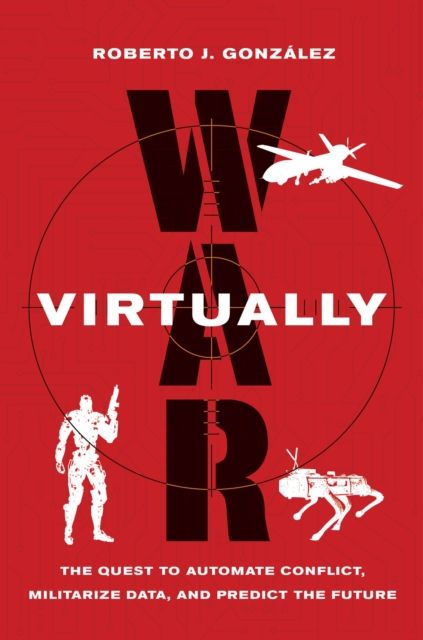
War Virtually
A critical look at how the US military is weaponizing
technology and data for new kinds of warfare-and why we must
resist. War Virtually is the story of how
scientists, programmers, and engineers are racing to develop
data-driven technologies for fighting virtual wars, both at home
and abroad. In this landmark book, Roberto J. González gives us a
lucid and gripping account of what lies behind the autonomous
weapons, robotic systems, predictive modeling software, advanced
surveillance programs, and psyops techniques that are transforming
the nature of military conflict. González, a cultural
anthropologist, takes a critical approach to the techno-utopian
view of these advancements and their dubious promise of a less
deadly and more efficient warfare. With clear, accessible prose,
this book exposes the high-tech underpinnings of contemporary
military operations-and the cultural assumptions they're built on.
Chapters cover automated battlefield robotics; social scientists'
involvement in experimental defense research; the blurred line
between political consulting and propaganda in the internet era;
and the military's use of big data to craft new counterinsurgency
methods based on predicting conflict. González also lays bare the
processes by which the Pentagon and US intelligence agencies have
quietly joined forces with Big Tech, raising an alarming prospect:
that someday Google, Amazon, and other Silicon Valley firms might
merge with some of the world's biggest defense contractors. War
Virtually takes an unflinching look at an algorithmic
future-where new military technologies threaten democratic
governance and human survival.
eBook


Curse on This Country
Imperial Japanese soldiers were notorious for blindly following
orders, and their enemies in the Pacific War derided them as
\"cattle to the slaughter.\" But, in fact, the Japanese Army had a
long history as one of the most disobedient armies in the world.
Officers repeatedly staged coups d'états, violent insurrections,
and political assassinations; their associates defied orders given
by both the government and the general staff, launched independent
military operations against other countries, and in two notorious
cases conspired to assassinate foreign leaders despite direct
orders to the contrary.
In Curse on This Country , Danny Orbach explains the
culture of rebellion in the Japanese armed forces. It was a culture
created by a series of seemingly innocent decisions, each
reasonable in its own right, which led to a gradual weakening of
Japanese government control over its army and navy. The
consequences were dire, as the armed forces dragged the government
into more and more of China across the 1930s-a culture of rebellion
that made the Pacific War possible. Orbach argues that brazen
defiance, rather than blind obedience, was the motive force of
modern Japanese history.
Curse on This Country follows a series of dramatic
events: assassinations in the dark corners of Tokyo, the famous
rebellion of Saigō Takamori, the \"accidental\" invasion of Taiwan,
the Japanese ambassador's plot to murder the queen of Korea, and
the military-political crisis in which the Japanese prime minister
\"changed colors.\" Finally, through the sinister plots of the
clandestine Cherry Blossom Society, we follow the deterioration of
Japan into chaos, fascism, and world war.
Imperial Japanese soldiers were notorious for blindly following
orders, and their enemies in the Pacific War derided them as
\"cattle to the slaughter.\" But, in fact, the Japanese Army had a
long history as one of the most disobedient armies in the world.
Officers repeatedly staged coups d'états, violent insurrections,
and political assassinations; their associates defied orders given
by both the government and the general staff, launched independent
military operations against other countries, and in two notorious
cases conspired to assassinate foreign leaders despite direct
orders to the contrary.In Curse on This Country , Danny
Orbach explains the culture of rebellion in the Japanese armed
forces. It was a culture created by a series of seemingly innocent
decisions, each reasonable in its own right, which led to a gradual
weakening of Japanese government control over its army and navy.
The consequences were dire, as the armed forces dragged the
government into more and more of China across the 1930s-a culture
of rebellion that made the Pacific War possible. Orbach argues that
brazen defiance, rather than blind obedience, was the motive force
of modern Japanese history. Curse on This Country follows a
series of dramatic events: assassinations in the dark corners of
Tokyo, the famous rebellion of Saigō Takamori, the \"accidental\"
invasion of Taiwan, the Japanese ambassador's plot to murder the
queen of Korea, and the military-political crisis in which the
Japanese prime minister \"changed colors.\" Finally, through the
sinister plots of the clandestine Cherry Blossom Society, we follow
the deterioration of Japan into chaos, fascism, and world war.
eBook

Fighting for a living
This book investigates the circumstances that have produced starkly different systems of recruiting and employing soldiers in different parts of the globe over the last years.
eBook