
Catalogue Search | MBRL


Are you sure you want to remove the book from the shelf?

{{itemTitle}}
5,671
result(s) for
"modern church history"
Sort by:


Church, Society, and Religious Change in France, 1580-1730
This readable and engaging book by an acclaimed historian is the only wide-ranging synthesis devoted to the French experience of religious change during the period after the wars of religion up to the early Enlightenment. Joseph Bergin provides a clear, up-to-date, and thorough account of the religious history of France in the context of social, institutional, and cultural developments during the so-called long seventeenth century.
Bergin argues that the French version of the Catholic Reformation showed a dynamism unrivaled elsewhere in Europe. The traumatic experiences of the wars of religion, the continuing search within France for heresy, and the challenge of Augustinian thought successively energized its attempts at religious change. Bergin highlights the continuing interaction of church and society and shows that while the French experience was clearly allied to its European context, its path was a distinctive one.
eBook


Translating catechisms, translating cultures : the expansion of Catholicism in the early modern world
Translating Catechisms, Translating Cultures explores the dimensions of early modern transcultural Christianities, the leeway of religious negotiation in and outside of Europe by comparing catechisms and their translations in the context of several Jesuit missions (including China, India, Japan, Ethiopia, Northern America and England).
eBook

Milton and Catholicism
\"This collection of original essays by literary critics and historians analyzes a wide range of Milton's writing, from his early poetry, through his mid-century political prose, to De Doctrina Christiana, which was unpublished in his lifetime, and finally to his last and greatest poems. The contributors investigate the rich variety of approaches to Milton's engagement with Catholicism and its relationship to reformed religion. The essays address latent tensions and contradictions, explore the nuances of Milton's relationship to the easy commonplaces of Protestant compatriots, and disclose the polemical strategies and tactics that often shape that engagement. The contributors link Milton and Catholicism with early modern confessional conflicts between Catholics and Protestants that in turn led to new models and standards of authority, scholarship, and interiority. In Milton's case, he deployed anti-Catholicism as a rhetorical device and the negative example out of which Protestants could shape their identity. The contributors argue that Milton's anti-Catholicism aligns with his understanding of inwardness and conscience and illuminates one of the central conflicts between Catholics and Protestants in the period. Building on recent scholarship on Catholic and anti-Catholic discourses over the English Tudor and Stuart period, new understandings of martyrdom, and scholarship on Catholic women, Milton and Catholicism provides a diverse and multifaceted investigation into a complex and little explored field in Milton studies. Contributors: Alastair Bellany, Thomas Cogswell, Thomas N. Corns, Ronald Corthell, Angelica Duran, Martin Dzelzainis, John Flood, Estelle Haan, and Elizabeth Sauer\"-- Provided by publisher.
BOOK

Science and Christianity in Pulpit and Pew
This book moves beyond the clichés of conflict and harmony to explore the tangled web of historical interactions involving scientific and religious beliefs. The lead chapter offers an overview of the history of science and Christianity from the perspective of the ordinary people who filled the pews of churches or loitered around outside. The book closely looks at two of the most influential Protestant theologians in 19th-century America: Charles Hodge and William Henry Green. Hodge, after decades of struggling to harmonize God's two revelations in nature and in the Bible in the end famously described Darwinism as atheism. Green, on the basis of his careful biblical studies, concluded that Ussher's chronology was unreliable, thus opening the door for Christian anthropologists to accommodate the subsequent discovery of human antiquity. This book traces the millennia-long history of so-called methodological naturalism, the commitment to explaining the natural world without appeals to the supernatural. By the early 19th century this practice was becoming the defining characteristic of science; in the late 20th century it became the central point of attack in the audacious attempt of intelligent designers to redefine science. The book ends the reassessment by arguing that although science has markedly changed the world we live in, it has contributed less to secularizing it than many have claimed.
eBook

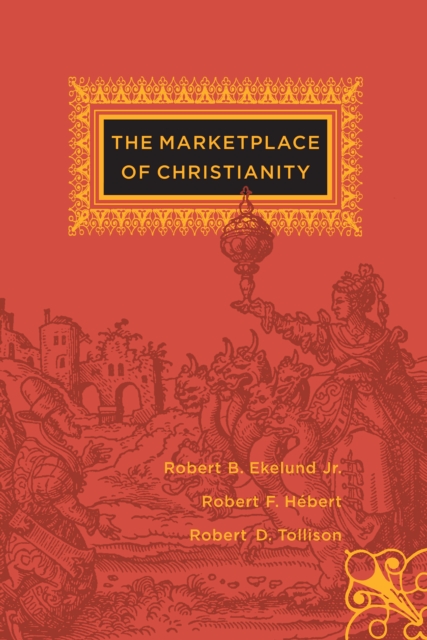
The Marketplace of Christianity
Economics can help us understand the evolution and development of religion, from the market penetration of the Reformation to an exploration of today's hot-button issues including evolution and gay marriage.
This startlingly original (and sure to be controversial) account of the evolution of Christianity shows that the economics of religion has little to do with counting the money in the collection basket and much to do with understanding the background of today's religious and political divisions. Since religion is a set of organized beliefs, and a church is an organized body of worshippers, it's natural to use a science that seeks to explain the behavior of organizations—economics—to understand the development of organized religion. The Marketplace of Christianity applies the tools of economic theory to illuminate the emergence of Protestantism in the sixteenth century and to examine contemporary religion-influenced issues, including evolution and gay marriage.
The Protestant Reformation, the authors argue, can be seen as a successful penetration of a religious market dominated by a monopoly firm—the Catholic Church. The Ninety-five Theses nailed to the church door in Wittenberg by Martin Luther raised the level of competition within Christianity to a breaking point. The Counter-Reformation, the Catholic reaction, continued the competitive process, which came to include \"product differentiation\" in the form of doctrinal and organizational innovation. Economic theory shows us how Christianity evolved to satisfy the changing demands of consumers—worshippers.
The authors of The Marketplace of Christianity avoid value judgments about religion. They take preferences for religion as given and analyze its observable effects on society and the individual. They provide the reader with clear and nontechnical background information on economics and the economics of religion before focusing on the Reformation and its aftermath. Their analysis of contemporary hot-button issues—science vs. religion, liberal vs. conservative, clerical celibacy, women and gay clergy, gay marriage—offers a vivid illustration of the potential of economic analysis to contribute to our understanding of religion.
eBook

The architecture of Barry Byrne : taking the Prairie School to Europe
\"Barry Byrne (1883-1967) was a radical architect who sought basic principles as fervently as his mentor Frank Lloyd Wright and his inspiration Louis Sullivan, forging an individual style with taut planar skins enveloping modern space plans. In 1922 he designed the first modern Catholic church building, St. Thomas the Apostle in Chicago, and in 1924 he traveled to Europe where he met Mies, Mendelsohn, Oud, and other modernist architects there. He was the only Prairie School architect to build in Europe, designing the concrete Church of Christ the King, built in 1928-31 in Cork, Ireland. A dedicated modernist and progressive Catholic, Byrne concentrated for much of his career on Catholic churches and schools throughout North America, many of them now considered landmarks. This book charts the entire length of Byrne's work, highlighting its distinctive features while discussing the cultural conditions that kept Byrne in the shadows of his more famous contemporaries. Illustrated by more than one hundred photographs and drawings, this biography explores the interplay of influences and impulses--individualism and communalism, modernism and tradition, pragmatism and faith--enduring throughout Byrne's life and work. \"-- Provided by publisher.
Book
Promoting the Saints
The studies in this volume concentrate on a complex set of socio-cultural phenomena, the cult of saints, in a variety of regions from Egypt to Poland, with a focus on Italy and Central Europe. The subjects of the contributions range in time from the fourth until the eighteenth century. The diversity of approaches adopted by the contributors—from literary analysis and historical anthropology to archaeology and art history—represents that open and multidisciplinary historical research that characterizes the work of Gábor Klaniczay to whom these essays are dedicated.
eBook