
Catalogue Search | MBRL


Are you sure you want to remove the book from the shelf?

{{itemTitle}}
36,768
result(s) for
"monastery"
Sort by:


The Jamāl Gaṛhī Monastery in Gandhāra: An Examination of Buddhist Sectarian Identity Through Textual and Archaeological Evidence
In the 19th century, the British archaeologist Sir Alexander Cunningham identified the remains of an unidentified Buddhist monastery at Jamāl Gaṛhī, an ancient site located approximately 13 km from present-day Mardān, Pakistan. Subsequent excavations by the Archaeological Survey of India between 1920 and 1921 unearthed a schist inscription dated to the year “359”. Heinrich Lüders, the renowned German Indologist and epigraphist, attributed this inscription to the Dharmaguptaka sect/school. Despite this early attribution, the Monastery’s precise sectarian characteristics have remained largely unexplored in later scholarship. This article reevaluates the site’s sectarian identity by employing a “ground-to-text” methodology that integrates archaeological evidence with textual analysis, with a particular focus on the Chinese translation of the Dharmaguptaka Vinaya. Through this comparative framework, this study seeks to elucidate the religious ideas reflected in the site’s material culture and their relationship with Dharmaguptaka disciplinary thought. The analysis encompasses the architectural remnants of the stūpa excavated by Cunningham and the “Fasting Buddha” statuary, now preserved in the National Museum of Pakistan, the British Museum, and other sites, situating these artifacts within the distinctive visual and contemplative traditions linked to the Dharmaguptaka Vinaya. By integrating architectural, sculptural, textual, and epigraphic materials, this article provides a nuanced understanding of sectarian developments at Jamāl Gaṛhī and argues that an explicit emphasis on the ‘Middle Way’ ideology constituted a defining feature of the Dharmaguptaka tradition during this period.
Journal Article

Byzantine Hermeneutics and Pedagogy in the Russian North
The first micro-historical 'ethnology of reading' in the Early Slavic field,Byzantine Hermeneutics and Pedagogy in the Russian Northwill prove fascinating to western medievalists, Byzantinists, Slavists, and book historians.
eBook

Seismic vulnerability of monastery temples of stone masonry in Sikkim Himalaya
Buddhist monasteries in the Sikkim region have conserved and portrayed the art of Tibetan and Chinese architectural style through centuries. These historic structures have sustained varied degrees of damage due to earlier earthquakes. Their performance in the recent Sikkim earthquake of M 6.9 on 18 September 2011 shows their high seismic vulnerability. A quick seismic assessment using certain simplified indices suggests higher vulnerability of damage for these heritage structures. A post-earthquake ambient vibration test established these monastery temples as short-period structures with fundamental period of 0.23 to 0.37 s. A finite element analysis of one of these temples has been done to study its dynamic behaviour. The response spectrum and static nonlinear pushover analysis highlighted vulnerable portions of stone masonry walls and provided useful insights for proper retrofitting to mitigate damage in future earthquakes.
Journal Article
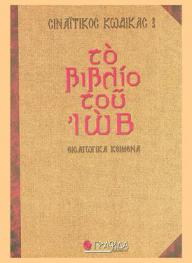
The book of Job
A facsimile reproduction of Sinaitikos kodikas 3 from St. Catherine Monastery, Sinai. Published with two introductory volumes, one in Modern Greek (To vivlio tou Iov) and one in English (The book of Job), comprising introductions to and translations of the manuscript. Introductory volumes authored by Miltiades Konstantinou et al.
Book

Architectural features and typological analysis of historical Syriac churches in Mardin rural area
This study deals with the architectural features, typological diversity and sustainability of the historical Syriac churches in the rural areas of Mardin province in southeastern Turkey. Mardin countryside, which bears the traces of different civilisations starting from the pre-Christian period, is of great importance especially for the architectural and cultural heritage of the Syriac Orthodox community. Within the scope of the research, 61 churches and monasteries, most of which were built between the 4th and 9th centuries, were examined in detail, preserving their original structural features and survey drawings of these buildings were created. In this context, a typological classification of the churches and monasteries (monastery churches) in rural Mardin was conducted, identifying three main plan types: single nave village churches oriented along the east-west axis, multi-nave churches and monastery-type churches oriented along the north-south axis. Important architectural elements of these buildings, such as Kduskudshin, doors, windows and bell towers, were analysed in detail and their impact on the original character of the buildings was studied. The results of the study indicate that the preservation of Syriac religious buildings in rural Mardin is crucial not only for the conservation of these buildings but also for ensuring the continuity of the multi-layered cultural heritage of the region.
Journal Article