
Catalogue Search | MBRL


Are you sure you want to remove the book from the shelf?

{{itemTitle}}
731
result(s) for
"monastic life"
Sort by:


Saints and their communities : miracle stories in twelfth century England
This book offers a new approach to the study of lay religion as evidenced in collections of miracle narratives in 12th-century England. There are a number of problems associated with the interpretation of this hagiographical genre and an extended introduction discusses these. The first issue is the tendency to read these narratives as transparent accounts of lay religion as if it were something susceptible to static, ‘ethnographic’ treatment in isolation from wider social and political activities. The second issue is the challenge of explaining the miraculous as a credible part of cultural experience, without appealing to reductionist notions of a ‘medieval mindset’. The third issue is the problem of how to take full account of the fact that these sources are representations of lay experience by monastic authors. The author argues that miracle narratives were the product of and helped to foster lay notions of Christian practice and identity centred on the spiritual patronage of certain enshrined saints. The six main chapters provide fully contextualized studies of selected miracle collections. The author looks at when these collections were made, who wrote them, the kinds of audiences they are likely to have reached, and the messages they were intended to convey. He shows how these texts served to represent specific cults in terms that articulated the values and interests of the institutions acting as custodians of the relics; and how alongside other programmes of textual production, these collections of stories can be linked to occasions of uncertainty or need in the life of these institutions. A concluding chapter argues the case for miracle collections as evidence of the attempt by traditional monasteries to reach out to the relatively affluent peasantry, and to urban communities in society, and their rural hinterlands with offers of protection and opportunities for them to express their social status with reference to tomb-centred sanctity.
eBook

The name of the rose
In 1327, finding his sensitive mission at an Italian abbey further complicated by seven bizarre deaths, Brother William of Baskerville turns detective.
Book

By Force and Fear
An unwilling, desperate nun trapped in the cloister, unable to gain release: such is the image that endures today of monastic life in early modern Europe. InBy Force and Fear, Anne Jacobson Schutte demonstrates that this and other common stereotypes of involuntary consignment to religious houses-shaped by literary sources such as Manzoni's The Betrothed-are badly off the mark.
Drawing on records of the Congregation of the Council, held in the Vatican Archive, Schutte examines nearly one thousand petitions for annulment of monastic vows submitted to the Pope and adjudicated by the Council during a 125-year period, from 1668 to 1793. She considers petitions from Roman Catholic regions across Europe and a few from Latin America and finds that, in about half these cases, the congregation reached a decision. Many women and a smaller proportion of men got what they asked for: decrees nullifying their monastic profession and releasing them from religious houses. Schutte also reaches important conclusions about relations between elders and offspring in early modern families. Contrary to the picture historians have painted of increasingly less patriarchal and more egalitarian families, she finds numerous instances of fathers, mothers, and other relatives (including older siblings) employing physical violence and psychological pressure to compel adolescents into \"entering religion.\" Dramatic tales from the archives show that many victims of such violence remained so intimidated that they dared not petition the pope until the agents of force and fear had died, by which time they themselves were middle-aged. Schutte's innovative book will be of great interest to scholars of early modern Europe, especially those who work on religion, the Church, family, and gender.
eBook


Old Age, Sickness & Death: Buddhist Monastic Retirement & Eldercare Within South Korea’s Super-Aged Society
As the Buddhist monastic community in Korea has entered an era marked by aging demographics, the issues surrounding the welfare of the order’s monastics in their retirement years have become increasingly pressing. In response, in 2011, the Jogye Order enacted the Monastic Welfare Act and established the Monastic Welfare Society with the aim of enabling monks to fully devote themselves to their religious duties by assuming institutional responsibility for their healthcare, pension, residential welfare, and end-of-life needs. Over a decade since the system’s implementation, the Jogye Order has achieved notable progress towards achieving the Monastic Welfare Act’s aims. However, while the order has stabilized medical coverage for its clergy, there remain considerable gaps in its provisions for income and housing for elderly monastics. This article surveys the Jogye Order’s efforts to establish systemic care for its elderly monastics, with a particular focus on the Jogye Order’s 2011 Monastic Welfare Act and subsequent activities of the Monastic Welfare Society. It then critically examines the current state of eldercare within the order, along with its strengths and weakness, before engaging in a comparative discussion regarding the clerical eldercare and welfare systems provided by both the Korean Catholic Church and the Thai Buddhist community.
Journal Article

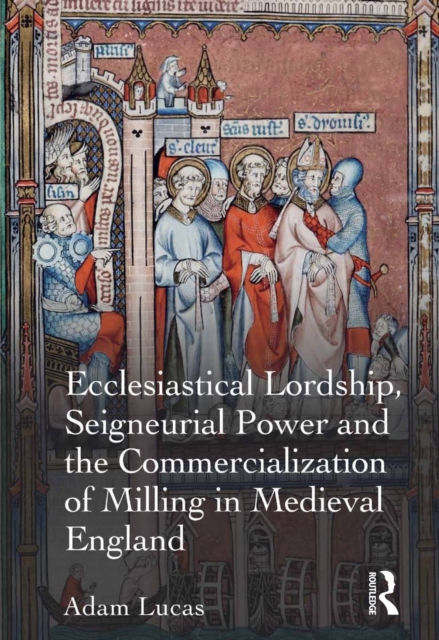
Ecclesiastical Lordship, Seigneurial Power and the Commercialization of Milling in Medieval England
This is the first detailed study of the role of the Church in the commercialization of milling in medieval England. Focusing on the period from the late eleventh to the mid sixteenth centuries, it examines the estate management practices of more than thirty English religious houses founded by the Benedictines, Cistercians, Augustinians and other minor orders, with an emphasis on the role played by mills and milling in the establishment and development of a range of different sized episcopal and conventual foundations. Contrary to the views espoused by a number of prominent historians of technology since the 1930s, the book demonstrates that patterns of mill acquisition, innovation and exploitation were shaped not only by the size, wealth and distribution of a house's estates, but also by environmental and demographic factors, changing cultural attitudes and legal conventions, prevailing and emergent technical traditions, the personal relations of a house with its patrons, tenants, servants and neighbours, and the entrepreneurial and administrative flair of bishops, abbots, priors and other ecclesiastical officials.
eBook

Embracing age : how Catholic Nuns became models of aging well
\"Embracing Age: How Catholic Nuns Became Models of Aging Well examines a community of individuals whose aging trajectories contrast mainstream American experiences. In mainstream American society, aging is presented as a \"problem,\" a state to be avoided as long as possible, a state that threatens one's ability to maintain independence, autonomy, control over one's surroundings. Aging \"well\" (or avoiding aging) has become a 21st century American preoccupation. Embracing Age provides a window into the everyday lives of American Catholic nuns who experience longevity and remarkable health and well-being at the end of life. Catholic nuns aren't only healthier in older age, they are healthier because they practice a culture of acceptance and grace around aging. Embracing Age demonstrates how aging in the convent becomes understood by the nuns to be a natural part of the life course, not one to be feared or avoided. Anna I. Corwin shows readers how Catholic nuns create a cultural community that provides a model for how to grow old, decline, and die that is both embedded in American culture and quite distinct from other American models\"-- Provided by publisher.
BOOK

Lives of the Anchoresses
In cities and towns across northern Europe in the twelfth and thirteenth centuries, a new type of religious woman took up authoritative positions in society, all the while living as public recluses in cells attached to the sides of churches. In Lives of the Anchoresses, Anneke Mulder-Bakker offers a new history of these women who chose to forsake the world but did not avoid it. Unlike nuns, anchoresses maintained their ties to society and belonged to no formal religious order. From their solitary anchorholds in very public places, they acted as teachers and counselors and, in some cases, theological innovators for parishioners who would speak to them from the street, through small openings in the walls of their cells. Available at all hours, the anchoresses were ready to care for the community's faithful whenever needed. Through careful biographical studies of five emblematic anchoresses, Mulder-Bakker reveals the details of these influential religious women. The life of the unnamed anchoress who was mother to Guibert of Nogent shows the anchoress's role as a spiritual guide in an oral culture. A study of Yvette of Huy shows the myriad possibilities open to one woman who eventually chose the life of an anchoress. The accounts of Juliana of Cornillon and Eve of St. Martin raise questions about the participation of religious women in theological discussions and their contributions to church liturgy. And the biographical study of Margaret the Lame of Magdeburg explores the anchoress's role as day-to-day religious instructor to the ordinary faithful.
eBook