
Catalogue Search | MBRL


Are you sure you want to remove the book from the shelf?

{{itemTitle}}
15,292
result(s) for
"money in politics"
Sort by:

Empirical Models of Lobbying
This article offers a review of the recent empirical literature on lobbying within political economy. In surveying extant research, we emphasize quid pro quo and informational issues in special interest politics and highlight crucial open questions in both. The two main unresolved methodological issues remain (
a
) how to account for the impact of lobbying on which equilibrium policies are chosen and advanced and (
b
) how distorted those equilibrium policies are relative to the social optimum. Of the principal open questions within political economy, a comprehensive, quantitative assessment of the welfare effects of lobbying remains one of the most elusive.
Journal Article

Fundraising on the fringe: Do ideologically extreme candidates solicit small donations?
Do ideologically extreme candidates actively pursue small donations? The literature on money in politics debates whether “small” individual campaign donors are more ideologically extreme than large donors. This paper reverses the question, investigating whether extreme candidates request smaller contributions from potential donors. Using data from U.S. congressional candidates’ fundraising platforms in the 2020 elections, I examine how campaigns typically present a set of suggested donation amounts to solicit money from potential donors efficiently. While party, in-state income levels, and the usage of major fundraising platforms mattered, ideological extremism had no bearing on the amounts candidates asked for. Given that solicitation amounts have been long and easily optimized through A/B testing, I interpret this as extreme candidates not finding it profitable to ask for smaller amounts, which is more aligned with the view that small donors are not more ideologically extreme than large donors.
Journal Article

‘Lordy Me!’ Can donations buy you a British peerage? A study in the link between party political funding and peerage nominations, 2005–2014
Trust in political institutions has declined across developed democracies. One of the main reasons cited for this lack of trust has been the role of money in politics, while standing up to ‘big money’ has been a common rallying cry of populists of both left- and right-wing variants. Political scientists have tried to examine the role of big money in two main steps: firstly, by showing that money can buy access to legislators; and, secondly, that legislators are thereby more responsive to the wishes of donors when writing and voting on laws. Researchers have used experiments and other techniques to show that Congressional staffs are more responsive to requests from donors compared to others and have also shown aggregate trends in responsiveness to the preferences of the wealthier. In this paper we try and go one step further: to show that donors can become legislators. We do this by looking at the example of the House of Lords. Compiling an original dataset of large donations and nominations for peerages, the authors show that, when the ‘usual suspects’ for a position, like former MPs and party workers, are accounted for, donations seem to play an outsize role in accounting for the remaining peers.
Journal Article

Dialing for Dollars, Dialing for Domination: Normatively Evaluating the Congressional Fundraising Imperative
Members of the United States Congress labor under a pressing fundraising imperative. Congresspersons believe that they must raise very large sums of money in order to secure re-election, to help their fellow partisans in Congress get re-elected, and to rise to positions of Congressional and party leadership. This leads members of Congress to accord tremendous importance to fundraising while in office. In this article, I draw on the normative scholarship on domination to offer a novel critique of the Congressional fundraising imperative. There is good reason, I argue here, to believe that the fundraising imperative promotes the domination of non-affluent Americans by their wealthy counterparts, thereby unjustifiably depriving citizens of ordinary means of their freedom.
Journal Article
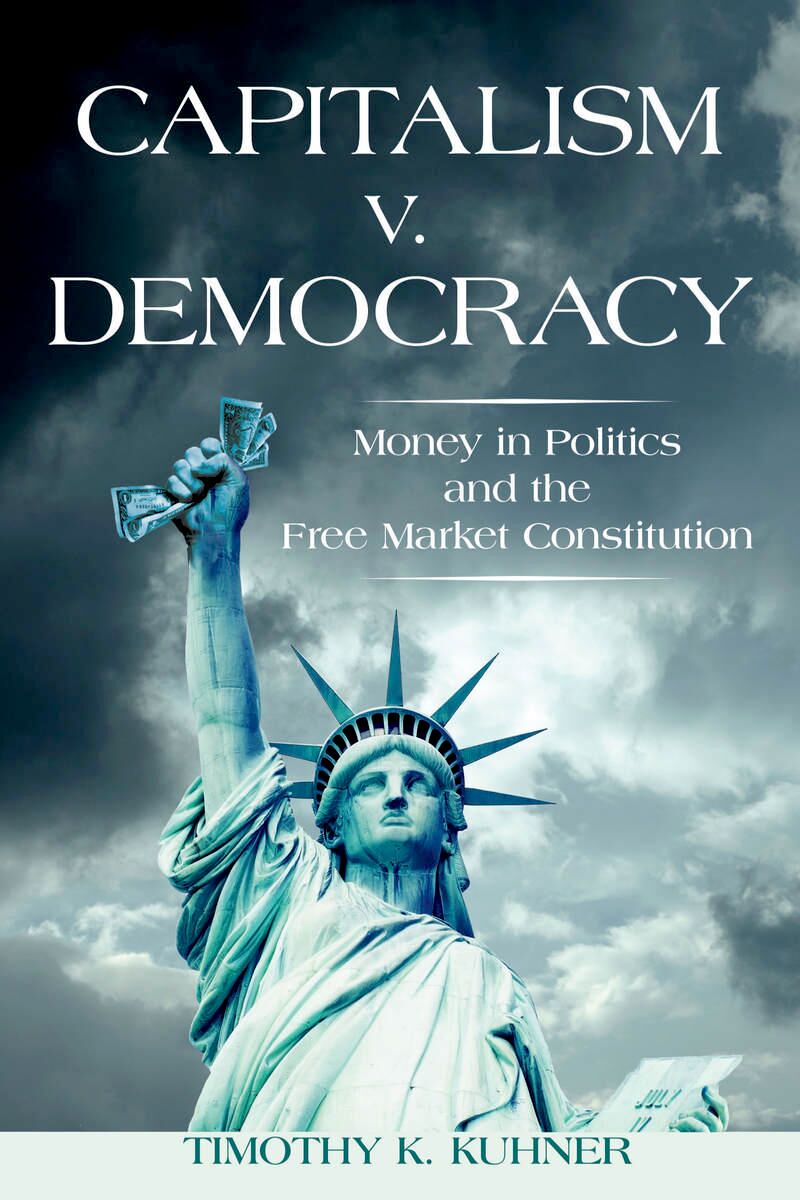
Capitalism v. democracy : money in politics and the free market constitution
As of the latest national elections, it costs approximately $1 billion to become president, $10 million to become a Senator, and $1 million to become a Member of the House. High-priced campaigns, an elite class of donors and spenders, superPACs, and increasing corporate political power have become the new normal in American politics. In Capitalism v. Democracy, Timothy Kuhner explains how these conditions have corrupted American democracy, turning it into a system of rule that favors the wealthy and marginalizes ordinary citizens. Kuhner maintains that these conditions have corrupted capitalism as well, routing economic competition through political channels and allowing politically powerful companies to evade market forces. The Supreme Court has brought about both forms of corruption by striking down campaign finance reforms that limited the role of money in politics. Exposing the extreme economic worldview that pollutes constitutional interpretation, Kuhner shows how the Court became the architect of American plutocracy.
Capitalism v. Democracy offers the key to understanding why corporations are now citizens, money is political speech, limits on corporate spending are a form of censorship, democracy is a free market, and political equality and democratic integrity are unconstitutional constraints on money in politics. Supreme Court opinions have dictated these conditions in the name of the Constitution, as though the Constitution itself required the privatization of democracy. Kuhner explores the reasons behind these opinions, reveals that they form a blueprint for free market democracy, and demonstrates that this design corrupts both politics and markets. He argues that nothing short of a constitutional amendment can set the necessary boundaries between capitalism and democracy.
eBook
Tiny Donations, Big Impact: How Small-Dollar Donors are Eroding the Power of Party Insiders
The shift to small- dollar fundraising in the 2020 Democratic nomination contest is not only a change in how campaigns operate. Campaigns that depended on small donors also shifted their rhetoric and behavior, flaunting their “outsider,” populist credentials and decrying politics as usual. The new power of small donors has the potential to be the greatest challenge to the control of party elites over the presidential nomination process since the reforms of the 1970s.
Journal Article

What do campaign contributions buy? Lobbyists’ strategic giving
Scholars looking for evidence of corruption in Congress have focused on the data available to them: the limited contributions of political action committees. This literature has largely failed to identify systematic money-induced legislative behavior. But what if lobbyists are using their personal funds to contribute to congressional campaigns? I use newly available data to show that individual lobbyists make contributions in predictable ways, favoring key members at key times. In particular, healthcare lobbyists were significantly more likely to give to members of the committees drafting the Affordable Care Act relative to other members and other times. The findings represent an important step forward in understanding what actors who are interested in legislative decisions might expect in return for their campaign contributions.
Journal Article
On the advantages of a well-constructed lobbying system: toward a more democratic, modern lobbying process
The American lobbying information processing system is woefully outdated. The mechanisms by which citizen, interest group, and business concerns are incorporated into the policymaking process have largely not been updated in over 200 years. Lobbyists set up meetings with staffers and members of Congress and share position papers with them about their arguments on a given policy issue. There is no central location where staffers can find out who is lobbying on a given bill and what they are arguing. In this paper, we make the case for a new information processing system that would provide Congress with a more efficient and effective way to manage the information flooding the Hill, and which would ensure more transparency about who is lobbying on any given bill and what they are saying. If used effectively by Congress, watchdog groups, and journalists, this system could result in better representation for a more diverse group of citizens.
Journal Article

Do individual disclosure rules for parliamentarians improve government effectiveness?
The pros and cons of stricter disclosure rules for parliamentarians are hotly debated. Some argue that disclosure rules for parliamentarians increase transparency of the legislative branch, leading to lower levels of rent-seeking and corruption, increased citizen trust in parliament, and better quality of law-making. Others argue that disclosure rules endanger the privacy of parliamentarians, that their introduction would stop businesspeople and lawyers from running for seats, which would decrease the quality of law-making. This is the first attempt to empirically test these conjectures on the composition of parliament empirically. We find that the introduction of disclosure rules is usually not accompanied by a significant shift in the proportion of lawyers and businesspeople in parliament.
Journal Article

The Intersection of Technology, Money Politics, and Democracy in Indonesia
The paper investigates the intersection of technology, money politics, and democracy in Indonesia, focusing on regional elections in Central Java Province. The study aims to understand how technological advancements influence money politics and impact democratic integrity. A descriptive qualitative approach was used, gathering primary data through interviews with political analysts, local politicians, technoscience experts, and community leaders, and secondary data from existing literature. The findings reveal that while technology can enhance transparency and voter engagement, it also facilitates money politics through anonymous donations and misinformation. The research highlights the persistent practice of money politics driven by economic disparities, undermining democratic values. The study concludes with recommendations for robust regulatory frameworks and collaborative efforts among stakeholders to enhance electoral integrity Este artículo investiga la intersección entre tecnología, política monetaria y democracia en Indonesia, centrándose en las elecciones regionales de la provincia de Java Central. El estudio pretende entender cómo influyen los avances tecnológicos en la política monetaria y en la integridad democrática. Se utilizó un enfoque cualitativo descriptivo, recopilando datos primarios mediante entrevistas con analistas políticos, políticos locales, expertos en tecnociencia y líderes comunitarios, y datos secundarios de la bibliografía existente. Los resultados revelan que, si bien la tecnología puede mejorar la transparencia y la participación de los votantes, también facilita la política del dinero a través de donaciones anónimas y desinformación. La investigación pone de relieve la práctica persistente de la política del dinero impulsada por las disparidades económicas, que socava los valores democráticos. El estudio concluye con recomendaciones de marcos reguladores sólidos y esfuerzos de colaboración entre las partes interesadas para mejorar la integridad electoral.
Journal Article