
Catalogue Search | MBRL


Are you sure you want to remove the book from the shelf?

{{itemTitle}}
49,822
result(s) for
"multicultural"
Sort by:


The New Political Economy of Urban Education
\"Urban education and its contexts have changed in powerful ways. Old paradigms are being eclipsed by global forces of privatization and markets and new articulations of race, class, and urban space. These factors and more set the stage for Pauline Lipman's insightful analysis of the relationship between education policy and the neoliberal economic, political, and ideological processes that are reshaping cities in the United States and around the globe.
Using Chicago as a case study of the interconnectedness of neoliberal urban policies on housing, economic development, race, and education, Lipman explores larger implications for equity, justice, and \"\"the right to the city\"\". She draws on scholarship in critical geography, urban sociology and anthropology, education policy, and critical analyses of race. Her synthesis of these lenses gives added weight to her critical appraisal and hope for the future, offering a significant contribution to current arguments about urban schooling and how we think about relations between neoliberal education reforms and the transformation of cities. By examining the cultural politics of why and how these relationships resonate with people's lived experience, Lipman pushes the analysis one step further toward a new educational and social paradigm rooted in radical political and economic democracy.\"
eBook


Why Aren't We There Yet?
Co-published with Despite seeming endless debate and public attention given to the issue for several decades, those committed to creating welcoming and engaging campus environments for all students recognize that there is considerably more work to be done, and ask \"Why aren't we there yet, and when will we be done?\" While our campuses have evolved from being exclusionary and intolerant, and publicly espouse the objectives of being welcoming, accepting, affirming, and engaging, the data on admissions, retention, and graduation clearly indicate that these goals have not been achieved.The contributors to this book seek to offer new insights to improve student affairs, emphasizing action that recognizes this is a complex and multi-faceted process, and beginning with the assertion that, without recognizing the influences of privilege and inequality, we educators cannot promote truly welcoming environments. This book focuses on guiding individuals and groups through learning how to have difficult conversations that lead us to act to create more just campuses, and provides illustrations of multiple ways to respond to difficult situations. It advocates for engaging in fruitful dialogues regarding differing social identities including race, ethnicity, religion, gender, and sexual orientation, to lead readers through a process that advocates for justice, and for taking personal responsibility for contributing to the solution. The book is framed around the five elements of the process of engaging in difficult conversations that not only advocate for change but also create change: self knowledge, knowledge of and experiences with others, understanding historical and institutional contexts, understanding how to change the status quo, and transformative action.
eBook

The globalisation of intercultural education : the politics of macro-micro integration
This book examines the intersection of globalisation and intercultural education by focusing on the trajectory of education policy: from development to adoption and implementation.The centrality of the nation-state has been constrained by a wide range of new socio-cultural, political and economic phenomena over the past decade such as globalisation, Europeanisation, modernisation, and global recession. The main implications of these developments have only just begun to unfold, and continue to be debated by policy-makers, academics, and educators. However, it is widely accepted that global socio-political and economic developments have allowed supranational institutions, functioning across nation states rather than within them, to perform many state functions with regards to education policy development and implementation. Yet, much remains unknown (and under-researched) about the impact of these still-nascent developments on the trajectory of intercultural education. This book sets out to fill in this gap by examining the intersection of globalisation and intercultural education through macro-micro integration. After all, for modern societies to establish social cohesion, education research should examine issues of citizenship, democracy, and intercultural education under the lens of globalisation.
Book


The Routledge International Companion to Multicultural Education
This volume is the first authoritative reference work to provide a truly comprehensive international description and analysis of multicultural education around the world. It is organized around key concepts and uses case studies from various nations in different parts of the world to exemplify and illustrate the concepts. Case studies are from many nations, including the United States, the United Kingdom, Canada, Australia, France, Germany, Spain, Norway, Bulgaria, Russia, South Africa, Japan, China, India, New Zealand, Malaysia, Singapore, Indonesia, Brazil, and Mexico. Two chapters focus on regions - Latin America and the French-speaking nations in Africa. The book is divided into ten sections, covering theory and research pertaining to curriculum reform, immigration and citizenship, language, religion, and the education of ethnic and cultural minority groups among other topics.
With fortynewly commissioned pieces written by a prestigious group of internationally renowned scholars, The Routledge International Companion to Multicultural Education provides the definitive statement on the state of multicultural education and on its possibilities for the future.
eBook

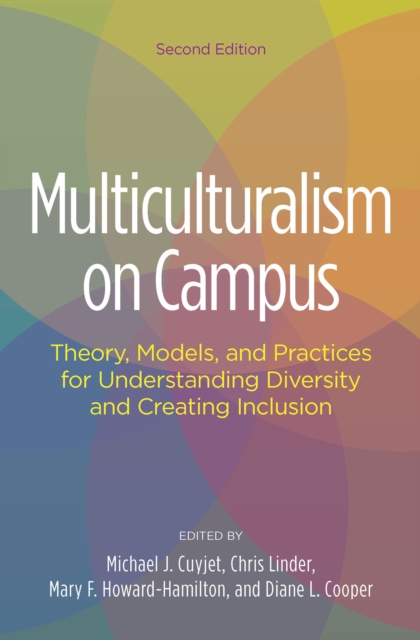
Multiculturalism on Campus
The first edition of this book constituted a comprehensive resource for students of higher education, faculty, higher education administrators and student affairs leaders engaging with multiculturalism and diverse populations on college campuses. It was one of the first texts to gather in a single volume the related theories, assessment methods, and environmental and application issues pertinent to the study and practice of multiculturalism, while also offering approaches to enhancing multicultural programming and culturally diverse campus environments. This second edition retains the structure and vision of the first, introducing readers to the key theories and models for understanding the complexity of the students they serve, and for reflecting on their own values and motivations. It provides an array of case studies, discussion questions, examples of best practice, and recommendations about resources for use in the classroom. This edition includes a new chapter on intersectionality, updates several chapters, presents a number of new cultural frameworks and updated best practices for creating an inclusive environment for marginalized groups, and expands the third section of the book on cultural competent practice.
eBook