
Catalogue Search | MBRL


Are you sure you want to remove the book from the shelf?

{{itemTitle}}
11
result(s) for
"mutually assured destruction"
Sort by:

To Kill Nations
\"Edward Kaplan's To Kill Nations is a
fascinating work that packs a thermonuclear punch of ideas and
arguments... The work is suitable for anyone from advanced
undergraduates to experts in the field.\" ― Strategy
Bridge
In To Kill Nations , Edward Kaplan
traces the evolution of American strategic airpower and preparation
for nuclear war from this early air-atomic era to a later period
(1950-1965) in which the Soviet Union's atomic capability,
accelerated by thermonuclear weapons and ballistic missiles, made
American strategic assets vulnerable and gradually undermined
air-atomic strategy.
Kaplan throws into question both the inevitability and
preferability of the strategic doctrine of MAD. He looks at the
process by which cultural, institutional, and strategic ideas about
MAD took shape and makes insightful use of the comparison between
generals who thought they could win a nuclear war and the cold
institutional logic of the suicide pact that was MAD. Kaplan also
offers a reappraisal of Eisenhower's nuclear strategy and diplomacy
to make a case for the marginal viability of air-atomic military
power even in an era of ballistic missiles.
eBook

M.A.D. AGAIN?
The article introduces a new meaning of the acronym M.A.D. (Mutually Assured Destruction) in the field of security. From the original connection with nuclear issues, its use is moving to the area of cyberspace. The text introduces the basic division of domains important for human activities. It explains their importance in terms of undeniable usability and availability for mankind, at the same time, it draws attention to their vulnerability and the need to ensure their protection. It deals in more details with the new fifth domain – cyberspace. In this context, security threats are mentioned and some legal aspects are indicated.
Journal Article
M.A.D. Again?
The article introduces a new meaning of the acronym M.A.D. (Mutually Assured Destruction) in the field of security. From the original connection with nuclear issues, its use is moving to the area of cyberspace. The text introduces the basic division of domains important for human activities. It explains their importance in terms of undeniable usability and availability for mankind, at the same time, it draws attention to their vulnerability and the need to ensure their protection. It deals in more details with the new fifth domain – cyberspace. In this context, security threats are mentioned and some legal aspects are indicated.
Journal Article

Jaderné odstrašování a koncept MAD ve vzájemných vztazích Spojených států a Ruské federace
The text analyses the position, role and perception of mutual nuclear deterrence between the United States and the Russian Federation in the period after the end of the Cold War. The authors argue that the deterrence is still present in the Russian-American relationship, despite the fact, that its intensity significantly decreased. They come to conclusion that this feature of mutual relationship is going to be present in the foreseeable future as well as the ongoing debates.
Journal Article
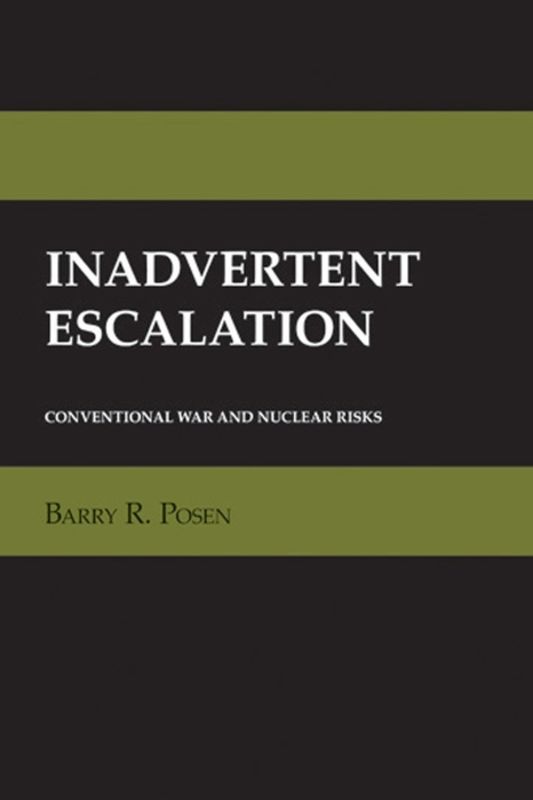
Inadvertent Escalation
Posen has written a provocative and important book...
which explores an issue that could increase in relevance as nuclear
weapons proliferate throughout the Third World. ― Intelligence
and National Security
In this sobering book, Barry R. Posen demonstrates how the
interplay between conventional military operations and nuclear
forces could, in conflicts among states armed with both
conventional and nuclear weaponry, inadvertently produce pressures
for nuclear escalation. Knowledge of these hidden pressures, he
believes, may help some future decision maker avoid
catastrophe.
Building a formidable argument that moves with cumulative force,
he details the way in which escalation could occur not by mindless
accident, or by deliberate preference for nuclear escalation, but
rather as a natural accompaniment of land, naval, or air warfare at
the conventional level. Posen bases his analysis on an empirical
study of the east-west military competition in Europe during the
1980s, using a conceptual framework drawn from international
relations theory, organization theory, and strategic theory.
The lessons of his book, however, go well beyond the east-west
competition. Since his observations are relevant to all military
competitions between states armed with both conventional and
nuclear weaponry, his book speaks to some of the problems that
attend the proliferation of nuclear weapons in longstanding
regional conflicts. Optimism that small and medium nuclear powers
can easily achieve \"stable\" nuclear balances is, he believes,
unwarranted.
In this sobering book, Barry R. Posen demonstrates how the
interplay between conventional military operations and nuclear
forces could, in conflicts among states armed with both
conventional and nuclear weaponry, inadvertently produce pressures
for nuclear escalation. Knowledge of these hidden pressures, he
believes, may help some future decision maker avoid
catastrophe.Building a formidable argument that moves with
cumulative force, he details the way in which escalation could
occur not by mindless accident, or by deliberate preference for
nuclear escalation, but rather as a natural accompaniment of land,
naval, or air warfare at the conventional level. Posen bases his
analysis on an empirical study of the east-west military
competition in Europe during the 1980s, using a conceptual
framework drawn from international relations theory, organization
theory, and strategic theory.The lessons of his book, however, go
well beyond the east-west competition. Since his observations are
relevant to all military competitions between states armed with
both conventional and nuclear weaponry, his book speaks to some of
the problems that attend the proliferation of nuclear weapons in
longstanding regional conflicts. Optimism that small and medium
nuclear powers can easily achieve \"stable\" nuclear balances is, he
believes, unwarranted.
eBook

Sakyo Komatsu’s Planetary Imagination
This chapter explores major works of Sakyo Komatsu, one of the Founding Fathers of contemporary Japanese science fiction, with special emphasis on his 1964 novel The Day of Resurrection, along with Fukasaku Kinji's 1980 film adaptation Virus. While his first novel, The Japanese Apache (1964), narrates the way postwar Japanese have reconstructed their identity as cyborgian, this second novel, The Day of Resurrection, dramatizes how full-scale nuclear war is ignited by the possible coincidences between natural disaster and artificial disaster, which we were to witness nearly fifty years after original publication of the novel—in the multiple disasters in eastern Japan on March 11, 2011. The chapter also speculates on the transnational impacts of the novel upon Michael Crichton's The Andromeda Strain (1969) and Junot Díaz’s The Brief Wondrous Life of Oscar Wao (2008).
Book Chapter

Crisis Bargaining, Escalation, and MAD
Although incomplete information is recognized to be an essential feature of crises, game-theoretic formulations have not generally modeled this explicitly. This paper models a mutually assured destruction (MAD) crisis as a game of sequential bargaining with incomplete information, sufficiently simple that its equibria may be found. These provide better game-theoretic foundations for the notions of resolve and critical risk and their role in crises and also make it possible to compare the bargaining dynamics of this model with those of descriptively richer, but incompletely specified models, revealing several inconsistencies: several analyses of MAD conclude that the state with the greatest resolve in this contest of resolve will prevail. Many models based on critical risks suggest that a state is less likely to escalate, the greater its adversary's resolve. In our model, however, the state with the weakest resolve sometimes prevails, and some states prove more likely to escalate if their adversaries' resolve is greater.
Journal Article

US War Planning: Changing Preferences and the Evolution of Capabilities
This chapter contains sections titled:
Value of War Planning
Concept of War
Institutional Capabilities
The Spanish–American War and its Aftermath
World War I
The Interwar Period
World War II
The Cold War Era
Post ‐ Cold War
Now and into the Future
The Dearth of War Planning Histories
Bibliography
Book Chapter

The Tradition of Non-Use of Nuclear Weapons
Tannenwald reviews The Tradition of Non-Use of Nuclear Weapons by T.V. Paul.
Book Review