
Catalogue Search | MBRL


Are you sure you want to remove the book from the shelf?

{{itemTitle}}
706,710
result(s) for
"national-park"
Sort by:

Yosemite and Sequoia/Kings Canyon National Parks
\"Travel to America's national parks is growing every year. Tourist visits to Yosemite in 2016 were up almost 20% over 2015, while visitation to Sequoia was up over 14%. Focused coverage on only the best places so travelers can make the most out of their limited time. Carefully vetted recommendations for all types of establishments and price points\"--Provided by publisher.
Book

Emergence and collapse of early villages
Ancestral Pueblo farmers encountered the deep, well watered, and productive soils of the central Mesa Verde region of Southwest Colorado around A.D. 600, and within two centuries built some of the largest villages known up to that time in the U.S. Southwest. But one hundred years later, those villages were empty, and most people had gone. This cycle repeated itself from the mid-A.D. 1000s until 1280, when Puebloan farmers permanently abandoned the entire northern Southwest. Taking an interdisciplinary approach, this book examines how climate change, population size, interpersonal conflict, resource depression, and changing social organization contribute to explaining these dramatic shifts. Comparing the simulations from agent-based models with the precisely dated archaeological record from this area, this text will interest archaeologists working in the Southwest and in Neolithic societies around the world as well as anyone applying modeling techniques to understanding how human societies shape, and are shaped by the environments we inhabit.
eBook

Frommer's Yosemite & neighboring parks
\"From the most trusted name in travel, Frommer's Yosemite & Neighboring Parks is a savvy, easily carry able, completely up-to-date guide to one of the United State's most storied vacation destinations. With helpful advice and honest recommendations from long-time California expert Rosemary McClure, the book covers these parks iconic attractions, plus their hidden gems\"-- Amazon.com.
Book

Kindred
He was an Austrian immigrant; she came from Tasmania. He grew up beside the Carinthian Alps; she climbed mountains when few women dared. Their honeymoon glimpse of Cradle Mountain lit an urge that filled their waking hours. Others might have kept this splendour to themselves, but Gustav Weindorfer and Kate Cowle sensed the significance of a place they sought to share with the world. When they stood on the peak in the heat of January 1910, they imagined a national park for all. Kindred: A Cradle Mountain Love Story traces the achievements of these unconventional adventurers and their fight to preserve the wilderness where they pioneered eco-tourism. Neither lived to see their vision fully realised: the World Heritage listed landscape is now visited by 250,000 people each year. Award-winning journalist Kate Legge tells the remarkable story behind the creation of the Cradle Mountain sanctuary through the characters at its heart.
eBook

Yellowstone cougars : ecology before and during wolf restoration
\"Examines the effect of wolf restoration on cougar population in Yellowstone National Park. No other study has addressed theoretical and practical aspects of competition between large carnivores. A thorough examination of cougar ecology, how they interact and [are] influenced by wolves, how this knowledge informs management and conservation\"--Provided by publisher.
Book
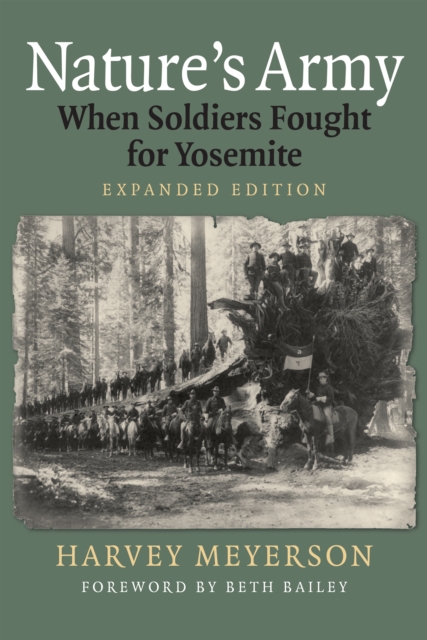
Nature's Army
Blessings on Uncle Sam's soldiers! They have done their job
well, and every pine tree is waving its arms for joy .-John
Muir
Muir's words and this book both celebrate a crucial but largely
forgotten episode in our nation's history-how a generation prior to
the creation of a National Park Service, the US Army ran Yosemite
National Park in an unusual alliance with the fabled
preservationist John Muir and his Sierra Club. Harvey Meyerson
brings that largely forgotten episode in our nation's history to
life and uses it as a touchstone for a reconsideration of a century
of civilian-military cooperation in environmental protection and
infrastructure construction whose impact and relevance still
resonate.
Despite the worldwide renown and popularity of Yosemite National
Park, few people know that its first stewards were drawn from the
so-called Old Army. From 1890 until the establishment of the
National Park Service in 1916, these soldiers proved to be
extremely competent and farsighted wilderness managers. Meyerson
recaptures the forgotten history of these early environmentalists
and how they set significant standards for the future oversight of
our national parks.
The army, Meyerson suggests, had actually been well prepared to
assume this stewardship. During its first hundred years-and despite
the interruptions of warfare-its soldiers had crisscrossed the
American landscape, preparing maps and writing detailed reports
describing climate, weather, physical terrain, ecosystems, and the
diverse flora and fauna populating the lands they explored and
often protected during an era of wide-open exploitation of natural
resources. Such experience made the army better suited than any
other federal agency to oversee the early national parks
system.
Combining environmental, military, political, and cultural
history, Meyerson's study is especially timely in light of
Yosemite's enormous popularity (four million visitors annually) and
recent controversies pitting conservation forces against dam
builders and proponents of expanded public access.
eBook

Ensuring Greater Yellowstone's Future
How can environmental problems be solved when they cross boundaries and involve diverse people? What kind of leadership and institutions will bring success? From experience in the greater Yellowstone region, Susan G. Clark looks at leadership and policy in managing natural resources. She assesses accomplishments toward sustainability over the past forty years.
Focusing on The Greater Yellowstone Coordinating Committee, a federal group of heads of national parks, national forests, and national wildlife refuges, Clark identifies fundamental leadership tasks needed, explains what changes in skill will be required, and makes many practical recommendations for every leader, citizen, and group involved with large-scale conservation anywhere worldwide.
eBook

American wolf : a true story of survival and obsession in the West
The story of the rise of a Yellowstone wolf, and what her life and death tell us about the struggle for the American West. -- Provided by publisher.
Book

Protected areas and their surrounding territory: socioecological systems in the context of ecological solidarity
The concept of ecological solidarity (ES) is a major feature of the 2006 law reforming national park policy in France. In the context of biodiversity conservation, the objectives of this study are to outline the historical development of ES, provide a working definition, and present a method for its implementation that combines environmental pragmatism and adaptive management. First, we highlight how ES provides a focus on the interdependencies among humans and nonhuman components of the socioecological system. In doing so, we identify ES within a framework that distinguishes ecological, socioecological, and sociopolitical interdependencies. In making such interdependencies apparent to humans who are not aware of their existence, the concept of ES promotes collective action as an alternative or complementary approach to stateâ or marketâbased approaches. By focusing on the awareness, feelings, and acknowledgement of interdependencies between actors and between humans and nonhumans, we present and discuss a learningâbased approach (participatory modeling) that allows stakeholders to work together to construct cultural landscapes for present and future generations. Using two case studies, we show how an ES analysis goes beyond the ecosystem management approach to take into account how human interactions with the environment embody cultural, social, and economic values and endorse an ethically integrated science of care and responsibility. ES recognizes the diversity of these values as a practical foundation for socially engaged and accountable actions. Finally, we discuss how ES enhances academic support for a socioecological systems approach to biodiversity conservation and promotes collaboration with decisionâmakers and stakeholders involved in the adaptive management of protected areas and their surrounding landscapes.
Journal Article