
Catalogue Search | MBRL


Are you sure you want to remove the book from the shelf?

{{itemTitle}}
103
result(s) for
"nazi regime"
Sort by:
Beyond the Conceivable
The major essays of Dan Diner, who is widely read and quoted in Germany and Israel, are finally collected in an English edition. They reflect the author’s belief that the Holocaust transcends traditional patterns of historical understanding and requires an epistemologically distinct approach. One can no longer assume that actors as well as historians are operating in the same conceptual universe, sharing the same criteria of rational discourse. This is particularly true of victims and perpetrators, whose memories shape the distortions of historical narrative in ways often diametrically opposed.
The essays are divided into three groups. The first group talks about anti-Semitism in the context of the 1930s and the ideologies that drove the Nazi regime. The second group concentrates on the almost unbelievably different perceptions of the \"Final Solution,\" with particularly illuminating discussions of the Judenrat, or Jewish council. The third group considers the Holocaust as the subject of narrative and historical memory. Diner focuses above all on perspectives: the very notions of rationality and irrationality are seen to be changeable, depending on who is applying them. And because neither rational nor irrational motives can be universally assigned to participants in the Holocaust, Diner proposes, from the perspective of the victims, the idea of the counterrational. His work is directed toward developing a theory of Holocaust historiography and offers, clearly and coherently, the highest level of reflection on these problems.
eBook

Lois Welzenbacher as an Architect of the Nazi Air Force: New Perspectives on the Siebel Aircraft Factory
The Siebel aircraft factory in Halle an der Saale, Germany, where scouts and bombers for the Nazi regime were produced, is architect Lois Welzenbacher’s largest project, constructed in 1939–1944. The complex was severely damaged during the final years of World War II. Its remains were eventually dismantled in 1946. Existing monographs on the architect interpret it as a manifestation of the incorruptibility of Welzenbacher’s modernist architectural vision. Newly discovered drawings reveal his designs for the site, which significantly differ from the realised structure. This paper explores these deviations and their underlying causes by recontextualising Welzenbacher’s work in Halle. I argue that his more traditional-looking initial designs reflect not his incorruptibility, but rather his opportunism under the Nazi regime.
Journal Article

Why did they kill? : Cambodia in the shadow of genocide
Of all the horrors human beings perpetrate, genocide stands near the top of the list. Its toll is staggering: well over 100 million dead worldwide. Why Did They Kill? is one of the first anthropological attempts to analyze the origins of genocide. In it, Alexander Hinton focuses on the devastation that took place in Cambodia from April 1975 to January 1979 under the Khmer Rouge in order to explore why mass murder happens and what motivates perpetrators to kill. Basing his analysis on years of investigative work in Cambodia, Hinton finds parallels between the Khmer Rouge and the Nazi regimes. Policies in Cambodia resulted in the deaths of over 1.7 million of that country's 8 million inhabitants—almost a quarter of the population--who perished from starvation, overwork, illness, malnutrition, and execution. Hinton considers this violence in light of a number of dynamics, including the ways in which difference is manufactured, how identity and meaning are constructed, and how emotionally resonant forms of cultural knowledge are incorporated into genocidal ideologies.
eBook

Aus den Anfängen der GTA und der Gestalttheoretischen Psychotherapie – Ein Rückblick anlässlich der 80. Geburtstage von Hans-Jürgen Walter und Hilarion Petzold
In diesem Beitrag werden die Anfänge der GTA und der Gestalt Theory ab Ende der 1970er Jahre nachgezeichnet. Diese Anfänge waren angesichts der Zerschlagung der Gestaltpsychologie und der Vertreibung eines großen Teils ihrer akademischen Vertreter durch das Nazi Regime überaus schwierig: War mit dem Ende des sog. „Dritten Reiches“ die Nazi-Ideologie in Deutschland noch keineswegs überwunden, was sich u.a. auch darin zeigte, dass man sich nicht erinnern mochte, welche bedeutende international geachteter Richtung mit der Berliner Schule der Gestaltpsychologie vor dem Nazi-Regime die Psychologie in Deutschland prägte, geschweige denn, dass man sich bemüht hätte, führende Vertreter zurück zu gewinnen. Der Fokus der Darstellung ist aber auch auf die beiden Persönlichkeiten Hans-Jürgen Walter und Hilarion Petzold gerichtet, die aus der Gestalttherapie kommend umfassende Konzepte von Psychotherapeutischem Verständnis entwickelten, die unter der Bezeichnung „Gestalttheoretische Psychotherapie“ und „Integrative Therapie“ wichtige Grundsteine auch für heutige Diskurse darstellen. Beide konnten am 25. März 2024 ihren 80. Geburtstag feiern, wobei die Gratulation seitens der GTA auch das Gedenken an Rainer Kästl einschließt, der ebenfalls für die Entwicklung der Gestalttheoretischen Psychotherapie Bedeutendes beigetragen hat, seinen 75. Geburtstag in 2024 aber aufgrund seines frühen Todes (2020) nicht begehen konnte.
Journal Article

Richard Korherrs „Bericht über die Endlösung der europäischen Judenfrage
The life and career of the statistician Richard Korherr offers a clear illustration of the entanglements of German academics in the Nazi regime. Born in 1903, Korherr started his career as an academic in the relatively new discipline of demography. The Italian dictator Benito Mussolini wrote a preface for Korherr’s book Geburtenrückgang (Declining Birth Rate), with Heinrich Himmler writing another after the Nazis took power in Germany. In 1942, Himmler became his supervisor. Korherr compiled and wrote the first survey of the Shoah, the “Report on the Final Solution of the European Jewish Question”, which later came to be known as the Korherr Report. So far, little is known on how Korherr came to write this expert report and which sources he relied on. This article is based on Korherr’s recently-released personnel files that are held at the Federal Ministry of Finances. In these files, Korherr revealed five sources: data from Jewish and non-Jewish academics, German Church statistics, official statistics from Austria and Germany, data from the Reichsvereinigung der Juden in Deutschland (Reich Association of Jews in Germany), and the SS-Reichssicherheitshauptamt (Reich Main Security Office). He might also have got information directly from the concentration camps and death camps, as Adolf Eichmann told the interrogators in Jerusalem. This article evaluates this newly found report and briefly describes Korherr’s career in the fledgling Federal Republic of Germany.
Journal Article

Politicized Aesthetics: German Art in Warsaw of 1938
This paper focuses attention on the reception of the exhibition “Deutsche Bildhauer der Gegenwart”, which was inaugurated on April 23
, 1938 at the Institute of Art Propaganda in Warsaw – an institution whose exhibition hall was considered a venue of crucial importance to the cultural policy of the Polish state. The presentation was organized in the framework of a cultural exchange between Poland and Germany which was initiated by an exhibition of Polish contemporary art mounted in 1935 at the Preußischen Akademie der Künste in Berlin.
I will present the response of the Warsaw public to the presentation of contemporary German sculpture within the context of traditionalist ideology which was promulgated in Poland as much as across Europe in the decades between the two world wars. Drawing on traditionalism, which heralded a prevalence of national cultural values strongly anchored in the past, I will question the relevance of its rhetoric to the artistic phenomena evolving under political pressure. It seems intriguing to juxtapose the accounts provided by Polish and German authorities from the art world in an attempt to grasp the semantic content of such categories as “the genius of the race”, as reflected in the 1930s’ critical discourse. Moreover, in order to reflect upon the concept of propaganda art – another key notion of the time – it is worth considering the response of Polish commentators to official exhibitions of other nation-states held in Warsaw in the 1930s.
Journal Article

Genocide
This chapter focuses on the particular and unique links between the crime of genocide and ethnicity, nationality, and race. It demonstrates these links first in the legal histories of the crime of genocide. The chapter presents contemporary understandings of genocide that move out of the shadow of the Holocaust and into the landscape of ethnopolitical warfare and conflict. It explores links between ethnicity, ideology, and motivation of perpetrator groups and discusses efforts at prevention and intervention. The contemporary understanding of genocide is inexorably linked to and shaped bythe Holocaust, the murder of the European Jews by the German Nazi‐regime between 1939 and 1945. Raphael Lemkin, a Polish–Jewish refugee is credited with coining the term “genocide”, and he conceived of it explicitly as a crime against an ethnic, national, or religious group.
Book Chapter

Body of evidence: integrating Eduard Pernkopf’s Atlas into a librarian-led medical humanities seminar
Background: Anatomical subjects depicted in Eduard Pernkopf’s richly illustrated Topographische Anatomie des Menschen may be victims of the Nazi regime. Special collections librarians in the history of medicine can use this primary resource to initiate dialogs about ethics with medical students.Case Presentation: Reported here is the authors’ use of Pernkopf’s Atlas in an interactive medical humanities seminar designed for third-year medical students. Topical articles, illustrations, and interviews introduced students to Pernkopf, his Atlas, and the surrounding controversies. We aimed to illustrate how this controversial historical publication can successfully foster student discussion and ethical reflection.Conclusions: Pernkopf’s Atlas and our mix of contextual resources facilitated thoughtful discussions about history and ethics amongst the group. Anonymous course evaluations showed student interest in the subject matter, relevance to their studies, and appreciation of our special collection’s space and contents.
Journal Article
Why Did They Kill?
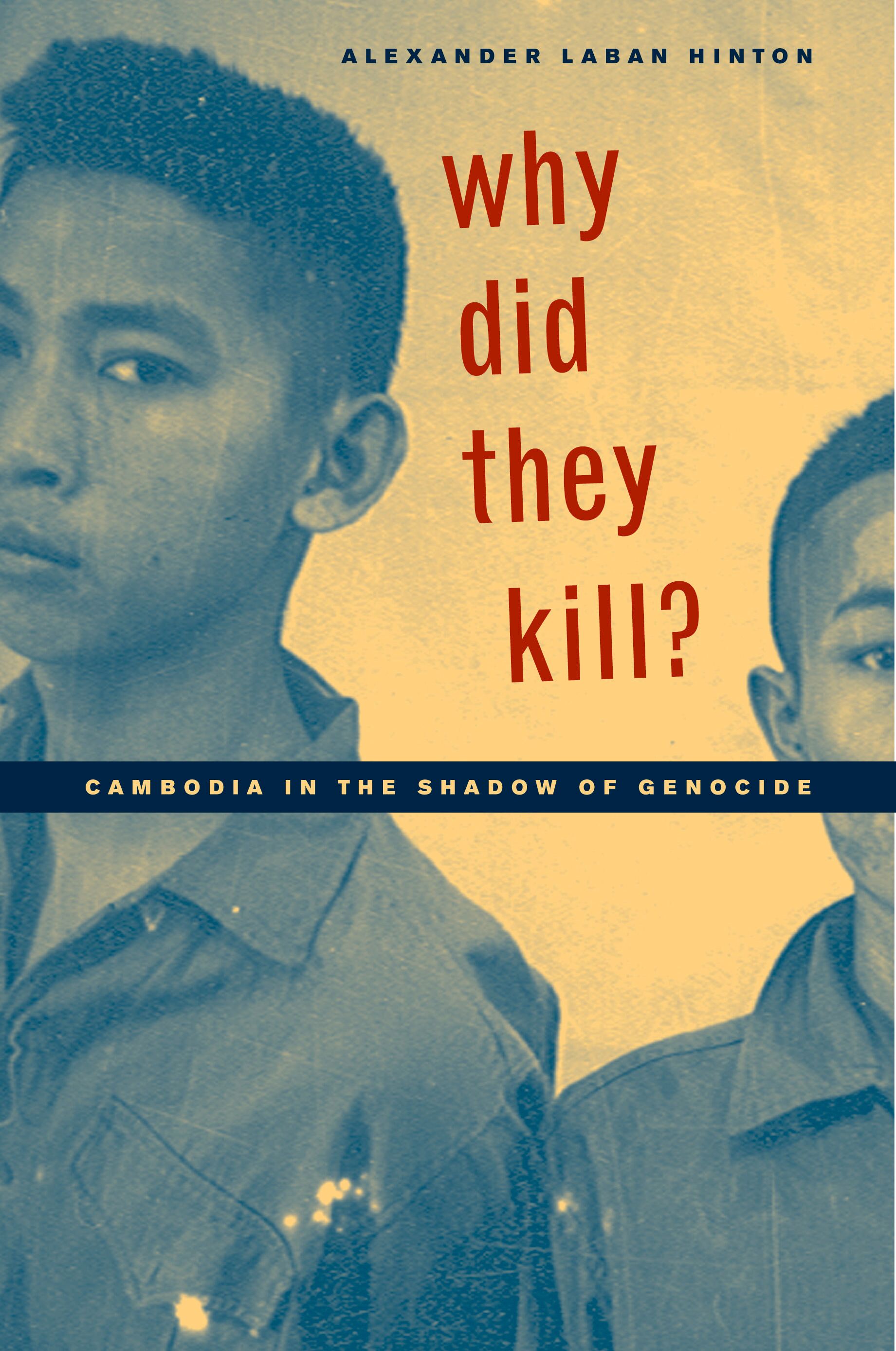
Of all the horrors human beings perpetrate, genocide stands near the top of the list. Its toll is staggering: well over 100 million dead worldwide. Why Did They Kill? is one of the first anthropological attempts to analyze the origins of genocide. In it, Alexander Hinton focuses on the devastation that took place in Cambodia from April 1975 to January 1979 under the Khmer Rouge in order to explore why mass murder happens and what motivates perpetrators to kill. Basing his analysis on years of investigative work in Cambodia, Hinton finds parallels between the Khmer Rouge and the Nazi regimes. Policies in Cambodia resulted in the deaths of over 1.7 million of that country's 8 million inhabitants—almost a quarter of the population--who perished from starvation, overwork, illness, malnutrition, and execution. Hinton considers this violence in light of a number of dynamics, including the ways in which difference is manufactured, how identity and meaning are constructed, and how emotionally resonant forms of cultural knowledge are incorporated into genocidal ideologies.
eBook
Richard Korherrs „Bericht über die Endlösung der europäischen Judenfrage
The life and career of the statistician Richard Korherr offers a clear illustration of the entanglements of German academics in the Nazi regime. Born in 1903, Korherr started his career as an academic in the relatively new discipline of demography. The Italian dictator Benito Mussolini wrote a preface for Korherr’s book Geburtenrückgang (Declining Birth Rate), with Heinrich Himmler writing another after the Nazis took power in Germany. In 1942, Himmler became his supervisor. Korherr compiled and wrote the first survey of the Shoah, the “Report on the Final Solution of the European Jewish Question”, which later came to be known as the Korherr Report. So far, little is known on how Korherr came to write this expert report and which sources he relied on. This article is based on Korherr’s recently-released personnel files that are held at the Federal Ministry of Finances. In these files, Korherr revealed five sources: data from Jewish and non-Jewish academics, German Church statistics, official statistics from Austria and Germany, data from the Reichsvereinigung der Juden in Deutschland (Reich Association of Jews in Germany), and the SS-Reichssicherheitshauptamt (Reich Main Security Office). He might also have got information directly from the concentration camps and death camps, as Adolf Eichmann told the interrogators in Jerusalem. This article evaluates this newly found report and briefly describes Korherr’s career in the fledgling Federal Republic of Germany.
Journal Article