
Catalogue Search | MBRL


Are you sure you want to remove the book from the shelf?

{{itemTitle}}
284
result(s) for
"netflix"
Sort by:
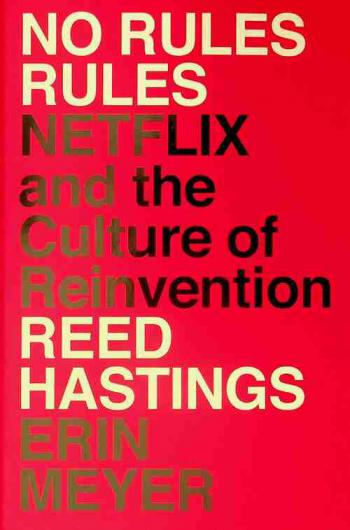
No rules rules : netflix and the culture of reinvention
\"Netflix cofounder Reed Hastings reveals for the first time the unorthodox culture behind one of the world's most innovative, imaginative, and successful companies There's never before been a company like Netflix. Not only because it has led a revolution in the entertainment industries; or because it generates billions of dollars in annual revenue; or even because it is watched by hundreds of millions of people in nearly 200 countries. When Reed Hastings co-founded Netflix, he developed a set of counterintuitive and radical management principles, defying all tradition and expectation, which would allow the company to reinvent itself over and over on the way to becoming one of the most loved brands in the world. Rejecting the conventional wisdom under which other companies operate, Reed set new standards, valuing people over process, emphasizing innovation over efficiency, and giving employees context, not controls. At Netflix, adequate performance gets a generous severance and hard work is irrelevant. At Netflix, you don't try to please your boss, you practice radical candor instead. At Netflix, employees never need approval, and the company always pays top of market. When Hastings and his team first devised these principles, the implications were unknown and untested, but over just a short period of time they have led to unprecedented flexibility, speed, and boldness. The culture of freedom and responsibility has allowed the company to constantly grow and change as the world, and its members' needs, have also transformed. Here for the first time, Hastings and Erin Meyer, bestselling author of The Culture Map and one of the world's most influential business thinkers, dive deep into the controversial philosophies at the heart of the Netflix psyche, which have generated results that are the envy of the business world. Drawing on hundreds of interviews with current and past Netflix employees from around the globe and never-before-told stories of trial and error from his own career, No Rules Rules is the full, fascinating, and untold story of a unique company making its mark on the world\"-- Provided by publisher.

The Netflix Effect
Netflix is the definitive media company of the 21st century. It was among the first to parlay new Internet technologies into a successful business model, and in the process it changed how consumers access film and television. It is now one of the leading providers of digitally delivered media content and is continually expanding access across a host of platforms and mobile devices. Despite its transformative role, however, Netflix has drawn very little critical attention—far less than competitors such as YouTube, Apple, Amazon, Comcast, and HBO. This collection addresses this gap, as the essays are designed to critically explore the breadth and diversity of Netflix’s effect from a variety of different scholarly perspectives, a necessary approach considering the hybrid nature of Netflix; its inextricable links to new models of media production and distribution, to new modes of viewer engagement and consumer behavior, its relationship to existing media conglomerates and consumer electronics, to its capabilities as a web-based service provider and data network, and to its reliance on a broader technological infrastructure. Marking the first scholarly work to address its significance, The Netflix Effect provides a critical framework for understanding the company’s specific strategies as well as its broader social, economic, and cultural impact.
eBook


Automated Product Recommendations with Preference-Based Explanations
[Display omitted]
•Automated recommendations are prone to errors.•Explanations of the reasoning underlying recommendations can mitigate negative effects of errors.•A novel method combines content and collaborative filtering.•It outperforms established recommender approaches in terms of prediction accuracy.•It has also the ability to provide actionable explanations.
Many online retailers, such as Amazon, use automated product recommender systems to encourage customer loyalty and cross-sell products. Despite significant improvements to the predictive accuracy of contemporary recommender system algorithms, they remain prone to errors. Erroneous recommendations pose potential threats to online retailers in particular, because they diminish customers’ trust in, acceptance of, satisfaction with, and loyalty to a recommender system. Explanations of the reasoning that lead to recommendations might mitigate these negative effects. That is, a recommendation algorithm ideally would provide both accurate recommendations and explanations of the reasoning for those recommendations. This article proposes a novel method to balance these concurrent objectives. The application of this method, using a combination of content-based and collaborative filtering, to two real-world data sets with more than 100 million product ratings reveals that the proposed method outperforms established recommender approaches in terms of predictive accuracy (more than five percent better than the Netflix Prize winner algorithm according to normalized root mean squared error) and its ability to provide actionable explanations, which is also an ethical requirement of artificial intelligence systems.
Journal Article


Oferta programowa, katalogi i imperializm kulturowy
Artykuł pochodzi z wydanej w 2019 r. książki pt. Netflix Nations. The Geography of Digital Distribution. Autor poświęca w nim uwagę sposobom funkcjonowania amerykańskiego serwisu na rynkach zagranicznych, ze szczególnym uwzględnieniem Kanady i państw Unii Europejskiej, przy czym jego uwaga ogniskuje się na kontrowersyjnym stosunku treści amerykańskich i lokalnych. Lobato dokonuje analizy w porządku diachronicznym, odnosząc się do zmian zarówno w obrębie teorii medioznawczych, jak i w ustawodawstwie dotyczącym rynku medialnego, oraz synchronicznym, porównując metody działania platformy w różnych miejscach na świecie i polityczne reakcje na nie. W ostatniej części badacz zastanawia się nad rozbieżnościami między stosunkowo surową polityką kulturalną zmierzającą do ujarzmienia giganta i preferencjami widowni, która swoimi wyborami współtworzy jego ofertę programową; ponadto autor zachęca do dalszego namysłu nad związkami – jak sam pisze – między katalogami, algorytmami rekomendacji i krajowymi rozwiązaniami w zakresie polityki medialnej, jako że nasze środowisko medialne w coraz większym stopniu staje się środowiskiem usług na żądanie. Tekst jest tłumaczeniem rozdziału Content, Catalogs, and Cultural Imperialism z książki Ramona Lobato Netflix Nations. The Geography of Digital Distribution, New York University Press, New York 2019 (http://opensquare.nyupress.org/books/9781479804948/read/) © 2019 by New York University.
Journal Article


Watching While Black Rebooted
No detailed description available for \"Watching While Black Rebooted!\".
eBook

That will never work : the birth of Netflix and the amazing life of an idea
\"Once upon a time, brick-and-mortar video stores were king. Late fees were ubiquitous, video-streaming unheard was of, and widespread DVD adoption seemed about as imminent as flying cars. Indeed, these were the widely accepted laws of the land in 1997, when Marc Randolph had an idea. It was a simple thought-leveraging the internet to rent movies-and was just one of many more and far worse proposals, like personalized baseball bats and a shampoo delivery service, that Randolph would pitch to his business partner, Reed Hastings, on their commute to work each morning. But Hastings was intrigued, and the pair-with Hastings as the primary investor and Randolph as the CEO-founded a company. Now with over 150 million subscribers, Netflix's triumph feels inevitable, but the twenty first century's most disruptive start up began with few believers and calamity at every turn. From having to pitch his own mother on being an early investor, to the motel conference room that served as a first office, to server crashes on launch day, to the now-infamous meeting when Netflix brass pitched Blockbuster to acquire them, Marc Randolph's transformational journey exemplifies how anyone with grit, gut instincts and determination can change the world-even with an idea that many think will never work.\"--Amazon.com.
Book

From Netflix Streaming to Netflix and Chill: The (Dis)Connected Body of Serial Binge-Viewer
With the digitization of the entertainment industry, our everyday media encounters become increasingly data-saturated. In the framework of the digital attention economy, lifestyle technologies stimulate and modulate intensive participation on a regular basis. By conceptualizing the American streaming brand and content provider Netflix as a networked experiential environment, this article explores the practice of binge-watching in light of its multilayered possibilities for user engagement. With the focus on the affective entanglements of recommendation, attention, and attachment, the first part of the article foregrounds binge-watching as the main driving force behind Netflix’s promotional stance on personalization and quality. The second part provides a situated analysis on how binge-viewing technologies and bodies connect and disconnect by zooming in on users’ adaptations of the viral catchphrase “Netflix and chill” on Tumblr. Highlighting the embodied dynamics of engagement with today’s tech brands, I argue for thinking about the value of these dynamics as embedded in the digital logic of contact/capture.
Journal Article