
Catalogue Search | MBRL


Are you sure you want to remove the book from the shelf?

{{itemTitle}}
1,563
result(s) for
"numerical calculations"
Sort by:


When Computers Were Human
Before Palm Pilots and iPods, PCs and laptops, the term \"computer\" referred to the people who did scientific calculations by hand. These workers were neither calculating geniuses nor idiot savants but knowledgeable people who, in other circumstances, might have become scientists in their own right. When Computers Were Human represents the first in-depth account of this little-known, 200-year epoch in the history of science and technology. Beginning with the story of his own grandmother, who was trained as a human computer, David Alan Grier provides a poignant introduction to the wider world of women and men who did the hard computational labor of science. His grandmother's casual remark, \"I wish I'd used my calculus,\" hinted at a career deferred and an education forgotten, a secret life unappreciated; like many highly educated women of her generation, she studied to become a human computer because nothing else would offer her a place in the scientific world. The book begins with the return of Halley's comet in 1758 and the effort of three French astronomers to compute its orbit. It ends four cycles later, with a UNIVAC electronic computer projecting the 1986 orbit. In between, Grier tells us about the surveyors of the French Revolution, describes the calculating machines of Charles Babbage, and guides the reader through the Great Depression to marvel at the giant computing room of the Works Progress Administration. When Computers Were Human is the sad but lyrical story of workers who gladly did the hard labor of research calculation in the hope that they might be part of the scientific community. In the end, they were rewarded by a new electronic machine that took the place and the name of those who were, once, the computers.
eBook
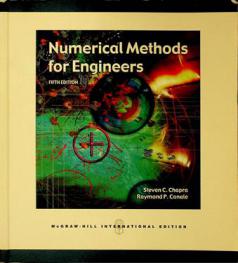
Numerical methods for engineers
The fifth edition of 'Numerical Methods for Engineers' includes challenging problems drawn from all engineering disciplines, of which 80% are new or revised.
Book

Numerical Analysis for Light Absorption Spectra of the Base of DNA-Wrapped Single-Walled Carbon Nanotubes
This study numerically demonstrates the light absorption spectra of each base of DNA-wrapped single-walled carbon nanotubes (SWCNTs). Previous experimental and theoretical studies show that the optical properties of these composites are different from the bare SWCNTs. In this work, we investigated the bases of DNA that influence optical properties. To obtain stable molecular states for studying optical properties, molecular dynamics calculations were performed. Additionally, light absorption spectra in the ultraviolet-to-near-infrared region of one type of base-wrapped (e.g., adenine-, thymine-, cytosine-, or guanine-wrapped) SWCNTs were investigated by utilizing the semi-empirical molecular orbital theory using SCIGRESS commercial software. This method can significantly reduce the calculation time compared to the ab initio molecular orbital method, making the handling of composites of bases and SWCNTs possible. We found that the largest peaks appear at a wavelength of around 300 nm for all the composites. Furthermore, we found that the light absorption spectra above 570 nm are strongly influenced by adenine and cytosine. Thus, our computational results provide insight into the optical properties and the effects of base–SWCNTs that are difficult to investigate experimentally under the influence of solvents and various molecules.
Journal Article

Calculated values : finance, politics, and the quantitative age
Modern political culture features a deep-seated faith in the power of numbers to find answers, settle disputes, and explain how the world works. Whether evaluating economic trends, measuring the success of institutions, or divining public opinion, we are told that numbers don't lie. But numbers have not always been so revered. Calculated Values traces how numbers first gained widespread public authority in one nation, Great Britain. Into the seventeenth century, numerical reasoning bore no special weight in political life. Complex calculations were often regarded with suspicion, seen as the narrow province of navigators, bookkeepers, and astrologers, not gentlemen. This changed in the decades following the Glorious Revolution of 1688. Though Britons' new quantitative enthusiasm coincided with major advances in natural science, financial capitalism, and the power of the British state, it was no automatic consequence of those developments, William Deringer argues. Rather, it was a product of politics--ugly, antagonistic, partisan politics. From Parliamentary debates to cheap pamphlets, disputes over taxes, trade, and national debt were increasingly conducted through calculations. Some of the era's most pivotal political moments, like the 1707 Union of England and Scotland and the 1720 South Sea Bubble, turned upon calculative conflicts. As Britons learned to fight by the numbers, they came to believe, as one calculator wrote in 1727, that \"facts and figures are the most stubborn evidences.\" Yet the authority of numbers arose not from efforts to find objective truths that transcended politics, but from the turmoil of politics itself.-- Provided by publisher
Book

Design, analysis and optimization of porous titanium alloys scaffolds by using additive manufacture
In order to have a stronger bond with the surrounding bone, the bone prosthesis needs to have interconnecting pores for bone cells to grow and more importantly to avoid stress shielding. At the same time, human bones have different composition and structure of bone tissue in different parts of the body due to different physical factors of the person, so the elastic modulus of the bones that need to be supported and replaced are not the same. And additive manufacturing has the advantages of rapid, efficient and precise manufacturing of complex shapes and high-quality three-dimensional structures, which can manufacture porous scaffold bone prosthesis, and achieve more accurate mechanical property requirements by controlling the design parameters. To study the effect of design strut length and design strut cross-section diameter size on the elastic modulus of tetrahedral titanium alloy scaffold unit, and with the help of UG NX, several digital models of porous titanium alloy scaffolds were constructed with the strut length and the strut cross-section diameter size as the parameters of variation, and then the elastic modulus of each porous titanium alloy scaffold was measured by ANSYS Workbench 2022, and the elasticity modulus of each porous titanium alloy scaffold was further derived from the relationship between the strut length and strut cross-section diameter size and the porous titanium alloy scaffold. Then the elastic modulus of each porous titanium alloy bracket was measured by ANSYS Workbench 2022, and the mathematical model between the strut length, strut cross-section size and elastic modulus of the porous titanium alloy bracket was further derived. Then, ANSYS Workbench 2022 was used to measure the elastic modulus of each porous titanium alloy bracket and further derive the mathematical model between strut length, strut cross-section diameter size and elastic modulus of the porous titanium alloy bracket, with the help of which the elastic modulus of the porous titanium alloy bracket with specific diameters and strut lengths was finally deduced to validate the correctness of the above predicted mathematical model, and to make reasonable explanations and corrections for the deviations. explanation and correction of deviations. As a result, the rapid prototyping technology can be used to design the required porous titanium alloy bracket in a more detailed way.
Journal Article

Effect of Non-Uniform Torsion on Elastostatics of a Frame of Hollow Rectangular Cross-Section
In this paper, results of numerical simulations and measurements are presented concerning the non-uniform torsion and bending of an angled members of hollow cross-section. In numerical simulation, our linear-elastic 3D Timoshenko warping beam finite element is used, which allows consideration of non-uniform torsion. The finite element is suitable for analysis of spatial structures consisting of beams with constant open and closed cross-sections. The effect of the secondary torsional moment and of the shear forces on the deformation is included in the local finite beam element stiffness matrix. The warping part of the first derivative of the twist angle due to bimoment is considered as an additional degree of freedom at the nodes of the finite elements. Standard beam, shell and solid finite elements are also used in the comparative stress and deformation simulations. Results of the numerical experiments are discussed, compared, and evaluated. Measurements are performed for confirmation of the calculated results.
Journal Article


Characteristics of a Surgical Snare Using Microwave Energy
Currently, minimally invasive treatments that insert various treatment devices into an endoscope are actively being performed. A high-frequency (HF) snare is commonly used as an energy device inserted into an endoscope. However, using a high-frequency snare, problems usually occur, such as the obstruction of the visual field caused by smoke. On the other hand, microwave heating produces less smoke and provides a better visual field. In this study, a snare using microwave energy inserted into an endoscope is proposed, and its characteristics are evaluated.
Journal Article

Stress relaxation in epithelial monolayers is controlled by the actomyosin cortex
Epithelial monolayers are one-cell-thick tissue sheets that line most of the body surfaces, separating internal and external environments. As part of their function, they must withstand extrinsic mechanical stresses applied at high strain rates. However, little is known about how monolayers respond to mechanical deformations. Here, by subjecting suspended epithelial monolayers to stretch, we find that they dissipate stresses on a minute timescale and that relaxation can be described by a power law with an exponential cut-off at timescales larger than about 10 s. This process involves an increase in monolayer length, pointing to active remodelling of cellular biopolymers at the molecular scale during relaxation. Strikingly, monolayers consisting of tens of thousands of cells relax stress with similar dynamics to single rounded cells, and both respond similarly to perturbations of the actomyosin cytoskeleton. By contrast, cell–cell junctional complexes and intermediate filaments do not relax tissue stress, but form stable connections between cells, allowing monolayers to behave rheologically as single cells. Taken together, our data show that actomyosin dynamics governs the rheological properties of epithelial monolayers, dissipating applied stresses and enabling changes in monolayer length.Stress relaxation in cell monolayers shows remarkable similarities with that of single cells, suggesting the rheology of epithelial tissues is mediated by the actomyosin cortex—with dynamics reminiscent of those on a cellular level.
Journal Article