
Catalogue Search | MBRL


Are you sure you want to remove the book from the shelf?

{{itemTitle}}
92,385
result(s) for
"open source software"
Sort by:


Qiita: rapid, web-enabled microbiome meta-analysis
Multi-omic insights into microbiome function and composition typically advance one study at a time. However, in order for relationships across studies to be fully understood, data must be aggregated into meta-analyses. This makes it possible to generate new hypotheses by finding features that are reproducible across biospecimens and data layers. Qiita dramatically accelerates such integration tasks in a web-based microbiome-comparison platform, which we demonstrate with Human Microbiome Project and Integrative Human Microbiome Project (iHMP) data.
Journal Article

Reproducible econometrics using R
This text is designed to facilitate reproducibility in econometrics. It does so by using open source software (R) and recently developed tools (R Markdown and bookdown) that allow the reader to engage in reproducible research. Illustrative examples are provided throughout, and a range of topics are covered. Assignments, exams, slides, and a solution manual are available for instructors.
Book

Competition Among Proprietary and Open-Source Software Firms: The Role of Licensing in Strategic Contribution
In enterprise software markets, firms are increasingly using
services
-based business models built on open-source software (OSS) to compete with established, proprietary software firms. Because third-party firms can also strategically contribute to OSS and compete in the services market, the nature of competition between OSS constituents and proprietary software firms can be complex. Moreover, their incentives are likely influenced by the licensing schemes that govern OSS. We study a three-player game and examine how open-source licensing affects competition among an open-source originator, an open-source contributor, and a proprietor competing in an enterprise software market. In this regard, we examine (1) how quality investments and prices are endogenously determined in equilibrium, (2) how license restrictiveness impacts equilibrium investments and the quality of offerings, and (3) how license restrictiveness affects consumer surplus and social welfare. Although some in the open-source community often advocate restrictive licenses such as the GNU General Public License because it is not always in the best interest of the originator for the contributor to invest greater development effort, such licensing can actually be detrimental to both consumer surplus and social welfare when it exacerbates this incentive conflict. We find such an outcome in markets characterized by software providers with similar development capabilities yet cast in favor of the proprietor. In contrast, when these capabilities either become more dispersed or remain similar but tilt in favor of open source, a more restrictive license instead encourages greater effort from the OSS contributor, leads to higher OSS quality, and provides a larger societal benefit.
This paper was accepted by Chris Forman, information systems.
Journal Article

Ultimate Git and GitHub for Modern Software Development
Ultimate Git and GitHub for Modern Software Development is a comprehensive guide that empowers developers to harness the full potential of Git and GitHub for efficient version control and seamless collaboration. This book takes you on a journey through the fundamentals of Git, exploring its commands, branching strategies, and conflict resolution techniques. It then delves into the world of GitHub, teaching you how to create repositories, collaborate with teams, and contribute to open-source projects.Whether you're a beginner or an experienced developer, this handbook equips you with the skills and knowledge to streamline your development workflow, ensure code integrity, and foster a collaborative coding environment. With clear explanations, real-world examples, and best practices, you will learn to leverage the power of these tools to enhance your coding experience and elevate your projects to new heights.
eBook

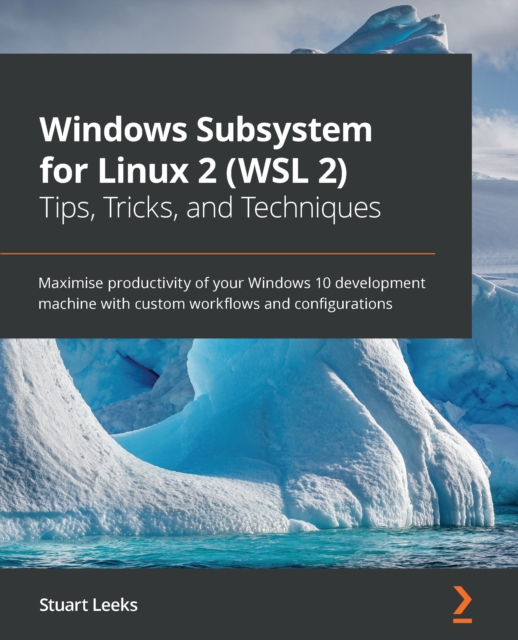
Windows Subsystem for Linux 2 (WSL 2) Tips, Tricks, and Techniques
A practical handbook that will help you bridge the gap between Windows and Linux to develop apps that leverage the best features across both ecosystems with seamless interoperability Key Features * Configure and control WSL to suit your needs and preferences * Discover tips for working seamlessly between Windows and WSL Linux distros * Learn how to work effectively with containers in WSL, as well as how to containerize your development environments with Visual Studio Code to isolate your dependencies Book Description Windows Subsystem for Linux (WSL) allows you to run native Linux tools alongside traditional Windows applications. Whether you're developing applications across multiple operating systems or looking to add more tools to your Windows environment, WSL offers endless possibilities. You'll start by understanding what WSL is and learn how to install and configure WSL along with different Linux distros. Next, you'll learn techniques that allow you to work across both Windows and Linux environments. You'll discover how to install and customize the new Windows Terminal. We'll also show you how to work with code in WSL using Visual Studio Code (VS Code). In addition to this, you'll explore how to work with containers with Docker and Kubernetes, and how to containerize a development environment using VS Code. While Microsoft has announced support for GPU and GUI applications in an upcoming release of WSL, at the time of writing these features are either not available or only in early preview releases. This book focuses on the stable, released features of WSL and giving you a solid understanding of the amazing techniques that you can use with WSL today. By the end of this book, you'll be able to configure WSL and Windows Terminal to suit your preferences, and productively use Visual Studio Code for developing applications with WSL. What you will learn * Install and configure Windows Subsystem for Linux and Linux distros * Access web applications running in Linux from Windows * Invoke Windows applications, file systems, and environment variables from bash in WSL * Customize the appearance and behavior of the Windows Terminal to suit your preferences and workflows * Explore various tips for enhancing the Visual Studio Code experience with WSL * Install and work with Docker and Kubernetes within Windows Subsystem for Linux * Discover various productivity tips for working with Command-line tools in WSL Who this book is for This book is for developers who want to use Linux tools on Windows, including Windows-native programmers looking to ease into a Linux environment based on project requirements or Linux developers who've recently switched to Windows. This book is also for web developers working on open source projects with Linux-first tools such as Ruby or Python, or developers looking to switch between containers and development machines for testing apps. Prior programming or development experience and a basic understanding of running tasks in bash, PowerShell, or the Windows Command Prompt will be required.
eBook


Problem-formulation and problem-solving in self-organized communities: How modes of communication shape project behaviors in the free open-source software community
Research summary: Building on the problem-solving perspective, we study behaviors related to projects and the communication-based antecedents of such behaviors in the free open-source software (FOSS) community. We examine two kinds of problem/project-behaviors: Individuals can set up projects around the formulation of new problems or join existing projects and define and/or work on subproblems within an existing problem. The choice between these two behaviors is influenced by the mode of communication. A communication mode with little a priori structure is the best mode for communicating about new problems (i.e., formulating a problem); empirically, it is associated with project launching behaviors. In contrast, more structured communication fits subproblems better and is related to project joining behaviors. Our hypotheses derive support from data from the FOSS community. Managerial summary: We study how the way in which individuals communicate influence the project-behaviors they engage in. We find that relatively unstructured communication is associated with the setting up new projects, while communication that is structured around an artifact is associated with joining projects. Our findings hold implications for understanding how management may influence project behaviors and problem-solving: Firms that need to concentrate on more incremental problem-solving efforts (e.g., because a sufficient number of attractive problems have already been defined) should create environments in which interaction is undertaken mainly via artifacts. On the other hand, if firms seek to generate new problems (e.g., new strategic opportunities), they should create environments in which open-ended, verbal conversation is relatively more important than artifact-based communication.
Journal Article