
Catalogue Search | MBRL


Are you sure you want to remove the book from the shelf?

{{itemTitle}}
80,854
result(s) for
"paleontology"
Sort by:

Paleontology : the study of prehistoric life
Presents general information about paleontologists, what they learn about prehistoric animals and vegetation by studying them.
Book


Earth history and palaeogeography
Using full-colour palaeogeographical maps from the Cambrian to the present, this interdisciplinary volume explains how plate motions and surface volcanism are linked to processes in the Earth's mantle, and to climate change and the evolution of the Earth's biota. These new and very detailed maps provide a complete and integrated Phanerozoic story of palaeogeography. They illustrate the development of all the major mountain-building orogenies. Old lands, seas, ice caps, volcanic regions, reefs, and coal beds are highlighted on the maps, as well as faunal and floral provinces. Many other original diagrams show sections from the Earth's core, through the mantle, and up to the lithosphere, and how Large Igneous Provinces are generated, helping to understand how plates have appeared, moved, and vanished through time. Supplementary resources are available online, making this an invaluable reference for researchers, graduate students, professional geoscientists and anyone interested in the geological history of the Earth.- Source other than Library of Congress.
Book
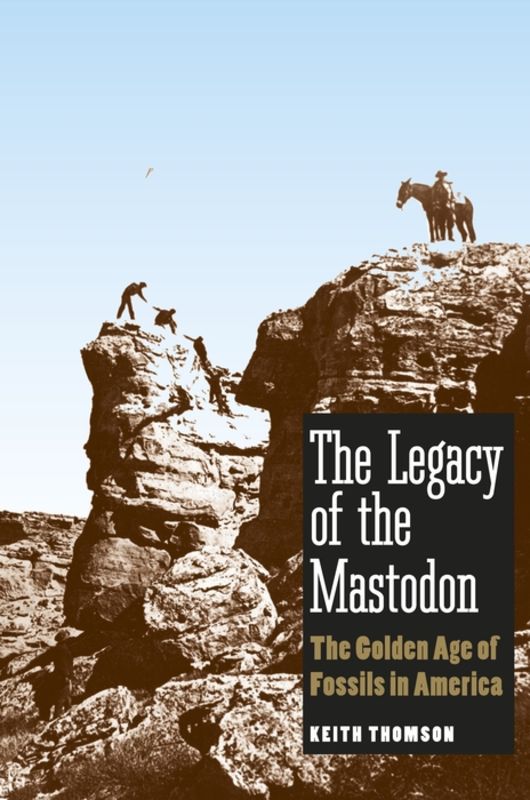
The Legacy of the Mastodon
The uncovering in the mid-1700s of fossilized mastodon bones and teeth at Big Bone Lick, Kentucky, signaled the beginning of a great American adventure. The West was opening up and unexplored lands beckoned. Unimagined paleontological treasures awaited discovery: strange horned mammals, birds with teeth, flying reptiles, gigantic fish, diminutive ancestors of horses and camels, and more than a hundred different kinds of dinosaurs. This exciting book tells the story of the grandest period of fossil discovery in American history, the years from 1750 to 1890.
The volume begins with Thomas Jefferson, whose keen interest in the American mastodon led him to champion the study of fossil vertebrates. The book continues with vivid descriptions of the actual work of prospecting for fossils--a pick in one hand, a rifle in the other--and enthralling portraits of Joseph Leidy, Ferdinand Hayden, Edward Cope, and Othniel Marsh among other major figures in the development of the science of paleontology. Shedding new light on these scientists' feuds and rivalries, on the connections between fossil studies in Europe and America, and on paleontology's contributions to America's developing national identity,The Legacy of the Mastodonis itself a fabulous discovery for every reader to treasure.
eBook


Techniques for virtual palaeontology
Virtual palaeontology, the use of interactive three-dimensional digital models as a supplement or alternative to physical specimens for scientific study and communication, is rapidly becoming important to advanced students and researchers. Using non-invasive techniques, the method allows the capture of large quantities of useful data without damaging the fossils being studied
Techniques for Virtual Palaeontology guides palaeontologists through the decisions involved in designing a virtual palaeontology workflow and gives a comprehensive overview, providing discussions of underlying theory, applications, historical development, details of practical methodologies, and case studies. Techniques covered include physical-optical tomography (serial sectioning), focused ion beam tomography, all forms of X-ray CT, neutron tomography, magnetic resonance imaging, optical tomography, laser scanning, and photogrammetry. Visualization techniques and data/file formats are also discussed in detail.
Readership: All palaeontologists and students interested in three-dimensional visualization and analysis.
New Analytical Methods in Earth and Environmental Science
Because of the plethora of analytical techniques now available, and the acceleration of technological advance, many earth scientists find it difficult to know where to turn for reliable information on the latest tools at their disposal, and may lack the expertise to assess the relative strengths or limitations of a particular technique. This new series will address these difficulties by providing accessible introductions to important new techniques, lab and field protocols, suggestions for data handling and interpretation, and useful case studies. The series represents an invaluable and trusted source of information for researchers, advanced students and applied earth scientists wishing to familiarise themselves with emerging techniques in their field.
All titles in this series are available in a variety of full-colour, searchable eBook formats. Titles are also available in an enhanced eBook edition which may include additional features such as DOI linking, high resolution graphics and video.
eBook

The age of mammals : the Oligocene & Miocene epochs
Learn about how mammals and birds increased their collective footprint to dominate the Earth, and how they evolved to present-day form.
Book
Contributions of Federico Olóriz to the systematic paleontology of ammonites and taxa dedicated to him
Federico Olóriz es un reconocido científico geólogo-paleontólogo de la Universidad de Granada, España, quien a lo largo de su carrera académica ha contribuido de manera destacada al estudio del Jurásico y de los ammonites, principalmente. Entre sus diversas aportaciones, una de las más importantes es la revisión paleontológica sistemática de varios taxones del grupo, con la propuesta de varios géneros, subgéneros, especies y subespecies nuevos, así como la modificación de varias familias. Su exitosa trayectoria ha sido merecedora de reconocimientos, por parte de varios especialistas, con la dedicatoria de diversos taxones en honor a su nombre. Se presenta la recopilación de todos aquellos taxones propuestos por el autor y colaboradores, así como taxones dedicados a él. La presentación es cronológica, se da clasificación taxonómica a nivel familia, figuras, holotipo, diagnosis original, localidad tipo y datos de edad. Se excluyen aquellas contribuciones del autor y/o colaboradores para variantes y taxones propuestos informalmente (mencionados sólo como n. 1 o sp. A, etc.). Palabras clave Cefalópodos * Radiolarios * Jurásico * Paleontología sistemática Federico Olóriz is a renowned geologist-paleontologist scientist from the University of Granada, Spain, who throughout his academic career has contributed in an outstanding way to the study of the Jurassic and ammonites, mainly. Among his various contributions, one of the most important is the systematic paleontological revision of several taxa of the group, with the proposal of several new genera, subgenera, species and subspecies, as well as the amendment of several families. His successful career has been deserving of recognition, by several specialists, with the dedication of various taxa in honor of his name. The compilation of all those taxa proposed by the author and collaborators, as well as taxa dedicated to him, is presented. The presentation is chronological, taxonomic classification from family level, figures, holotype, original diagnosis, type locality and age data are given. Excluded are those contributions of the author and/or collaborators for variants, and taxa proposed informally (mentioned only as n. 1 or sp. A, etc.). Keywords Cephalopoda * Radiolarian * Jurassic * Systematic paleontology
Journal Article