
Catalogue Search | MBRL


Are you sure you want to remove the book from the shelf?

{{itemTitle}}
182
result(s) for
"palestrina"
Sort by:

The Allied bombing of Central Italy : the restoration of the Nile mosaic and Sanctuary of Fortuna at Palestrina
\"The Allied Bombing of Central Italy examines the results of the Second World War Allied bombing campaign on Palestrina and Rome, Italy, and the long-term impact of the war on the mountainside town and on the Barberini family's art collection including the Nile Mosaic. It explores the history and cultural significance of Palestrina, its strategic setting, the recovery of the town, the restoration of the Nile Mosaic, which remains the largest Egyptian-style mosaic extant. A unique aspect of the destruction was that it uncovered a pagan temple, the Sanctuary of Fortuna. The bombing destroyed the homes built on its terraces but revealed the ancient structure buried beneath which had remained unseen for half a millennium. It took more than a decade for the mosaic to be restored and the Sanctuary of Fortuna established as a national archeological museum. The book explores the pressure by the Mussolini regime to control the Barberini family's art collection, the uses of cultural materials for propaganda purposes, the Allied use of airpower in the Italian theater of war, the postwar decision-making and recovery process. The book is one of the very few long-range studies of the war's impact on a single Italian town. It is suitable for academic seminars and an educated general audience\"-- Provided by publisher.
BOOK

The Parody Mass and the Rethorical-Pedagogical Principle of Imitation
In the sixteenth century, composing a parody Mass was a means to pay tribute to an admired piece and master the composing techniques shown therein. The parody Mass is grounded on the principles of imitation and emulation, on which the whole Renaissance rhetoric is based. This article analyses the Missa Quem dicunt homines by Palestrina. It stresses that in the Renaissance a musician could choose to compose a parody Mass, instead of a Mass on cantus firmus, not only to go towards the taste of his clients, and to suit his own preferences, but also to adhere to a certain rhetorical-pedagogical school of thought.
Journal Article

Rome and environs
This superb guide brings the work of Filippo Coarelli, one of the most widely published and well-known scholars of Roman topography, archeology and art, to a broad English-language audience. Conveniently organized by walking tours and illustrated throughout with clear maps, drawings, and plans, Rome and Environs: An Archaeological Guide covers all of the major, and an unparalleled number of minor, ancient sites in the city, and, unlike most other guides of Rome, includes major and many minor sites within easy reach of the city, such as Ostia Antica, Palestrina, Tivoli, and the many areas of interest along the ancient Roman roads. An essential resource for tourists interested in a deeper understanding of Rome's classical remains, it is also the ideal book for students and scholars approaching the ancient history of one of the world's most fascinating cities. • Covers all the major sites including the Capitoline, the Roman Forum, the Imperial Fora, the Palatine Hill, the Valley of the Colosseum, the Esquiline, the Caelian, the Quirinal, and the Campus Martius. • Discusses important clusters of sites-one on the area surrounding Circus Maximus and the other in the vicinity of the Trastevere, including the Aventine and the Vatican. • Covers the history and development of the city walls and aqueducts. • Follows major highways leading outside of the city to important and fascinating sites in the periphery of Rome. • Features 189 maps, drawings, and diagrams, and an appendix on building materials and techniques. • Includes an updated and expanded bibliography for students and scholars of Ancient Rome.
eBook

Giovanni Pierluigi da Palestrina
First Published in 2002. Routledge is an imprint of Taylor & Francis, an informa company.
eBook

Auditory Streaming Complexity and Renaissance Mass Cycles
How did Renaissance listeners experience the polyphonic mass ordinary cycle in the soundscape of the church? We hypothesize that the textural differences in complexity between mass movements allowed listeners to track the progress of the service, regardless of intelligibility of the text or sophisticated musical knowledge. Building on the principles of auditory scene analysis, this article introduces the Auditory Streaming Complexity Estimate, a measure to evaluate the blending or separation of each part in polyphony, resulting in a moment-by-moment tally of how many independent streams or sound objects might be heard. When applied to symbolic scores for a corpus of 216 polyphonic mass ordinary cycles composed between c. 1450 and 1600, we show that the Streaming Complexity Estimate captures information distinct from the number of parts in the score or the distribution of voices active through the piece. While composers did not all follow the same relative complexity strategy for mass ordinary movements, there is a robust hierarchy emergent from the corpus as a whole: a shallow V shape with the Credo as the least complex and the Agnus Dei as the most. The streaming complexity of masses also significantly increased over the years represented in this corpus.
Journal Article

Hidden Forms in Palestrina's First Book of Four-Voice Motets
This study offers analysis-based explanations of the construction of points of imitation in Palestrina's First Book of Four-Voice Motets. The traditional view that musical sense is based on repetition seems almost irrelevant to this repertoire, and the wonderfully unpredictable arrangement of thematic entries has seemed a mark of Palestrina's greatness. The project of this essay is to answer the following questions: Why does Palestrina repeat the soggetto as many times as he does? Why does he choose a particular order of voices? Of transpositions? In short, how does he shape the point? I argue that Palestrina organizes his points around the repetition of modules (repeating contrapuntal combinations), and I find that that a mere handful of terms suffices to label all of the points in the collection. The richness and depth of meaning that have made Palestrina's music the object of constant fascination result less from the simple beauty of the lines than from the tension between these lines and the structural modules into which they are woven. Palestrina is probably not the only composer to use such techniques; modular analysis is a tool that can be used in other collections of pieces, in pieces for more voices and in other genres, and in pieces by other composers.
Journal Article

A Third Note: Helmholtz, Palestrina, and the Early History of Musicology
This contribution focuses on Hermann von Helmholtz’s work on Renaissance composer Giovanni Pierluigi da Palestrina. Helmholtz used his scientific concept of distortion to analyze this music and, reversely, to find corroboration for the concept in his musical analyses. In this, his work interlocked with nineteenth-century aesthetic and scholarly ideals. His eagerness to use the latest products of historical scholarship in early music reveals a specific view of music history. Historical documents of music provide the opportunity for the discovery of new experimental research topics and thereby also reveal insights into hearing under different conditions. The essay argues that this work occupies a peculiar position in the history of musicology; it falls under the header of “systematic musicology,” which eventually emerged as a discipline of musicology at the end of the nineteenth century. That this discipline has a history at all is easily overlooked, as many of its contributors were scientists with an interest in music. A history of musicology therefore must consider at least the following two caveats: parts of it take place outside the institutionalized field of musicology, and any history of musicology must, in the last instance, be embedded in a history of music.
Journal Article
Giovanni Pierluigi Da Palestrina
First Published in 2002.This guide introduces students and scholars to the literature on Palestrina as well as the complicated history of the publication of his works.This bibliography is divided into four primary sections: historical background on musical, social, and cultural life; biographical literature; studies of sources, music, and style.
eBook

Giovanni Pierluigi da Palestrina
First Published in 2002. Routledge is an imprint of Taylor & Francis, an informa company.
eBook
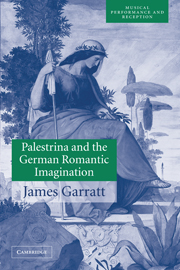
Palestrina and the German Romantic Imagination
Focusing on the reception of Palestrina, this bold interdisciplinary study explains how and why the works of a sixteenth-century composer came to be viewed as a paradigm for modern church music. It explores the diverse ways in which later composers responded to his works and style, and expounds a provocative model for interpreting compositional historicism. In addition to presenting insights into the works of Bruckner, Mendelssohn and Liszt, the book offers fresh perspectives on the institutional, aesthetic and ideological frameworks sustaining the cultivation of choral music in this period. This publication provides an overview and analysis of the relation between the Palestrina revival and nineteenth-century composition and it demonstrates that the Palestrina revival was just as significant for nineteenth-century culture as parallel movements in the other arts, such as the Gothic revival.
eBook