
Catalogue Search | MBRL


Are you sure you want to remove the book from the shelf?

{{itemTitle}}
947
result(s) for
"participatory art"
Sort by:
Pioneering Participatory Art Practices
Participatory art practices allow members of an audience to actively contribute to the creation of art.Annemarie Kok provides a detailed analysis and explanation of the use of participatory strategies in art in the so-called long sixties (starting around 1958 and ending around 1974) in Western Europe.
eBook
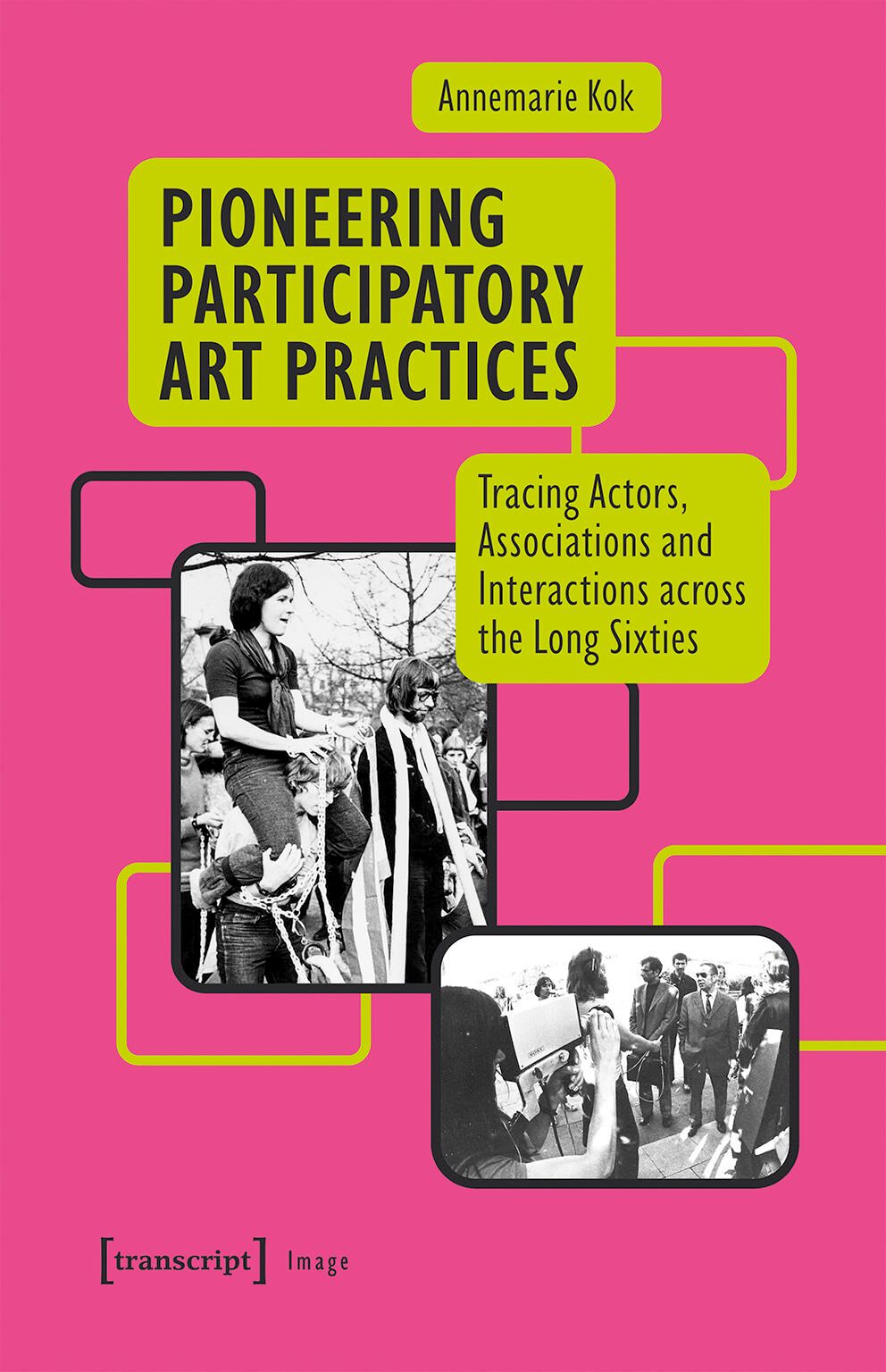
Pioneering Participatory Art Practices
Participatory art practices allow members of an audience to actively contribute to the creation of art. Annemarie Kok provides a detailed analysis and explanation of the use of participatory strategies in art in the so-called ›long sixties‹ (starting around 1958 and ending around 1974) in Western Europe. Drawing on extensive archival materials and with the help of the toolbox of the actor-network theory, she maps out the various actors of three case studies of participatory projects by John Dugger and David Medalla, Piotr Kowalski, and telewissen, all of which were part of documenta 5 (Kassel, 1972).
eBook

This is not ‘interesting’ research: Authentically Co-Creating Participatory Action Research in UK’s Post-Covid Culture Industries
This essay explores methodological, ethical, and practical aspects of authentically co-creating participatory action research (PAR) in post-Covid 19 participatory arts contexts in the UK. It analyses the limits and possibilities of PAR methods into leadership pathways in the UK’s arts and culture sector. In critical dialogue with decolonial and intersectional frameworks that seek to challenge and transform institutionalised privilege in the wake of the Covid pandemic, we investigate the financialisation of participatory strategies of cultural co-creation, with a particular focus on questions of racial and class dynamics in the arts. This essay develops a decolonial political ontology of PAR through a critique of both authenticity and its financialisation in participatory action research projects. Drawing on recent critical analyses of ‘post-extractivism’ and ‘co-creation’ in participatory research, we suggest that the recent financialisation of ‘impactful’ participation is an increasingly important but neglected ‘matter of concern’ for critical PAR methodologies.
Journal Article

The gestures of participatory art
The study critically reclaims participatory art beyond its co-option as a fuzzword of neoliberal governance. It examines a range of artistic practices from community theatre, immersive performance and the visual arts in different sites around the world. It offers a refreshing theorisation of participatory art as gesture.
eBook

Touching the audience: musical haptic wearables for augmented and participatory live music performances
This paper introduces the musical haptic wearables for audiences (MHWAs), a class of wearable devices for musical applications targeting audiences of live music performances. MHWAs are characterized by embedded intelligence, wireless connectivity to local and remote networks, a system to deliver haptic stimuli, and tracking of gestures and/or physiological parameters. They aim to enrich musical experiences by leveraging the sense of touch as well as providing new capabilities for creative participation. The embedded intelligence enables the communication with other external devices, processes input data, and generates music-related haptic stimuli. We validate our vision with two concert-experiments. The first experiment involved a duo of electronic music performers and twenty audience members. Half of the audience used an armband-based prototype of MHWA delivering vibro-tactile feedback in response to performers’ actions on their digital musical instruments, and the other half was used as a control group. In the second experiment, a smart mandolin performer played live for twelve audience members wearing a gilet-based MHWA, which provided vibro-tactile sensations in response to the performed music. Overall, results from both experiments suggest that MHWAs have the potential to enrich the experience of listening to live music in terms of arousal, valence, enjoyment, and engagement. Nevertheless, results showed that the audio-haptic experience was not homogeneous across participants, who could be grouped as those appreciative of the vibrations and those less appreciative of them. The causes for a lack of appreciation of the haptic experience were mainly identified as the sensation of unpleasantness caused by the vibrations in certain parts of the body and the lack of the comprehension of the relation between what was felt and what was heard. Based on the reported results, we offer suggestions for practitioners interested in designing wearables for enriching the musical experience of audiences of live music via the sense of touch. Such suggestions point towards the need of mechanisms of personalization, systems able to minimize the latency between the sound and the vibrations, and a time of adaptation to the vibrations.
Journal Article

Urban villages as living gallery: Shaping place identity with participatory art in Java, Indonesia
Over the past decade, urban villages across Java Indonesia that used to be slums were transformed into colorful villages and have become tourist destinations. Each urban village represents their local identities by creating colorful murals, promoting local food and organized festivals which expressed their unique heritage. The participatory art projects conducted in urban villages were aimed to shape place identity. Artist and residents collaboratively developed place narration and art themes. The participatory art project helps urban village residents to reimagine their place, connect ideas with place' history and culture. This study aims to understand how art and design are incorporated within the creation of place identity through participatory action. This study uses a qualitative approach to examine the mapping and engagement strategy applied in the creation of place identity in urban villages in Java Indonesia. Research data collected through in-depth interviews, semi-structured interviews, field observations, participant observation, photographs and visual archive documentation and supported by literature study. This article highlights several key points taken from case studies in three urban villages in Java. The findings of this study are to introduce a conceptual framework of the participatory art model for place identity formation in urban villages.
Journal Article
Out of time: The experience of contrasting temporal frameworks in participatory art
Participatory art turns the artwork into a process of engagement and co-creation, and it thus involves forms of time-based coordination that influence the experience of creating participatory art. In this paper I argue that participatory art is underscored by two contrasting temporal frameworks. One is the framework of long-term durational approaches that have been internalized among artists as an ethical and political obligation toward participants; the other is the short-term temporary framework that typically comes with project funding and steers the project toward delivery of target outcomes. To show the tensions to which these contrasting temporal frameworks can give rise, I analyze the development of a participatory art project in Copenhagen’s South Harbor. Specifically, the analysis emphasizes how tensions arose in respect to delimitations of project aspects such as who constitutes the creative team, what is the task before us, and what is our expected contribution to the community. By emphasizing the tensions arising from contrasting temporal frameworks, the article contributes to a more nuanced understanding of the experience of creating participatory art, and to problematizing the question of time for participatory art.
Journal Article
Out of Time: The Experience of Contrasting Temporal Frameworks in Participatory Art
Participatory art turns the artwork into a process of engagement and co-creation, and it thus involves forms of time-based coordination that influence the experience of creating participatory art. In this paper I argue that participatory art is underscored by two contrasting temporal frameworks. One is the framework of long-term durational approaches that have been internalized among artists as an ethical and political obligation toward participants; the other is the short-term temporary framework that typically comes with project funding and steers the project toward delivery of target outcomes. To show the tensions to which these contrasting temporal frameworks can give rise, I analyze the development of a participatory art project in Copenhagen’s South Harbor. Specifically, the analysis emphasizes how tensions arose in respect to delimitations of project aspects such as who constitutes the creative team, what is the task before us, and what is our expected contribution to the community. By emphasizing the tensions arising from contrasting temporal frameworks, the article contributes to a more nuanced understanding of the experience of creating participatory art, and to problematizing the question of time for participatory art.
Journal Article

Asians Unmasked
COVID-19 generated a health crisis and major loss of life throughout the world. Asian Americans (AA) have been uniquely impacted during this time by anti-Asian racism, at times blaming AA for the pandemic. A few years after the emergence of COVID-19, studies now show that anti-Asian violence during the pandemic opened historic wounds and exacerbated psychological legacies of trauma uniquely felt by AA.
In response, a national group of interdisciplinary AA women activists developed a community-based photovoice project called Asians* Unmasked. AA in the United States submitted photographs online and shared their experiences and ideas about social change during the early months of the pandemic (March 2020 - June 2020). Participants answered three questions adapted from the photovoice SHOWeD technique about their images as they related to their COVID-19 experiences. Fifty-five ethnically diverse AA (15-78 years old) submitted 82 photos. Using a cross-case qualitative analysis, seven domains were identified: (a) life and community changes, (b) connection and isolation, (c) racism and oppression, (d) health and mental health, (e) service to others, (f) resiliency and hope, and (g) ways to change the world after COVID-19. This article intends to “bring the gallery to the academy,” and share participants’ voices, photographs, and calls for change.
Journal Article
Participation beyond expectation: Contemporary art installation provokes unexpected responses in an English country house
In 2019 artist Layla Khoo created and installed a participatory artwork at Nunnington Hall, a property owned by the National Trust, UK. The artwork, named Change in Attitudes, was a response to the taxidermy collection of hunting trophies displayed on site, all shot and collected by the last owner of the house, Colonel Ronald Fife. The work sought to encourage visitors to consider their thoughts on this difficult part of the collection, both in its historical context and in light of current societal norms, by inviting them to participate with the artwork through choice-making. This case study first analyzes the impact of this work on visitor engagement at the site, both in the participation methods intended by the artist and in the unexpected participation methods employed by the visitors as the installation evolved. The questions raised by this case study are then considered, as well as the research currently under way which seeks to answer them.
Journal Article