
Catalogue Search | MBRL


Are you sure you want to remove the book from the shelf?

{{itemTitle}}
2,633
result(s) for
"payment orders"
Sort by:
EFFECTIVE PROTECTION OF CONSUMERS BY THE UCTD IN ORDER FOR PAYMENT PROCEDURE: THE ESTONIAN EXAMPLE
The order for payment procedure is a simplified procedure used in many member states of the EU. The procedure is highly formal and usually no substantial evidence is assessed in the course of the procedure. This is also the case in Estonia, where this procedure is used very frequently against consumers. The CJEU has, in several cases, assessed the national rules of Member States regarding the order for payment procedure and explained in which cases these rules are not in line with the purpose of the UCTD. In this article, Estonian legislation is used as an example to show that as the EU law does not address the order for payment procedure directly, the protection of consumers’ rights depends on the specificities of national procedural law. Even if the member state’s legislation is in compliance with the positions expressed by the CJEU, the order for payment procedure might not effectively ensure the protection required under the UCTD. This is so because, under the existing CJEU practice, the court does not have to demand submission of evidence, and sellers and suppliers can thus avoid the controls on unfairness in the standard terms quite easily. This paper also analyses whether it would be acceptable to fully delegate the order for payment procedure to computer systems including artificial intelligence, as it has been suggested to do in Estonia.
Journal Article

Athenian Economy and Society
In this ground-breaking analysis of the world's first private banks, Edward Cohen convincingly demonstrates the existence and functioning of a market economy in ancient Athens while revising our understanding of the society itself. Challenging the \"primitivistic\" view, in which bankers are merely pawnbrokers and money-changers, Cohen reveals that fourth-century Athenian bankers pursued sophisticated transactions. These dealings--although technologically far removed from modern procedures--were in financial essence identical with the lending and deposit-taking that separate true \"banks\" from other businesses. He further explores how the Athenian banks facilitated tax and creditor avoidance among the wealthy, and how women and slaves played important roles in these family businesses--thereby gaining legal rights entirely unexpected in a society supposedly dominated by an elite of male citizens.
Special emphasis is placed on the reflection of Athenian cognitive patterns in financial practices. Cohen shows how transactions were affected by the complementary opposites embedded in the very structure of Athenian language and thought. In turn, his analysis offers great insight into daily Athenian reality and cultural organization.
eBook

The Mediating Role of Resistance to Innovative Technology between the Characteristics of Innovative Technology and Sustainable Use of Innovative Payment Service
The purpose of this study is to verify the structural relationship between innovative technology characteristics (recognized usefulness, ease of use, perceived risk), resistance to innovative technologies and acceptance intentions in order for unmanned order payment services to become a sustainable industry. A survey was conducted on experienced users of unmanned order payment services residing in Seoul, and the main analysis results are as follows: first, after verifying the effect of innovative characteristics of unmanned order payment services on resistance to innovative technology, the perceived usefulness and perceived ease of use of unmanned order payment services negatively affect resistance to innovative technology, and perceived risk has a significant positive effect on resistance to innovative technology. Second, after verifying the effect of resistance to innovative technology to unmanned order payment services on acceptance intention, consumers’ resistance to unmanned order payment services negatively affects acceptance intention. Third, verifying the effect of characteristics of innovative technology of unmanned order payment services on acceptance intention, the perceived usefulness of unmanned order payment services directly had a positive effect on acceptance intention, but the perceived ease of use and perceived risk. Fourth, verification of the mediating effect of resistance to innovative technology in the relationship between the characteristics of innovative technology of unmanned order payment services and the acceptance intention proved significant mediating effects of all of perceived usefulness, perceived ease of use, and perceived risk.
Journal Article

Textbook of Aramaic Ostraca from Idumea, Volume 2
Since 1991, some 2,000 Aramaic ostraca deriving from the south of Israel have appeared on the antiquities market and are now scattered in 9 museums and libraries and 21 private collections. Of these, the majority are still not formally published, and in this second volume in the series, Bezalel Porten continues the publication of this important corpus of 4th century B.C.E. economic texts. With the expert epigraphic assistance of Ada Yardeni and hand-copies by her as well, Porten here provides the second volume of texts, organized by “dossier” based on the primary personage cited in the text. Color photographs (where available), ceramic descriptions, hand-copies, transcription, translation, and commentary are provided for each text, along with tables of seven grain dossiers. This publication will become the primary resource for information on these texts, which provide insight into the economic, social, and religious lives of Idumeans in the late Persian and early Hellenistic periods.
eBook
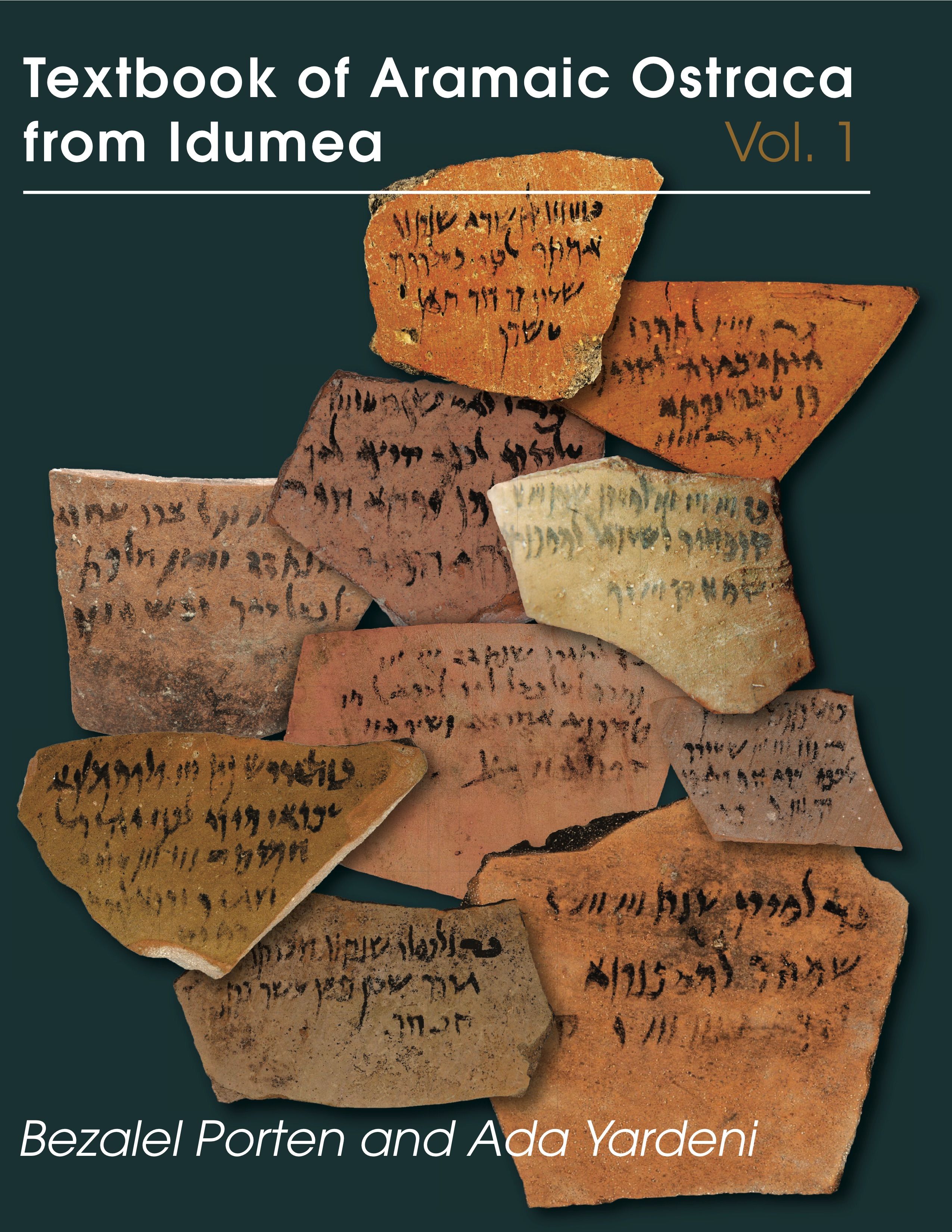
Textbook of Aramaic Ostraca from Idumea, Volume 1
Some 340 Aramaic ostraca of the Persian and Hellenistic periods have been excavated at 32 sites in Israel, from Yokneam in the north to Eilat in the south, with Arad and Beersheba being the main contributory sites. By far, however, the largest cache of texts is what has come to be known as “the Idumean ostraca”. These did not come from formal excavations but began to appear on the antiquities market in 1991. Since then, some 2,000 ostraca have reached 9 museums and libraries and 21 private collections. Of these, the majority are still not formally published, and in this volume (and those to follow), Bezalel Porten undertakes to provide a comprehensive edition of all these texts, in many cases as an editio princeps. Porten, with the expert epigraphic assistance of Ada Yardeni and hand-copies by her as well, here provides the first volume of texts, organized by “dossier” based on the primary personage cited in the text. Color photographs (where available), ceramic descriptions, hand-copies, transcription, translation, and commentary are provided for each text, along with figures and tables, and introductions and summaries of each dossier. An included CD contains a catalogue of all the texts and three color key-word-in-context concordances, for words, personal names, and months for the entire corpus. This publication will become the primary resource for information on these texts.
eBook

Inventory models for non-instantaneous deteriorating items with expiration dates under the joined effect of preservation technology and linearly time-dependent holding cost when order-size linked to advance payment
The aim of this study is to investigate a joint replenishment and preservation technology investment problem for non-instantaneous deteriorating items in which preservation technology investment affects not only the deterioration rate but also the length of the non-deterioration period. Regarding efforts towards delaying the deterioration process, the longer these items are kept in storage, the higher is the holding cost. Therefore, we consider the holding cost as a linearly increasing function of storage period. Along these lines, the retailer needs to balance the cost of investment in the preservation technology to reduce the deterioration rate and the increased total profit due to the decreased deterioration rate. This study discusses the scenario where the supplier offers the retailer the option to prepay a predefined percentage of the purchase cost if their order quantity exceeds or equals the minimum order quantity. Otherwise, the retailer takes a loan from a bank to prepay the entire purchasing cost. The main purpose of this study is to provide the best combined replenishment strategies and preservation technology investment under the abovementioned scenario by ensuring the maximum profit. A solution procedure is developed to determine the optimal solutions, and an algorithm is created by combining all theoretical results derived from the analytical study. Numerical examples are used to verify the theoretical results. Sensitivity analysis revealed some useful managerial insights. Results reveal that the retailer places orders under the conditions of a higher frequency with smaller order quantities to avoid excessive shortage costs when the holding cost is a linearly increasing function of the storage period.
Journal Article

JAVNOBILJEŽNIČKA OVRHA I ZAŠTITA POTROŠAČA: NOVI IZAZOVI EUROPEIZACIJE GRAÐANSKOG POSTUPKA
Ovrha na temelju vjerodostojne isprave pravni je institut koji se u proteklih nekoliko desetljeća transformirao od sasvim marginalnoga opcionalnog instrumenta ovršnog prava do praktičnog standarda u postupcima naplate nespornih novčanih tražbina koji brojčano predvodi u statistikama hrvatskih graðanskih postupaka. Usporedno je taj oblik certifikacije nespornog duga većim dijelom izmješten iz sudova te predan u nadležnost javnih bilježnika. Meðutim, preobrazba toga autohtonog instrumenta postjugoslavenskoga procesnog prava nastavlja se. U ovom radu analiziraju se interni i eksterni pritisci zbog kojih bi se javnobilježnička ovrha mogla, nakon što je doživjela svoj zenit, ponovno preobraziti i bitno ograničiti, a možda i napustiti kao instrument naplate duga u potrošačkim sporovima. Naime, recentna praksa Suda EU-a ne samo što načelno dovodi u pitanje nadležnost javnih bilježnika i njihovo pravo da donose rješenja koja bi bila ovršiva u širemu europskom prostoru, nego u nizu novih odluka upozorava i na to da bi javnobilježnička ovrha mogla u postupku na Sudu EU-a biti proglašena nesukladnom europskim propisima o zaštiti potrošača iz Direktive 93/13 o nepoštenim uvjetima u potrošačkim sporovima. Nakon komparativne analize odluka Suda EU-a i reakcija drugih država članica na slične izazove, autor se u zaključku bavi implikacijama novih izazova na najavljenu reformu ovršnog prava.
Journal Article

Does Payment For Order Flow To Your Broker Help Or Hurt You?
The presumption is that a broker executing a stock trade for a retail investor will get the investor the best possible price execution for the transaction. In fact, the broker often sells the retail investor's trade to an intermediary for cash payment. The broker's motivation to generate dealer profits seems to overcome the broker's fiduciary responsibility to obtain the best execution price for the customer, raising ethical questions. Purchasers and internalizers of order flow in the market may cause prices quoted on the NYSE to deteriorate, making all investors worse off.
Journal Article

Influence of order payment delays on the efficiency of multinomenclature reserve control models
For the multinomenclature EOQ reserve control model with renting storage space and delayed payment for the orders, we propose an approach to optimization that accounts for the temporal value of money. We estimate the influence of these delays both on the parameters of the optimal control strategy and on the efficiency of using floating capital. The study has been done for situations when the said delays let one pay for orders from the revenue on repeat order intervals. We establish a necessary and sufficient condition imposed on the duration of delays that guarantees that this order payment from the revenue is possible. We illustrate characteristic features of optimization procedures with numerical computations.
Journal Article

The Relationship Among Market-Making Revenue, Payment for Order Flow, and Trading Costs for Market Orders
The division of market-making revenue among dealer, broker, and trader is studied. When Knight Securities, a major Nasdaq dealer, interacts with market orders in actively traded stocks during the 4th quarter of 1996, it is estimated that its revenue is$0.057 per order. Knight pays brokers at least $ 0.025 per share (44% of revenue) for orders. To examine whether brokers appear to share these payments with traders, net trading costs (trade price net of commission) for traders using broker routing Knight orders is compared with estimated net trading costs for traders using only the discount broker it can be determined did not directly receive market-making revenue. It is found that the net trading cost of the broker refusing order-flow payments does not dominate the net trading cost of all brokers selling order flow to Knight. This finding suggests that order-flow payments do not unambiguously harm traders and challenges the conclusions of extant studies using only trade prices to assess market quality.
Journal Article