
Catalogue Search | MBRL


Are you sure you want to remove the book from the shelf?

{{itemTitle}}
2,655
result(s) for
"perestroika"
Sort by:


The Soviet Union 1988-1989
This volume of The Soviet Union 1988/89- the tenth in a series appearing since 1973- attempts to describe dramatic developments in domestic policy, problems of economic development, and efforts to change course in foreign policy and alter the image of the USSR in the international system.
eBook

Reclaiming the “Human Factor”
During the Perestroika years, humanistic psychology experienced a remarkable surge in the Soviet Union. This upturn was typically attributed to Western influence. Yet this narrative of passive import overlooks the agency of Soviet psychologists who engaged with American ideas not as disciples, but as active partners responding to and shaping a broader professional and political transformation. This article examines the boom of humanistic psychology in the late 1980s as a dynamic process influenced by the unique context of Gorbachev’s reforms. The study highlights how Soviet professionals used exchanges with American psychologists - especially those from the Association for Humanistic Psychology (AHP) - to craft their own Perestroika. Gorbachev’s rhetoric of revitalizing the “human factor” opened up new possibilities for centering the individual in both therapy and education. Figures such as Carl Rogers, Ruth Sanford, and Virginia Satir catalyzed this shift through live demonstrations and collaborative workshops, but the redefinition of psychological practice was largely driven from within. Drawing on media coverage and professional reflections, the analysis shows how humanistic methods enabled Soviet practitioners to overcome state-imposed constraints. What emerged was not the wholesale adoption of Western models but a “Perestroika from below” among late-Soviet humanistic psychologists: a grassroots reimagining of the discipline that paralleled and occasionally outpaced official reforms. This ‘Perestroika from below’ included creating a new, robust professionalism, forming independent institutions, and reclaiming state-dominated language.
Journal Article

Everyday Ethnicity and Popular Responses to Nation-Building Projects in Moldova After 1989
This introductory article highlights the main developments in the Republic of Moldova from the breakup of the Soviet Union to the present from the perspective of national sentiment and manifestations. Using Mark Beissinger’s concept of “tides of nationalism”, the article examines the bottom-up ethnic mobilisation between the “quiet” and the “noisy” phases of national projects in Moldova. With the persistence of the “quiet” phase of nationalism, in the last three decades, Moldova’s population transitioned from identification based on ethnicity to one focused on civic coexistence. However, Russia’s attack on Ukraine risks disrupting this balance, while contributing to the resurgence of ethnic sentiment at the expense of civic cohesion. Following an analysis of the literature in the field of “everyday nationalism”, the authors present the contributions to this thematic section, highlighting the relevance of the Republic of Moldova’s case within the regional and international context.
Journal Article
Reclaiming the “Human Factor”
During the Perestroika years, humanistic psychology experienced a remarkable surge in the Soviet Union. This upturn was typically attributed to Western influence. Yet this narrative of passive import overlooks the agency of Soviet psychologists who engaged with American ideas not as disciples, but as active partners responding to and shaping a broader professional and political transformation. This article examines the boom of humanistic psychology in the late 1980s as a dynamic process influenced by the unique context of Gorbachev’s reforms. The study highlights how Soviet professionals used exchanges with American psychologists - especially those from the Association for Humanistic Psychology (AHP) - to craft their own Perestroika. Gorbachev’s rhetoric of revitalizing the “human factor” opened up new possibilities for centering the individual in both therapy and education. Figures such as Carl Rogers, Ruth Sanford, and Virginia Satir catalyzed this shift through live demonstrations and collaborative workshops, but the redefinition of psychological practice was largely driven from within. Drawing on media coverage and professional reflections, the analysis shows how humanistic methods enabled Soviet practitioners to overcome state-imposed constraints. What emerged was not the wholesale adoption of Western models but a “Perestroika from below” among late-Soviet humanistic psychologists: a grassroots reimagining of the discipline that paralleled and occasionally outpaced official reforms. This ‘Perestroika from below’ included creating a new, robust professionalism, forming independent institutions, and reclaiming state-dominated language.
Journal Article

Perestroika și noua poetică basarabeană: Eugen Cioclea și Grigore Chiper
The poetic model Păunescu - Vieru hasn't diminished its value in the Bessarabian literary space and most probably the lyrism with ethnical and ethical elements will be regarded as a source of inspiration for the new generation of poets. The study problematizes a unifying perspective by simplifying, reducing the field of poetical experiences to a patriotic dominant feature. Considering the perspective from a distance, outside the Bessarabian literary space, as well as from the inside, we notice the way that a poet chooses one or several models no matter the space and its matrix, his mother tongue and the time frame he lives in. Considering and studying such authors as Eugen Cioclea and Grigore Chiper in the cultural-historic context of the Perestroika time and the following period, two personal and original lyrical voices are revealed, outside the poetic model of the Bessarabian patriotic commitment, obviously synchronizing with the poetic reality on the other side of the Prut River.
Journal Article

Andrejs Dripe’s Journalism about the Federal Republic of Germany and Its Impact on Societal Change in the 1980s
This article examines travels outside the Soviet Union by Latvian writers who were recognized by the occupation regime and acclaimed by the public during the Brezhnev Era, as one of the privileges enjoyed by the so-called creative intelligentsia, and how those travels were reflected in their literary and journalistic writings. Journeys abroad elicited conflicting emotions, and writers had to be relatively affluent to travel. Still, they often experienced humiliation when confronted with the reality of their meager financial means outside the U.S.S.R. and the fact that they remained in imprisonment even in the free West. The surge in popularity of literary periodicals in the 1980s played a crucial role in shaping a new culture of the press and journalism, as they provided large masses of readers with essential information about living abroad. Notes on the travels include observations on the socio-economic situation, environment, and political events and documents that have facilitated trips to the West. The case study explores the travelogue by Andrejs Dripe from the 1980s. Dripe’s journalism records the rapid transition from the Brezhnev Era to Gorbachev’s perestroika. It becomes the first official source of information about the West only a few people among his readers have visited.
Journal Article
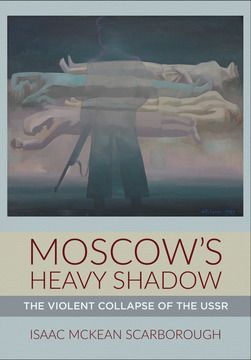
Moscow's Heavy Shadow
Moscow's Heavy Shadow tells
the story of the collapse of the USSR from the perspective of the
many millions of Soviet citizens who experienced it as a period of
abjection and violence. Mikhail Gorbachev and the leaders
of the USSR saw the years of reform preceding the collapse as
opportunities for rebuilding ( perestroika ), rejuvenation,
and openness ( glasnost ). For those in provincial cities
across the Soviet Union, however, these reforms led to rapid
change, economic collapse, and violence.
Focusing on Dushanbe, Tajikistan, Isaac McKean Scarborough
describes how this city experienced skyrocketing unemployment, a
depleted budget, and streets filled with angry young men unable to
support their families. Tajikistan was left without financial or
military resources, unable and unprepared to stand against the wave
of populist politicians of all stripes who took advantage of the
economic collapse and social discontent to try to gain power. By
May 1992, political conflict became violent and bloody and engulfed
the whole of Tajikistan in war. Moscow's Heavy Shadow
tells the story of how this war came to be, and how it was grounded
in the reform and collapse of the Soviet economy that came
before.
eBook