
Catalogue Search | MBRL


Are you sure you want to remove the book from the shelf?

{{itemTitle}}
2,204
result(s) for
"photovoltaic modules"
Sort by:

Maximizing Energy Generation in Agrivoltaic Systems: A Study of Bifacial and Monofacial Modules With Consideration of Module Height and Albedo Impact
This study evaluates the performance of bifacial and monofacial photovoltaic (PV) modules in agrivoltaic systems (AV) using PVsyst simulations, addressing the challenge of balancing agricultural productivity with PV yield. Its novelty lies in integrating field‐measured, monthly albedo data from a wheat field into system modelling and analyzing the specific influence of module height on bifacial performance. The methodology includes albedo measurements, AV design, and comparative simulations of monofacial and bifacial modules at 4 m (AV1) and 5 m (AV2) installation heights. Results indicate that bifacial modules produce 19.46% more energy than monofacial modules, and the height difference between AV1 and AV2 yields only a marginal annual gain of 380 kWh. Aligning module azimuth to the field orientation (−44°) minimizes agricultural disruption but causes a 5.3% loss in global radiation, illustrating operational trade‐offs. A layout of five module rows spaced 10 m apart prevents shading overlap, yielding a low shading factor (0.016). Overall, the simulations demonstrate that realistic albedo integration can enhance bifacial output by up to 19.48%, while also revealing the occasional incompatibility between maximizing PV generation and maintaining agricultural functionality in AVs. This study evaluates the performance of bifacial and monofacial PV modules in agrivoltaic systems using PVsyst simulations. Real albedo measurements from a wheat field were incorporated to ensure realistic results. Bifacial modules demonstrated a 19.46% increase in energy yield compared to monofacial ones. The effect of module height was found to be marginal, with only a 380 kWh difference between systems at 4 and 5 m heights. Aligning module azimuth with the field (−44°) reduced global radiation by 5.3%, showing the trade‐off between agricultural and photovoltaic requirements. Module spacing preserved crop productivity with minimal shading (factor = 0.016). Overall, the findings highlight the strong impact of albedo on energy production and underline the potential of agrivoltaics to address global food‐energy challenges.
Journal Article

Power Generation Prediction of Building-Integrated Photovoltaic System with Colored Modules Using Machine Learning
The building-integrated photovoltaic (BIPV) system is provoking mention as a technology for generating the energy consumed in cities with renewable sources. As the number of BIPV systems increases, performance diagnosis through power-generation predictions becomes more essential. In the case of a colored BIPV module that has been installed on a wall, it is more difficult to predict the amount of power generation because the shading loss varies based on the entrance altitude of the irradiance. Recently, artificial intelligence technology that is able to predict power by learning the output data of the system has begun being used. In this paper, the power values of colored BIPV systems that have been installed on walls are predicted, and the system output values are compared. The current-voltage (I–V) curve data are measured to predict the power required changing the intensity of the irradiance, and the linear regression model is derived for the changes in the voltage and current at a maximum power operating point and during irradiance changes. To improve the power prediction accuracy by considering the shading loss of colored BIPVs, a new model is proposed via neural network machine learning (ML). In addition, the accuracy of the proposed prediction models is evaluated by comparing the metrics such as RMSE, MAE, and R2. As a result of testing the linear regression model and the proposed ML model, the R2 values for the voltage and current values of the proposed ML model were 5% higher for voltage and 2% higher for current. From this result, the proposed ML model of the RMSE about real power improved by more than 50% (0.0754 kW) compared to the simulation model (0.1581 KW). The proposed model demonstrates high-accuracy power estimations and is expected to help diagnose the performance of BIPV systems with colored modules.
Journal Article

Renovation of Grid-Tied Solar Photovoltaic Plants: Problems and Prospects
—
Rapid development of energy technologies results, in particular, in that photovoltaic modules often become obsolete even before the end of their assigned service life. It is sufficient to say that, for the period from 2014 to nowadays, the average efficiency of photovoltaic modules has increased from 14–15 to 21%. The prices for photovoltaic products also continue to decrease. In this connection, the possibility of substituting the equipment of existing solar power plants with more advanced components is of interest. Photovoltaic module replacement versions, as well as technical and economic aspects of this process, are discussed taking Russia’s first grid-tied photovoltaic plant Kosh-Agach-1 as an example. The modern types of photovoltaic modules and the options of using them for solar plant renovation purposes are analyzed. The prime cost of the electricity generated is estimated with taking into account the replacements of modules and inverters. Special attention is paid to the compatibility of new modules with the old support structures and inverter equipment. The decrease of electricity prime cost after installing the new modules serves as the main renovation feasibility criterion. It is shown that the refurbishment of plants equipped with thin-film silicon modules by replacing them with domestically produced or Chinese modules consisting of silicon photovoltaic plates 166 × 166 mm in size looks to be the most promising option. The minimal prime cost of generated electricity is achieved in the case of using heterojunction modules and modules on the basis of photovoltaic converters with a rear contact.
Journal Article

Performance Evaluation of Various Photovoltaic Module Technologies at Nawabshah Pakistan
The purpose of this study was to evaluate the influence of module temperature on the efficiency of polycrystalline (p-Si), monocrystalline (m-Si), amorphous (a-Si) and thin film photovoltaic modules at outdoor environment of Nawabshah city Pakistan. The experimental setup was made and installed over the top roof of departmental building. Weather conditions, such as global solar radiation, ambient temperature, wind speed and relative humidity, power output and temperature of all selected four types of module technologies were measured at the site by logging data. Then, the logged data was normalized because of different rated power of photovoltaic modules for comparison purpose. Results revealed that less temperature impact was noted from thin film module and thus it gave more normalized power with 45.6% among other examined modules. On the basis of overall efficiency, p-Si, m-Si, a-Si and thin film modules gave 92.4%, 93.7%, 94.4% and 95.4% yearly average normalized efficiencies respectively. It was found that temperature has more impact on the efficiency of other examined modules compared to thin film modules. Thus, it is concluded from the study that thin film module is better in outdoor environment of Nawabshah
Journal Article

Tools for Researching the Parameters of Photovoltaic Modules
This paper addresses critical challenges in renewable energy research, particularly under the difficult operational conditions caused by the military conflict in Ukraine. Despite significant infrastructure loss due to the armed conflict (13% of solar and 70% of wind power), Ukraine maintains a commitment to reach 27% renewable energy in final consumption by 2030. However, the wartime conditions present unique challenges to scientific research, with laboratories vulnerable to missile strikes and frequently requiring evacuation. This paper introduces innovative portable laboratory stands designed for comprehensive analysis and monitoring of photovoltaic (PV) module parameters. These portable platforms, integrating advanced microcontrollers, sensors, and data-processing units, enable effective real-time monitoring and parameter estimation of PV modules, thereby enhancing their operational efficiency and reliability. Two distinct portable laboratory setups were developed and are detailed: the first focuses on real-time voltage and current measurements, while the second, termed the photovoltaic module parameter scanner (SPFEM), emphasizes data collection, remote data transmission, and database integration for subsequent analysis. This research provides essential tools for ensuring continuity in scientific activities and practical training for students and researchers amidst the ongoing security threats. The presented systems significantly contribute to optimizing the performance of PV systems in Ukraine and underscore the necessity for continuous adaptation and technological advancement in renewable energy infrastructure.
Journal Article

Maximizing aged photovoltaic array power: a computer modelling study
Photovoltaic (PV) modules age with time for various reasons such as corroded joints and terminals and glass coating defects, and their ageing degrades the PV array power. With the help of the PV array numerical model, this paper explores the effects of PV module ageing on the PV array power, and the power gains and costs of rearranging and recabling aged PV modules in a PV array. The numerical PV array model is first revised to account for module ageing, rearrangement and recabling, with the relevant equations presented herein. The updated numerical model is then used to obtain the array powers for seven different PV arrays. The power results are then analysed in view of the attributes of the seven PV array examples. A guiding method to recommend recabling after rearranging aged modules is then proposed, leading to further significant power gains, while eliminating intra-row mismatches. When certain conditions are met, it was shown that recabling PV modules after rearranging them may lead to further significant power gains, reaching 57% and 98% in two considered PV array examples. Higher gains are possible in other arrays. A cost–benefit analysis weighing annual power gains versus estimated recabling costs is also given for the seven considered PV array examples to guide recabling decisions based on technical and economic merits. In the considered examples, recabling costs can be recovered in <4 years. Compared with the powers of the aged arrays, power gains due to our proposed rearranging and recabling the PV arrays ranged between 73% and 131% in the considered examples—well over the gains reported in the literature. Moreover, the cost of our static module rearrangement and recabling method outshines the costs of dynamic reconfiguration methods recently published in the literature.
Journal Article
Research of the Energy Losses of Photovoltaic (PV) Modules after Hail Simulation Using a Newly-Created Testbed
The impact of hail ice cubes on composite structures (such as solar cells) causes actual defects. This article presents a series of tests, in which solar cell modules were exposed to hail simulation testbed balls, allowing to assess the following: the impact energy, which causes the major defects in solar cells; the formed micro-cracks in the structure of solar cells, resulting in the loss of power generated by a solar cell; and the solar cell parameters necessary for modelling. In addition, this article presents a digital analysis of hail simulation. Information received from the digital analysis was used to optimize the structure of solar cells in order to improve its resistance properties. The aim of this study was to present a simple method for experimental hail simulation. The proposed hail impact estimation method can be successfully applied to study the influence of the mechanical–dynamic impact of photovoltaic (PV) modules of different structures on the technical characteristics of these modules (structural stability, power generation, etc.). The study showed that PV modules are subjected to an irreversible effect of the excitation force (i.e., micro-cracking) and it can reduce the generated power by 2.33% to 4.83%.
Journal Article
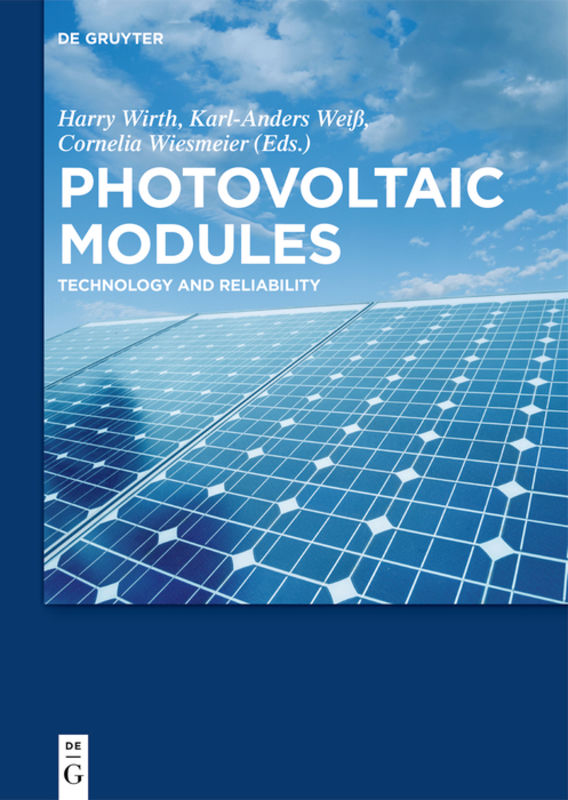
Photovoltaic Modules
Photovoltaic Modules: Technology and Reliability provides unique insights into concepts, material design strategies, manufacturing techniques, quality and service life analysis of wafer-based photovoltaic modules. Taking an interdisciplinary approach, the authors focus on two main topics. Part I – Crystalline Silicone Module Technology offers photovoltaics fundamentals: solar cell properties, module design, materials and production, basic module characterization, module power as well as efficiency and module performance. Part II, on the other hand, illustrates the state-of-the-art of module reliability by characterization of modules and degradation effects, examination of PV-Module loads, accelerated aging tests as well as reliability testing of materials and modules. A separate chapter is dedicated to PV module and component certification.
eBook

Gorilla Troops Optimizer for Electrically Based Single and Double-Diode Models of Solar Photovoltaic Systems
The extraction of parameters of solar photovoltaic generating systems is a difficult problem because of the complex nonlinear variables of current-voltage and power-voltage. In this article, a new implementation of the Gorilla Troops Optimization (GTO) technique for parameter extraction of several PV models is created. GTO is inspired by gorilla group activities in which numerous strategies are imitated, including migration to an unknown area, moving to other gorillas, migration in the direction of a defined site, following the silverback, and competition for adult females. With numerical analyses of the Kyocera KC200GT PV and STM6-40/36 PV modules for the Single Diode (SD) and Double-Diode (DD), the validity of GTO is illustrated. Furthermore, the developed GTO is compared with the outcomes of recent algorithms in 2020, which are Forensic-Based Investigation Optimizer, Equilibrium Optimizer, Jellyfish Search Optimizer, HEAP Optimizer, Marine Predator Algorithm, and an upgraded MPA. GTO’s efficacy and superiority are expressed by calculating the standard deviations of the fitness values, which indicates that the SD and DD models are smaller than 1E−16, and 1E−6, respectively. In addition, validation of GTO for the KC200GT module is demonstrated with diverse irradiations and temperatures where great closeness between the emulated and experimental P-V and I-V curves is achieved under various operating conditions (temperatures and irradiations).
Journal Article

PV Module Technology and Reliability – Status and Perspectives
Solar cell processing into modules is mostly responsible for the product's reliability, has a severe impact on product costs and controls 10–15% of its efficiency. This article gives an overview on current module technology and highlights innovative approaches to reduce material cost and increase module efficiency. High potential approaches like back contact technology are those that simultaneously address cell and module technology to offer efficiency gains in the range of 10%. Module reliability expectations of 25 years or more require quality assurance beyond the common type approval standards. In its second part, the article addresses stress factors for PV modules. To ensure fast innovation cycles, accelerated aging tests are used to reproduce these stress factors in the laboratory. Results from certification testing are discussed as well as new approaches for improved testing. More realistic test results can be obtained by simulating combinations of stress factors.
Journal Article