
Catalogue Search | MBRL


Are you sure you want to remove the book from the shelf?

{{itemTitle}}
72,544
result(s) for
"political resources"
Sort by:

The race for what's left : the global scramble for the world's last resources
Journalist Klare describes the impact the coming shortage of natural resources will have on the future of the human race.
Book

State Erosion
State failure is a central challenge to international peace and security in the post-Cold War era. Yet theorizing on the causes of state failure remains surprisingly limited. InState Erosion, Lawrence P. Markowitz draws on his extensive fieldwork in two Central Asian republics-Tajikistan, where state institutions fragmented into a five-year civil war from 1992 through 1997, and Uzbekistan, which constructed one of the largest state security apparatuses in post-Soviet Eurasia-to advance a theory of state failure focused on unlootable resources, rent seeking, and unruly elites.
In Tajikistan, Uzbekistan, and other countries with low capital mobility-where resources cannot be extracted, concealed, or transported to market without state intervention-local elites may control resources, but they depend on patrons to convert their resources into rents. Markowitz argues that different rent-seeking opportunities either promote the cooptation of local elites to the regime or incite competition over rents, which in turn lead to either cohesion or fragmentation. Markowitz distinguishes between weak states and failed states, challenges the assumption that state failure in a country begins at the center and radiates outward, and expands the \"resource curse\" argument to include cash crop economies, where mechanisms of state failure differ from those involved in fossil fuels and minerals. Broadening his argument to weak states in the Middle East (Syria and Lebanon) and Africa (Zimbabwe and Somalia), Markowitz shows how the distinct patterns of state failure in weak states with immobile capital can inform our understanding of regime change, ethnic violence, and security sector reform.
eBook

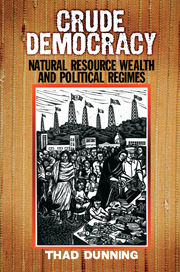
Crude Democracy
This book challenges the conventional wisdom that natural resource wealth promotes autocracy. Oil and other forms of mineral wealth can promote both authoritarianism and democracy, the book argues, but they do so through different mechanisms; an understanding of these different mechanisms can help elucidate when either the authoritarian or democratic effects of resource wealth will be relatively strong. Exploiting game-theoretic tools and statistical modeling as well as detailed country case studies and drawing on fieldwork in Latin America and Africa, this book builds and tests a theory that explains political variation across resource-rich states. It will be read by scholars studying the political effects of natural resource wealth in many regions, as well as by those interested in the emergence and persistence of democratic regimes.
eBook


Resource Extraction and Protest in Peru
Natural resource extraction has fueled protest movements in Latin America and existing research has drawn considerable scholarly attention to the politics of antimarket contention at the national level, particularly in Ecuador, Bolivia, and Argentina. Despite its residents reporting the third-highest level of protest participation in the region, Peru has been largely ignored in these discussions.In this groundbreaking study, Moisés Arce exposes a longstanding climate of popular contention in Peru. Looking beneath the surface to the subnational, regional, and local level as inception points, he rigorously dissects the political conditions that set the stage for protest. Focusing on natural resource extraction and its key role in the political economy of Peru and other developing countries, Arce reveals a wide disparity in the incidence, forms, and consequences of collective action.Through empirical analysis of protest events over thirty-one years, extensive personal interviews with policymakers and societal actors, and individual case studies of major protest episodes, Arce follows the ebb and flow of Peruvian protests over time and space to show the territorial unevenness of democracy, resource extraction, and antimarket contentions. Employing political process theory, Arce builds an interactive framework that views the moderating role of democracy, the quality of institutional representation as embodied in political parties, and most critically, the level of political party competition as determinants in the variation of protest and subsequent government response. Overall, he finds that both the fluidity and fragmentation of political parties at the subnational level impair the mechanisms of accountability and responsiveness often attributed to party competition. Thus, as political fragmentation increases, political opportunities expand, and contention rises. These dynamics in turn shape the long-term development of the state.Resource Extraction and Protest in Peruwill inform students and scholars of globalization, market transitions, political science, contentious politics and Latin America generally, as a comparative analysis relating natural resource extraction to democratic processes both regionally and internationally.
eBook


Carbon capitalism
Modern civilization and the social reproduction of capitalism are bound inextricably with fossil fuel consumption. But as carbon energy resources become scarcer, what implications will this have for energy-intensive modes of life? Can renewable energy sustain high levels of accumulation?? Or will we witness the end of existing capitalist economies? This book provides an innovative and timely study that mobilizes a new theory of capitalism to explain the rise and fall of petro-market civilization. Di Muzio investigates how theorists of political economy have largely taken energy for granted and illuminates how the exploitation of fossil fuels increased the universalization and magnitude of capital accumulation. He then examines the likelihood of renewable resources providing a feasible alternative and asks whether they can beat peak oil prices to sustain food production, health care, science and democracy. Using the capital as power framework, this book considers the unevenly experienced consequences of monetizing fossil fuels for people and the planet.
eBook