
Catalogue Search | MBRL


Are you sure you want to remove the book from the shelf?

{{itemTitle}}
978
result(s) for
"political uprisings"
Sort by:


The Effect of Political Uprisings on the Location of Price Discovery: Evidence from Egyptian Cross-Listed Equities
In this study, we aim to determine the location of price discovery for Egyptian cross-listed stocks around the political uprising that started on January 25, 2011, and resulted in a two-month stock market closure. We measure price discovery using Gonzalo and Granger's component share and Hasbrouck's information shares and find that, for some stocks, the contribution of the foreign market in pricing cross-listed equities increases in the period directly following the reopening of the Egyptian stock market. We discuss the factors that could explain the more pronounced shifts in the location of price discovery for some companies in the post-uprising period.
Journal Article

The Fear Within
Sixty years ago political divisions in the United States ran even deeper than today's name-calling showdowns between the left and right. Back then, to call someone a communist was to threaten that person's career, family, freedom, and, sometimes, life itself. Hysteria about the \"red menace\" mushroomed as the Soviet Union tightened its grip on Eastern Europe, Mao Zedong rose to power in China, and the atomic arms race accelerated. Spy scandals fanned the flames, and headlines warned of sleeper cells in the nation's midst--just as it does today with the \"War on Terror.\"
In his new book,The Fear Within, Scott Martelle takes dramatic aim at one pivotal moment of that era. On the afternoon of July 20, 1948, FBI agents began rounding up twelve men in New York City, Chicago, and Detroit whom the U.S. government believed posed a grave threat to the nation--the leadership of the Communist Party-USA. After a series of delays, eleven of the twelve \"top Reds\" went on trial in Manhattan's Foley Square in January 1949.
The proceedings captivated the nation, but the trial quickly dissolved into farce. The eleven defendants were charged under the 1940 Smith Act with conspiring to teach the necessity of overthrowing the U.S. government based on their roles as party leaders and their distribution of books and pamphlets. In essence, they were on trial for their libraries and political beliefs, not for overt acts threatening national security. Despite the clear conflict with the First Amendment, the men were convicted and their appeals denied by the U.S. Supreme Court in a decision that gave the green light to federal persecution of Communist Party leaders--a decision the court effectively reversed six years later. But by then, the damage was done. So rancorous was the trial the presiding judge sentenced the defense attorneys to prison terms, too, chilling future defendants' access to qualified counsel.
Martelle's story is a compelling look at how American society, both general and political, reacts to stress and, incongruously, clamps down in times of crisis on the very beliefs it holds dear: the freedoms of speech and political belief. At different points in our history, the executive branch, Congress, and the courts have subtly or more drastically eroded a pillar of American society for the politics of the moment. It is not surprising, then, thatThe Fear Withintakes on added resonance in today's environment of suspicion and the decline of civil rights under the U.S. Patriot Act.
eBook

Insurgent Nationalism: Political Imagination and Rupture in Côte d'Ivoire
Non-separatist insurgents unable to overthrow a sitting government often face a problem successful rebellions can avoid: They are not the only players who can claim to be acting on behalf of the nation. They will have to imagine the nation in a new way that distinguishes them from the older, established nationalism usually promoted by the existing government. This new nationalism aims to legitimise their actions, but first and foremost it has to be attractive to the population in the region under insurgent control and later to others as well. Each camp, the government and the insurgent side, articulates its understanding of the nation to the other side. In the process, both sides often also adopt different forms of imagination to render the specifics of their nationalism more visible to their followers as well as to partisans in the other camp. This article analyses this political articulation by taking Côte d'Ivoire as an example. Nichtseparatistische Aufständische, die nicht in der Lage sind, eine Regierung zu stürzen, stehen oft vor einem Problem, das sich nach erfolgreichen Rebellionen gar nicht stellt: Sie sind nicht die einzige politische Kraft, die behaupten kann, im Interesse der Nation zu handeln. Ihnen stellt sich daher die Aufgabe, eine neue Idee der Nation zu entwickeln, mit der sie sich vom bisherigen, älteren Nationalismus, wie er von der Regierung vertreten wird, unterscheiden. Dieser neue Nationalismus zielt darauf ab, die Aktionen der Rebellen zu rechtfertigen; zunächst und vor allem muss er aber attraktiv sein für die Bevölkerung der Region, die von ihnen kontrolliert wird, und später für weitere Teile der Bevölkerung. Regierung und Aufständische konfrontieren das jeweils andere Lager mit dem eigenen Verständnis der Nation. In diesem Prozess benutzen beide Seiten verschiedene Vorstellungen und Bilder, um das Spezifische ihres Nationalismus für ihre Anhänger, aber auch für Parteigänger im anderen Lager klarer herauszuarbeiten. Die Ereignisse in Côte d'Ivoire dienen dem Autor als Beispiel, um diese Form politischer Auseinandersetzung zu analysieren.
Journal Article

When Food Became Scarce
When Food Became Scarce is about the Great Leap Famine of 1958-61. Yixin Chen adopts a grassroots level analysis to explore an existential question concerning hundreds of millions of Chinese peasants: why did some peasants perish while others from the same villages facing the same collective problems of food scarcity survive?
Viewing the famine as a persistent ordeal, Chen identifies environment and lineage as two pivotal factors that influenced the rural populace's destiny. When food quotas under the Maoist communal dining system plummeted below subsistence or came to a halt, most individual villagers in the mountainous regions of southern China turned to their environment for alternative sustenance, ensuring their survival. More remarkably, across the nation, more peasants united in self-preservation strategies, concealing grains to elude excessive state requisitions, orchestrating food and crop riots, and collectively combating desperation. Given that the majority of Chinese villages were historically established on the foundation of consanguine relationships, creating an obligation among villagers to support one another due to shared ancestry, lineage emerged as a microlevel social mechanism that activated diverse forms of collective resistance. In villages where peasants effectively upheld their lineage organizations and adopted self-protective measures, their survival rates exceeded those of villages where the enforcement of Maoist Great Leap initiatives disrupted the lineage structure, leaving the communities more vulnerable. When Food Became Scare reorients the famine narrative, unpacking its intricacies from the perspective of the survival side.
eBook

Friendship and Politics in Post-Revolutionary France
In Friendship and Politics in Post-Revolutionary France, Sarah Horowitz brings together the political and cultural history of post-revolutionary France to illuminate how French society responded to and recovered from the upheaval of the French Revolution. The Revolution led to a heightened sense of distrust and divided the nation along ideological lines. In the wake of the Terror, many began to express concerns about the atomization of French society. Friendship, though, was regarded as one bond that could restore trust and cohesion. Friends relied on each other to serve as confidantes and men and women described friendship as a site of both pleasure and connection. Because trust and cohesion were necessary to the functioning of post-revolutionary parliamentary life, politicians turned to friends and ideas about friendship to create this solidarity. Relying on detailed analyses of politicians’ social networks, new tools from arising from the digital humanities, and examinations of their behind-the-scenes political transactions, Horowitz makes clear the connection between politics and emotions in the early nineteenth century, and she reevaluates the role of women in political life by showing the ways in which the personal was the political in the post-revolutionary era.
eBook
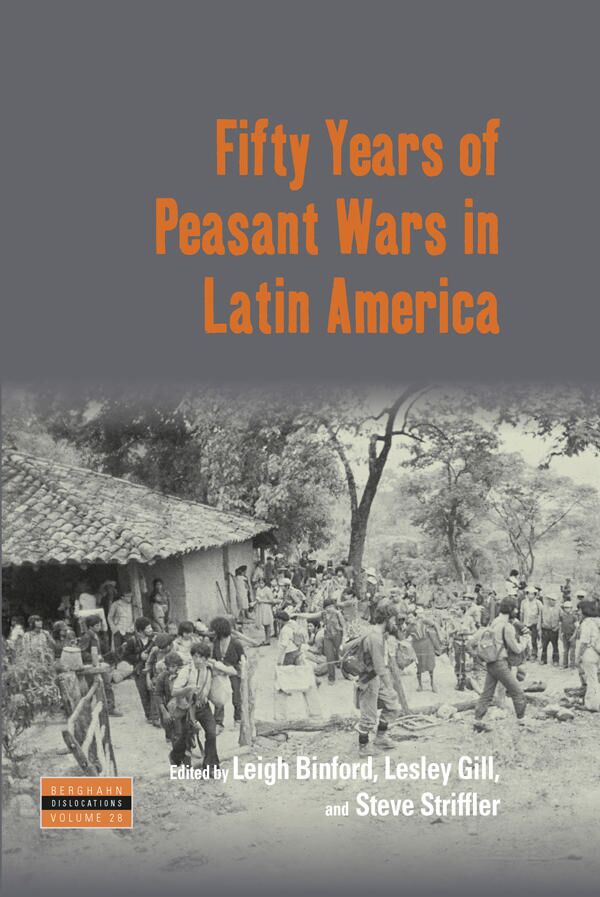
Fifty Years of Peasant Wars in Latin America
Informed by Eric Wolf's Peasant Wars of the Twentieth
Century , published in 1969, this book examines selected
peasant struggles in seven Latin American countries during the last
fifty years and suggests the continuing relevance of Wolf's
approach. The seven case studies are preceded by an Introduction in
which the editors assess the continuing relevance of Wolf's
political economy. The book concludes with Gavin Smith's reflection
on reading Eric Wolf as a public intellectual today.
eBook

The everlasting empire
Established in 221 BCE, the Chinese empire lasted for 2,132 years before being replaced by the Republic of China in 1912. During its two millennia, the empire endured internal wars, foreign incursions, alien occupations, and devastating rebellions--yet fundamental institutional, sociopolitical, and cultural features of the empire remained intact.The Everlasting Empiretraces the roots of the Chinese empire's exceptional longevity and unparalleled political durability, and shows how lessons from the imperial past are relevant for China today.
Yuri Pines demonstrates that the empire survived and adjusted to a variety of domestic and external challenges through a peculiar combination of rigid ideological premises and their flexible implementation. The empire's major political actors and neighbors shared its fundamental ideological principles, such as unity under a single monarch--hence, even the empire's strongest domestic and foreign foes adopted the system of imperial rule. Yet details of this rule were constantly negotiated and adjusted. Pines shows how deep tensions between political actors including the emperor, the literati, local elites, and rebellious commoners actually enabled the empire's basic institutional framework to remain critically vital and adaptable to ever-changing sociopolitical circumstances. As contemporary China moves toward a new period of prosperity and power in the twenty-first century, Pines argues that the legacy of the empire may become an increasingly important force in shaping the nation's future trajectory.
eBook

Nationalism and Revolution in Europe, 1763-1848
Addresses enduring historiographical problems concerning the appearance of the first national movements in Europe and their role in the crises associated with the Age of Revolution.
eBook

The Journey of a Tzotzil-Maya Woman of Chiapas, Mexico
No detailed description available for \"The Journey of a Tzotzil-Maya Woman of Chiapas, Mexico\".
eBook