
Catalogue Search | MBRL


Are you sure you want to remove the book from the shelf?

{{itemTitle}}
1,699,454
result(s) for
"population"
Sort by:


Population aging : is Latin America ready?
The past half-century has seen enormous changes in the demographic makeup of Latin America and the Caribbean (LAC). In the 1950s, LAC had a small population of about 160 million people, less than today's population of Brazil. Two-thirds of Latin Americans lived in rural areas. Families were large and women had one of the highest fertility rates in the world, low levels of education, and few opportunities for work outside the household. Investments in health and education reached only a small fraction of the children, many of whom died before reaching age five. Since then, the size of the LAC population has tripled and the mostly rural population has been transformed into a largely urban population. There have been steep reductions in child mortality, and investments in health and education have increased, today reaching a majority of children. Fertility has been more than halved and the opportunities for women in education and for work outside the household have improved significantly. Life expectancy has grown by 22 years. Less obvious to the casual observer, but of significance for policy makers, a population with a large fraction of dependent children has evolved into a population with fewer dependents and a very large proportion of working-age adults. This overview seeks to introduce the reader to three groups of issues related to population aging in LAC. First is a group of issues related to the support of the aging and poverty in the life cycle. Second is the question of the health transition. Third is an understanding of the fiscal pressures that are likely to accompany population aging and to disentangle the role of demography from the role of policy in that process.
eBook
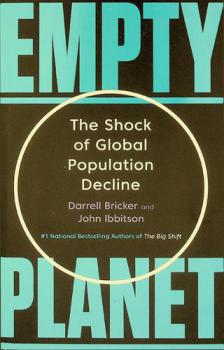
Empty planet : the shock of global population decline
\"For half a century, statisticians, pundits, and politicians have warned that a burgeoning planetary population will soon overwhelm the earth's resources. But a growing number of experts are sounding a different kind of alarm. Rather than growing exponentially, they argue, the global population is headed for a steep decline - and in many countries that decline has already begun. In Empty Planet, Ibbitson and Bricker find that a smaller global population will bring with it a number of benefits: fewer workers will command higher wages; the environment will improve; the risk of famine will wane; and falling birthrates in the developing world will bring greater affluence and autonomy for women. But enormous disruption lies ahead, too. We can already see the effects in Europe and parts of Asia, as aging populations and worker shortages weaken the economy and impose crippling demands on healthcare and social security. Canada and the United States are well-positioned to successfully navigate these coming demographic shifts--that is, unless growing isolationism and anti-immigrant backlash lead us to close ourselves off just as openness becomes more critical to our survival than ever before. Rigorously researched and deeply compelling, Empty Planet offers a vision of a future that we can no longer prevent--but one that we can shape, if we choose\"--Jacket.
Book

Ecological orbits : how planets move and populations grow
The main focus of the book is the presentation of the inertial view of population growth. This view provides a rather simple model for complex population dynamics, and is achieved at the level of the single species without invoking species interactions. An important part of the account is the maternal effect. Investment of mothers in the quality of their daughters makes the rate of reproduction of the current generation depend not only on the current environment, but also on the environment experienced by the previous generation.
eBook


Individual-based Modeling and Ecology
Individual-based models are an exciting and widely used new tool for ecology. These computational models allow scientists to explore the mechanisms through which population and ecosystem ecology arises from how individuals interact with each other and their environment. This book provides the first in-depth treatment of individual-based modeling and its use to develop theoretical understanding of how ecological systems work, an approach the authors call \"individual-based ecology.? Grimm and Railsback start with a general primer on modeling: how to design models that are as simple as possible while still allowing specific problems to be solved, and how to move efficiently through a cycle of pattern-oriented model design, implementation, and analysis. Next, they address the problems of theory and conceptual framework for individual-based ecology: What is \"theory\"? That is, how do we develop reusable models of how system dynamics arise from characteristics of individuals? What conceptual framework do we use when the classical differential equation framework no longer applies? An extensive review illustrates the ecological problems that have been addressed with individual-based models. The authors then identify how the mechanics of building and using individual-based models differ from those of traditional science, and provide guidance on formulating, programming, and analyzing models. This book will be helpful to ecologists interested in modeling, and to other scientists interested in agent-based modeling.
eBook


Social Bodies
Using as his example post-World War I Italy and the government's interest in the size, growth rate, and \"vitality\" of its national population, David Horn suggests a genealogy for our present understanding of procreation as a site for technological intervention and political contestation.Social Bodieslooks at how population and reproductive bodies came to be the objects of new sciences, technologies, and government policies during this period. It examines the linked scientific constructions of Italian society as a body threatened by the \"disease\" of infertility, and of women and men associalbodies--located neither in nature nor in the private sphere, but in that modern domain of knowledge and intervention carved out by statistics, sociology, social hygiene, and social work.
Situated at the intersection of anthropology, cultural studies, and feminist studies of science, the book explores the interrelated factors that produced the practices of reason we call social science and social planning. David Horn draws on many sources to analyze the discourses and practices of \"social experts,\" the resistance these encountered, and the often unintended effects of the new objectification of bodies and populations. He shows how science, while affirming that maternity was part of woman's \"nature,\" also worked to remove reproduction from the domain of the natural, making it an object of technological intervention. This reconstitution of bodies through the sciences and technologies of the social, Horn argues, continues to have material consequences for women and men throughout the West.
eBook

After the spike : population, progress and the case for people
If we continue as we are, with birth rates falling globally, the world's human population will soon peak and then begin a sudden and rapid decline. Within our grandchildren's lifetimes, older people will vastly outnumber younger ones. A generation beyond that, we will return to population levels equivalent to the Stone Age. It would be easy to think that fewer people would be better - better for the planet, better for the people who remain. In 'After the Spike', two of the world's leading population economists ask you to think again. From a careful weighing of the evidence and the many claims and counter-claims that surround this controversial subject, they explain why depopulation is not the solution we urgently need for climate crisis, nor will it raise living standards.
BOOK

Genetic Structure and Selection in Subdivided Populations (MPB-40)
Various approaches have been developed to evaluate the consequences of spatial structure on evolution in subdivided populations. This book is both a review and new synthesis of several of these approaches, based on the theory of spatial genetic structure. François Rousset examines Sewall Wright's methods of analysis based on F-statistics, effective size, and diffusion approximation; coalescent arguments; William Hamilton's inclusive fitness theory; and approaches rooted in game theory and adaptive dynamics. Setting these in a framework that reveals their common features, he demonstrates how efficient tools developed within one approach can be applied to the others.
Rousset not only revisits classical models but also presents new analyses of more recent topics, such as effective size in metapopulations. The book, most of which does not require fluency in advanced mathematics, includes a self-contained exposition of less easily accessible results. It is intended for advanced graduate students and researchers in evolutionary ecology and population genetics, and will also interest applied mathematicians working in probability theory as well as statisticians.
eBook