
Catalogue Search | MBRL


Are you sure you want to remove the book from the shelf?

{{itemTitle}}
3,071
result(s) for
"postmodern literature"
Sort by:

Rescaling Robert Kroetsch: A Reading across Communities, Borders, and Practices
[...]while he figured as the general editor, Kroetsch turned to his colleagues in Canada for the actual editorial work: [...]if postmodernism identified to Kroetsch and Spanos a global revolutionary movement set to debunk any form of dominant thinking, that \"desperate risking\" is indeed what Kroetsch would do in his own writing. 2.Postmodern Practices: From the Prairies to the West Coast Kroetsch's poetics and his cultural affiliations are of a piece. Among the techniques used to break away from formal constrictions are the inclusion, explicit or implicit, of other texts; allusion to the socio-cultural contexts outside the book; use of vernacular idiom; deliberate intrusion of nonsense into the poem; abundance of visual play with language, of puns, or hyperbolic and digressive narrative strategies. [...]Kroetschs poetic language, growing out of an oblique relation to cultural and literary authorities, works through absence and resistance while it attempts a new language. From the moment he ventures into FIELD COMPOSITION-puts himself in the open- he can go by no track other than the one the poem under hand declares, for itself. [...]he has to behave, and be, instant by instant, aware of some several forces just now beginning to be examined.
Journal Article
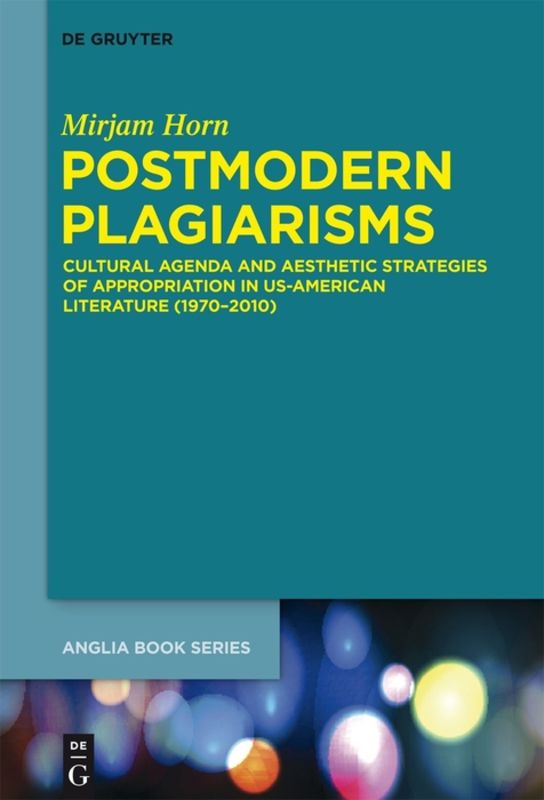
Postmodern Plagiarisms
This monograph takes on the question of how literary plagiarism is defined, exposed, and sanctioned in Western culture and how appropriating language assigned to another author can be considered a radical subversive act in postmodern US-American literature. While various forms of art such as music, painting, or theater have come to institutionalize appropriation as a valid mode to ventilate what authorship, originality, and the anxiety of influence may mean, the literary sphere still has a hard time acknowledging the unmarked acquisition of words, ideas, and manuscripts. The author shows how postmodern plagiarism in particular serves as a literary strategy of appropriation at the interface between literary economics, law, and theoretical discourses of literature. She investigates the complex expectations surrounding the strong link between an individual author subject and its alienable text, a link that several postmodern writers powerfully question and violate. Identifying three distinct practices of postmodern plagiarism, the book examines their specific situatedness, precepts, and subversive potential as litmus tests for the literary market, and the ongoing dynamic notion of the concepts authorship, originality, and creativity.
eBook

The Adventure an Aryballos as an Object Narrator from Classical Turkish Literature to Postmodern Literature / Nesne Anlatıcının Klasik Türk Edebiyatından Postmodern Edebiyata Serüveni ve Bir Aryballos Hikâyesi
All narrative-based texts are essentially based on a “plot” and a “narrator”. The story’s interpretation, the language used in the story, and the author’s style are not independent from the narrator where the narrator’s crucial role in narrative literary texts inherently requires the analysis of the narrator’s the position. If this narrator is not a human being, it attracts even more attention. Some poets and writers construct characters personalities through their relations with the objects in thier works. Over time, this interest in the object, has gone further in modern texts and has enabled the object to gain the role of a “narrator”. The object narrative genre, in which inanimate objects and animals serve as conscious main characters, is known as “novel of circulation”, “it-narrative”, “object narrative”, or “object tales” in 18th century English literature. In such works, objects and animals typically appear to tell their own life stories, but in the background their biographies always concentrate on the stories of others. One of the reasons the object narrator is much admired and frequently used by writers is the ability to move between social classes in a way that no human being can and to tell the stories of people from all statuses. Writers prefer to use an object narrator due to its satirical or didactic functions. Indeed, by reflecting the situation that can be experienced by an object, the object narrator enables the reader to approach the subject from a different perspective by empathizing with it. As a matter of fact, a non-human narrator who does not have the ability to speak, breaks habits and alienates the reader, which increases both literary pleasure and the reader’s interest in the genre through a different experience. In this study, I first discuss whether there are similar examples of the object narrator tradition in classical Turkish literature, which begun with the novels of circulation in the 18th century. Then, I discuss Aryballos, a novel written by Archaeologist Prof. Dr. Güven Bakır, which is an example of circulation narratives in recent Turkish literature: A Tale about a Vase, a Black Beetle, a Thistle and a Snake (An Ancient Beautification of Izmir), in the terms of the object narrators employed.
Journal Article


The African Past in America as a Bakhtinian and Levinasian Other. \Rememory\ as Solution in Toni Morrison's Beloved
A relational linguistic explanation of alterity and otherness in terms of reciprocity or interchangeability of subject and object positions constitutes the starting-point for an application of Levinas and Bakhtin's approaches to the theme of Time as other, to Toni Morrison's Beloved. The writer's neologism rememory implies physical and material designations which turn out to be con-fused with close-to-metaphysical claims about identity and coincidence. Consequently, the need, thirst or hunger, for a contingent and provisional sense of subjective and objective reality is reinforced by another re(a)lative distinction, to wit, the apparent opposition in the binomial presence/ absence, eventually amounting to the same. I also examine Levinas's metaphysical and common desire applied to beloved the character, storytelling as a way to enrich the characters' selves and the blues as a musical form that has evolved out of the African's terrible experience in America.
Journal Article

Rewriting the Surface: On Graffiti, the Law, and the Nature of Things
The article believes that the legal field needs to reconsider its approach to the surface of things. Using examples from jurisprudence of the United States, the United Kingdom, and the European Union and considering the legal tradition from the Roman Republic to today, the paper inquires why the law has evident problems in dealing with surface-oriented artforms, such as graffiti and postmodern literature. By consulting theorists of the surface, from Hegel over Critical Theory to Postmodernism, it will show that the law is outdated in the sense that it has failed to adapt its understanding of the nature of things. It will furthermore consider how property law and intellectual property law (including copyright) need to be revised in order to bring the law up-to-date with above developments.
Journal Article

A Play on Post-isms: The Unnamed Narrator’s Quest for Realness in Remainder
Tom McCarthy’s Remainder (2005) is a novel that plays with various themes pertaining to “post-isms.” The unnamed narrator’s unreal perception is a particular postmodern syndrome. McCarthy’s authorial aim is twofold: to appropriate ideas from contemporary literary theorists about unreality as a common postmodern condition, and to create a form of realism against the real, challenging the notion that realist literature can accurately reflect reality. With the advent of the twenty-first century, McCarthy enriches the discussion of unreality by incorporating technological themes, exploring the reasons for the blurring boundaries between the simulated and the real in the posthuman context. After a playful engagement with the post- “philosophies,” Remainder reveals deeper ethical issues, making it a parable for our times.
Journal Article

The Duality of Toni Morrison’s Beloved: Postmodern Religious Symbols That Highlight the Inherited Legacy of the American South
Toni Morrison’s novel Beloved includes a namesake character representing both Christianity and African cosmology. Beloved is neither straightforwardly good nor evil but serves as a dualistic and spiritual symbol. Though one could interpret Morrison’s narrative to support a postmodern religious multiplicity of voices, the potentially problematic theology still allows the readers to engage in useful discussions about the spiritual and cultural inheritance of the American South. Morrison’s narrative is only compatible with a Christian or African religious lens through recognizing symbolization as a representation of cultural manifestations rather than an endorsement of multiple worldviews.
Journal Article

Postmodern U.S. Fiction
This chapter contains sections titled:
Making It New, Again
Modern and Postmodern
Metafiction
Representation
References and Further Reading
Book Chapter

The Metafictive Nature of Postmodern Picturebooks
Throughout its history, the ecology of the picturebook has been impacted by various social and cultural changes. Postmodernism is one perspective, among other conceptual and theoretical frameworks, that has been proposed to explain some of the fundamental changes evident in many contemporary picturebooks. A review of the literature (Pantaleo & Sipe, 2008) reveals agreement among researchers and theorists that metafiction is one of the most prominent features exhibited in postmodern literature. Succinctly, metafiction draws the attention of readers to how texts work and to how meaning is created through the use of a number of devices or techniques. Following an overview of postmodern picturebooks and metafictive devices, the author provides an analysis of the metafictive devices evident in the picturebook NO BEARS (McKinlay & Rudge, 2012). The article concludes with a discussion of how postmodern picturebooks with metafictive devices can contribute to students' development as readers, writers, and creative thinkers.
Journal Article