
Catalogue Search | MBRL


Are you sure you want to remove the book from the shelf?

{{itemTitle}}
166,208
result(s) for
"power politics"
Sort by:
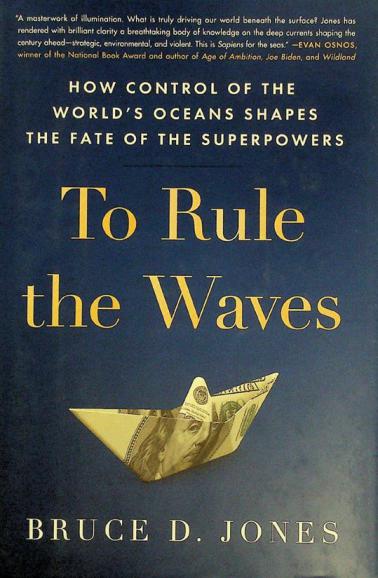
To rule the waves : how control of the world's oceans shapes the fate of the superpowers
\"For centuries, oceans were the chessboard on which empires battled for dominance. But in the nuclear age, air power and missile systems dominated our worries about security, and for the United States, the economy was largely driven by domestic production, with trucking and railways that crisscrossed the continent the primary modes of commercial transit. All that has changed, as nine-tenths of global commerce and the bulk of energy trade is today linked to sea-based flows. A brightly-painted 40-foot steel shipping container loaded in Asia with twenty tons of goods may arrive literally anywhere else in the world; how that really happens and who actually profits by it show that the struggle for power on the seas is a critical issue today. Now, in bright, closely observed prose, To Rule the Waves author Bruce Jones conducts us on a fascinating voyage through the great modern ports and naval bases of this era-from the vast container ports of Shanghai and Hong Kong to the vital naval base of the American 7th fleet in Hawaii to the sophisticated security arrangements in the port of New York. Along the way, the book illustrates how global commerce works, that we are amidst a global naval arms race, and why the oceans are so crucial to America's standing going forward. As Jones reveals, the three great geopolitical struggles of our time-for military power, for economic dominance, and over our changing climate-are playing out atop, within, and below the world's oceans. The essential question, he shows, is this: who will rule the waves and set the terms of the world to come?\"-- Provided by publisher.
Book

World Out of Balance
World Out of Balance is the most comprehensive analysis to date of the constraints on the United States' use of power in pursuit of its security interests. Stephen Brooks and William Wohlforth overturn conventional wisdom by showing that in a unipolar system, where the United States is dominant in the scales of world power, the constraints featured in international relations theory are generally inapplicable. In fact, the authors argue that the U.S. will not soon lose its leadership position; rather, it stands before a twenty-year window of opportunity for reshaping the international system.
Although American primacy in the world is unprecedented, analysts routinely stress the limited utility of such preeminence. The authors examine arguments from each of the main international relations theories--realism, institutionalism, constructivism, and liberalism. They also cover the four established external constraints on U.S. security policy--international institutions, economic interdependence, legitimacy, and balancing. The prevailing view is that these external constraints conspire to undermine the value of U.S. primacy, greatly restricting the range of security policies the country can pursue. Brooks and Wohlforth show that, in actuality, the international environment does not tightly constrain U.S. security policy. World Out of Balance underscores the need for an entirely new research agenda to better understand the contours of international politics and the United States' place in the world order.
eBook


The Song Remains the Same: International Relations After COVID-19
Since the onset of COVID-19, there has been a surfeit of commentary arguing that 2020 will have transformative effects on world politics. This paper asks whether, decades from now, the pandemic will be viewed as an inflection point. Critical junctures occur when an event triggers a discontinuous shift in key variables or forces a rapid acceleration of preexisting trends. Pandemics have undeniably had this effect in the far past. A welter of economic and medical developments, however, have strongly muted the geopolitical impact of pandemics in recent centuries. A review of how the novel coronavirus has affected the distribution of power and interest in its first six months suggests that COVID-19 will not have transformative effects on world politics. Absent a profound ex post shift in hegemonic ideas, 2020 is unlikely to be an inflection point.
Journal Article


Divided rule
After invading Tunisia in 1881, the French installed a protectorate in which they shared power with the Tunisian ruling dynasty and, due to the dynasty's treaties with other European powers, with some of their imperial rivals. This “indirect” form of colonization was intended to prevent the violent clashes marking France's outright annexation of neighboring Algeria. But as Mary Dewhurst Lewis shows in Divided Rule, France's method of governance in Tunisia actually created a whole new set of conflicts. In one of the most dynamic crossroads of the Mediterranean world, residents of Tunisia— whether Muslim, Jewish, or Christian—navigated through the competing power structures to further their civil rights and individual interests and often thwarted the aims of the French state in the process. Over time, these everyday challenges to colonial authority led France to institute reforms that slowly undermined Tunisian sovereignty and replaced it with a more heavy-handed form of rule—a move also intended to ward off France's European rivals, who still sought influence in Tunisia. In so doing, the French inadvertently encouraged a powerful backlash with major historical consequences, as Tunisians developed one of the earliest and most successful nationalist movements in the French empire. Based on archival research in four countries, Lewis uncovers important links between international power politics and everyday matters of rights, identity, and resistance to colonial authority, while re-interpreting the whole arc of French rule in Tunisia from the 1880s to the mid-20th century. Scholars, students, and anyone interested in the history of politics and rights in North Africa, or in the nature of imperialism more generally, will gain a deeper understanding of these issues from this sophisticated study of colonial Tunisia.
eBook


The Status of Status in World Politics
What is status? How does it work? What effects does it tend to have? A new wave of scholarship on status in international relations has converged on a central definition of status, several causal pathways, and the claim that the pursuit of status tends to produce conflict. The authors take stock of the status literature and argue that this convergence is not only a sign of progress, but also an obstacle to it. They find that the consensus definition conceals critical contradictions between standing and membership, that its causal pathways are promising but often in tension with each other, and that the literature may be overlooking the ways in which status can help states avoid conflict and promote cooperation under certain conditions.
Journal Article

The crisis of the twelfth century : power, lordship, and the origins of European government
This text traces the origins of European government to a crisis of lordship and its resolution. King John of England was only the latest and most conspicuous in a gallery of bad lords who dominated the populace instead of ruling it. Yet it was not so much the oppressed people as their tormentors who were in crisis. Rethinking a familiar history, Thomas Bisson explores what these violent people - and the outcries they provoked - contributed to the making of governments in kingdoms, principalities and towns.
Book

Visions of the End of the Cold War in Europe, 1945-1990
Exploring the visions of the end of the Cold War that have been put forth since its inception until its actual ending, this volume brings to the fore the reflections, programmes, and strategies that were intended to call into question the bipolar system and replace it with alternative approaches or concepts. These visions were associated not only with prominent individuals, organized groups and civil societies, but were also connected to specific historical processes or events. They ranged from actual, thoroughly conceived programmes, to more blurred, utopian aspirations — or simply the belief that the Cold War had already, in effect, come to an end. Such visions reveal much about the contexts in which they were developed and shed light on crucial moments and phases of the Cold War.
eBook