
Catalogue Search | MBRL


Are you sure you want to remove the book from the shelf?

{{itemTitle}}
765
result(s) for
"prédestination"
Sort by:

La théorie calviniste de la prédestination est-elle l’un des fondements de la théorie du choix rationnel ?
En utilisant la théorie calvinienne de l’intérêt, cette note s’intéresse à la doctrine de la prédestination comme l’une des origines possibles de l’autonomisation progressive du concept d’agent rationnel, l’une des pièces centrales de la théorie moderne des prix basée sur la logique de l’échange (dont le taux de l’intérêt n’est finalement qu’une dérivation). Using the Calvinian theory of interest, this note examines the doctrine of predestination as one of the possible origins of the progressive elaboration of the concept of rational agent, one of the central pieces of the modern theory of prices based on the logic of exchange (of which the rate of interest is ultimately only a derivation).
Journal Article
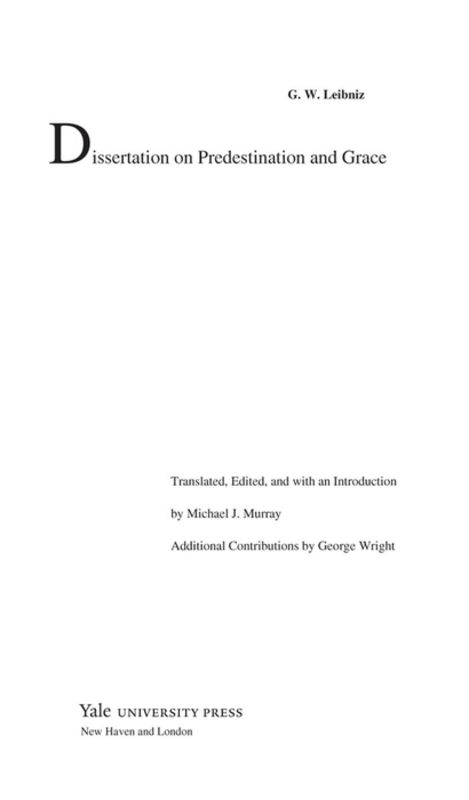
Dissertation on Predestination and Grace
In this book G. W. Leibniz presents not only his reflections on predestination and election but also a more detailed account of the problem of evil than is found in any of his other works apart from theTheodicy. Surprisingly, hisDissertation on Predestination and Gracehas never before been published in any form. Michael J. Murray's project of translating, editing, and providing commentary for the volume will therefore attract great interest among scholars and students of Leibniz's philosophy and theology. Leibniz addresses such topics as free will, moral responsibility, divine causation, justice, punishment, divine foreknowledge, and human freedom, revealing crucial aspects of the genesis of his mature metaphysics and the theological motivations behind it.
eBook

Scriptura Translata, Semper Transferenda: An English Version of Theodore Beza’s Syncretistic Abraham sacrifiant
Theodore Beza’s 1550 Abraham sacrifiant continues a rich tradition of translation and exegesis of the Akedah in the vibrant context of the humanist Reformation. Beza translates not so much from one language to another, since he takes the Olivetan Bible’s text of Genesis 22 for the argument of his play, but rather fuses two cultures and genres, Biblical narrative and Greek tragedy. His choice entails a crucial tension: a drama of redemption cannot be tragic. In fact, Beza incorporates comic elements from both medieval and classical sources in his work. Nonetheless, his work puts in play Calvinist themes such as saving faith and predestination. A modern translation should be faithful both to Beza’s adaptation of classical forms, such as stichomythia and choral odes, and to his expression of reformed doctrine, in the spirit of Arthur Golding’s near-contemporary English version of 1575. Like Golding’s translation, mine will inevitably adapt form and content to each other, with luck conveying Beza’s literary theology in the process.
Journal Article

Augustine’s IEnchiridion/I: An Anti-Pelagian Interpretation of the Creed
At first glance, Augustine did not combine his soteriology and his Trinitarian doctrine in his anti-Pelagian oeuvre. Therefore, this article pursues the more hidden and implicit connections between these topics. The starting point of this endeavour is an analysis of the Enchiridion, a catechetical work in which Augustine interpreted the Roman—later so-called Apostle’s—Creed. Simultaneously, Augustine directed his attention in the Enchiridion to questions and arguments which originate from the Pelagian controversy such as original sin, grace, baptism, remission of sin(s) and the theory of predestination. Thus, this article ponders the question of how Augustine reflected his Trinitarian doctrine within this anti-Pelagian soteriology. While Augustine seldom referred to his Trinitarian doctrine explicitly in the Enchiridion (and his anti-Pelagian oeuvre), he presented in these works a conception of how the triune God operates as creator and saviour. This anti-Pelagian concept of God seizes several aspects which also appear in Augustine’s De trinitate. Moreover, by emphasising the unity of God’s operation as creator and saviour against the Pelagians, Augustine argued in favour of a specific Trinitarian doctrine: opera trinitatis ad extra inseparabilia. Thus, this article finally tries to analyse how Augustine amalgamated his anti-Pelagian Christocentric soteriology with his Trinitarian doctrine.
Journal Article

How the Idea of Religious Toleration Came to the West
Religious intolerance, so terrible and deadly in its recent manifestations, is nothing new. In fact, until after the eighteenth century, Christianity was perhaps the most intolerant of all the great world religions. How Christian Europe and the West went from this extreme to their present universal belief in religious toleration is the momentous story fully told for the first time in this timely and important book by a leading historian of early modern Europe.
Perez Zagorin takes readers to a time when both the Catholic Church and the main new Protestant denominations embraced a policy of endorsing religious persecution, coercing unity, and, with the state's help, mercilessly crushing dissent and heresy. This position had its roots in certain intellectual and religious traditions, which Zagorin traces before showing how out of the same traditions came the beginnings of pluralism in the West. Here we see how sixteenth- and seventeenth-century thinkers--writing from religious, theological, and philosophical perspectives--contributed far more than did political expediency or the growth of religious skepticism to advance the cause of toleration. Reading these thinkers--from Erasmus and Sir Thomas More to John Milton and John Locke, among others--Zagorin brings to light a common, if unexpected, thread: concern for the spiritual welfare of religion itself weighed more in the defense of toleration than did any secular or pragmatic arguments. His book--which ranges from England through the Netherlands, the post-1685 Huguenot Diaspora, and the American Colonies--also exposes a close connection between toleration and religious freedom.
A far-reaching and incisive discussion of the major writers, thinkers, and controversies responsible for the emergence of religious tolerance in Western society--from the Enlightenment through the United Nations' Universal Declaration of Human Rights--this original and richly nuanced work constitutes an essential chapter in the intellectual history of the modern world.
eBook

‘Only’ or ‘also’ or ‘never mind’ Jesus?
This article explores two Christian perspectives on how to inherit eternity: The inclusive Christianity view and the exclusive Christianity view. The central research question is: What role does Jesus play in human salvation? Using a semi-systematic or narrative review approach, representative documents were analysed. According to these sources, many scholars believe that salvation can only be attained through Jesus by being a devoted follower. Other scholars argue that Jesus is merely instrumental in human salvation, while some assert that Jesus’ death has made salvation accessible to everyone. Additionally, another group of scholars claims that all individuals will get salvation, even without knowledge of Jesus.Intradisciplinary and/or interdisciplinary implicationsFrom a Christian perspective, the conclusion of these arguments asserts that the Bible should remain the primary source for finding answers. However, it is unclear whether individuals inherit eternity through their own free will (by grace) – justification through faith – or through God’s intervention or predestination.
Journal Article

The Messianic Secret and the Significance of Preaching in Gabriele Biondo, Otto Brunfels, and Celio Secondo Curione
The “messianic secret” in the New Testament refers to instances where Christ instructed his followers to keep silent about his identity. While contemporary studies on the messianic secret have predominantly employed the historico-critical method, the Early Modern Period witnessed diverse interpretations that focused on edification and moralization. These interpretations emphasized the concealed Messiah’s identity, the act of revelation, and the duty to transmit the divine message as inseparable aspects of the Christian faith. The primary objective of this study is to explore the development of messianic secret interpretations in the first half of the sixteenth century. The study aims to address key questions such as: How were Jesus’s injunctions to silence interpreted? How did these interpretations shape biblical readings, preaching practices, and the evangelical mission? Did they impact the definition of the Church? Through a comparative analysis, this study examines the interpretations of three relatively contemporary authors – Gabriele Biondo, Otto Brunfels, and Celio Secondo Curione. It argues for the interconnectedness between biblical exegesis, preaching, the audience, theological concepts like predestination, holy remnant, and salvation, as well as the organization of the Church. Ultimately, this research demonstrates that diverse interpretations of Jesus’s actions and the messianic secret were rooted in changes in exegetical methods, the definition of the Church, and the understanding of the salvific message conveyed by Christ.
Journal Article

Voorbeskikking, goed en kwaad, menslike verantwoordelikheid, en die sending
Predestination, good and evil, human responsibility, and mission. The background of this article is the challenge that Paul deals with in Romans, namely predestination and the reference to good and evil in theology. It seems as if God ordained good and evil. God is, however, holy and totally good. Sources by Augustine, Calvin, Weaver, Van de Beek and others highlight the questions in this regard. The central implications of the cross of Jesus, as well as the issue of human responsibility are extremely relevant in this regard. The objectives are to give a sound theological evaluation of the question of good and evil from the perspective of reformed theology in interaction with Scripture. Interaction with Scripture and theologians leads to a literature study and thereafter exegetical, hermeneutical and systematic theology issues are addressed. The results established that different positions are taken, but God is just and not the author of sin. This implicates a clear view on mission: reject sin and turn to God. The conclusions are: God is holy, but all mankind should reject evil and accept that God is the fountian of good. Mission is the act of the Triune God (missio Dei) in Jesus Christ, through the Holy Spirit, to lead sinners from darkness to God. The good in Jesus Christ, by his death on the cross and in his resurrection, overcame evil. Contribution: The article illuminates the issue of good and evil in a new way and offers insight into its significance for the mission. This has significance for the current missiological engagement.
Journal Article
“Enervare atque pervertere verba illa Christi Matthaei 11”: Arguing over Matthew 11:21–22 in Luis de Molina’s (1535–1600) Concordia and Leonardus Lessius’ De gratia efficaci
In the second half of the sixteenth century, the Jesuits Luis de Molina (1535–1600) and Leonardus Lessius (1554–1623) had been forced to defend their views on grace, free will and predestination against multiple attacks by fellow Catholic theologians. By comparing Molina’s commentaries on Matt 11:21–22 in his
of 1595 with Lessius’ remarks on the same verses in his
(1610), this contribution seeks to provide insights into the extent to which the theological views of both Jesuits differed. The article concludes that Lessius’ theological view diverges from Molina’s where it concerns the physical workings of grace. Furthermore, the two Jesuits differ on the question whether God grants equal aid to all or bestows some with more aid than others. Molina held the latter view, while Lessius, in keeping with the ideas of Henry of Ghent, defended the former.
Journal Article

Peter the Venerable and Islam
For over four centuries the principal source of Christian European knowledge of Islam stemmed from a project sponsored by Peter the Venerable, ninth abbot of Cluny, in 1142. This consisted of Latin translations of five Arabic works, including the first translation of the Koran in a western language. Known as the Toledan Collection, it was eventually printed in 1543 with an introduction by Martin Luther. The abbot also completed a handbook of Islam beliefs and a major analytical and polemical work, Liber contra sectam Saracenorum; annotated editions of these texts are included in this book.
Originally published in 1964.
The Princeton Legacy Library uses the latest print-on-demand technology to again make available previously out-of-print books from the distinguished backlist of Princeton University Press. These editions preserve the original texts of these important books while presenting them in durable paperback and hardcover editions. The goal of the Princeton Legacy Library is to vastly increase access to the rich scholarly heritage found in the thousands of books published by Princeton University Press since its founding in 1905.
eBook