
Catalogue Search | MBRL


Are you sure you want to remove the book from the shelf?

{{itemTitle}}
106,578
result(s) for
"private property"
Sort by:


William of Ockham’s Early Theory of Property Rights in Context
This book analyzes William of Ockham's early theory of property rights alongside those of his fellow dissident Franciscans, paying careful attention to each friar's use of Roman and civil law, which provided the conceptual building blocks of the poverty controversy.
eBook

Capitalism, Socialism and Property Rights
An in-depth examination of one of the defining issues that separates capitalism from socialism - the system of ownership, or property rights - which, when explored, highlight fundamental problems in the model of market socialism.
eBook

Property in East Central Europe
Property is a complex phenomenon comprising cultural, social, and legal rules. During the twentieth century, property rights in land suffered massive interference in Central and Eastern Europe. The promise of universal and formally equal rights of land ownership, ensuring predictability of social processes and individual autonomy, was largely not fulfilled. The national appropriation of property in the interwar period and the communist era represent an onerous legacy for the postcommunist (re)construction of a liberal-individualist property regime. However, as the scholars in this collection show, after the demise of communism in Eastern Europe property is again a major factor in shaping individual identity and in providing the political order and culture with a foundational institution. This volume analyzes both historical and contemporary forms of land ownership in Poland, Romania, and Yugoslavia in a multidisciplinary framework including economic history, legal and political studies, and social anthropology.
eBook

Property in the margins
Having its origins in the process of transformation and land reform that began to take shape in South Africa at the end of the last century, this strikingly original analysis of property starts from deep inside the property regime and not from a distant or abstract perspective on property rules and practices. Focusing on issues of stability and change in a transformative setting and on the role of tradition and legal culture in that context, the book argues that a property regime, including the system of property holdings and the rules and practices that entrench and protect them, tends to insulate itself against change through the security- and stability-seeking tendency of tradition and legal culture, including the deep assumptions about security and stability embedded in the rights paradigm, rhetoric and logic that dominate current legal culture.
eBook

Cyprus at the European Court of Human Rights : a critical appraisal of the court's jurisprudence on the rights to property and home in the context of displacement
A Critical analysis of the response of the ECtHR to the continuing violations of the rights to property and home of the Cyprus IDPs under ECHR general and specific jurisprudence, on Article 1 Protocol No. 1 and Article 8, as it has developed over the last 40 years.
eBook

A Public Empire
\"Property rights\" and \"Russia\" do not usually belong in the same sentence. Rather, our general image of the nation is of insecurity of private ownership and defenselessness in the face of the state. Many scholars have attributed Russia's long-term development problems to a failure to advance property rights for the modern age and blamed Russian intellectuals for their indifference to the issues of ownership.A Public Empirerefutes this widely shared conventional wisdom and analyzes the emergence of Russian property regimes from the time of Catherine the Great through World War I and the revolutions of 1917. Most importantly,A Public Empireshows the emergence of the new practices of owning \"public things\" in imperial Russia and the attempts of Russian intellectuals to reconcile the security of property with the ideals of the common good.
The book analyzes how the belief that certain objects-rivers, forests, minerals, historical monuments, icons, and Russian literary classics-should accede to some kind of public status developed in Russia in the mid-nineteenth century. Professional experts and liberal politicians advocated for a property reform that aimed at exempting public things from private ownership, while the tsars and the imperial government employed the rhetoric of protecting the sanctity of private property and resisted attempts at its limitation.
Exploring the Russian ways of thinking about property,A Public Empirelooks at problems of state reform and the formation of civil society, which, as the book argues, should be rethought as a process of constructing \"the public\" through the reform of property rights.
eBook

Identifying consumerist privately owned public spaces
Over the past several decades, more and more social activities happen in places which are privately owned. Scholars have called these properties ‘mass private property’ (MPP): the private properties that are open to the mass. However, while MPP arouses scholars’ attention and interest, there is not a clear understanding of what type of physical space is a ‘mass private property’. Rather, the concept of MPP is usually used in an intuitive and taken-for-granted way without examining the ideal essences of diverse MPP spaces. This essay clarifies the criteria by developing the ideal type of MPP. Although MPPs are diverse, to some extent they should share the ideal-typing features of real-estate, legal and sociological dimensions.
在过去几十年中,越来越多的社会活动在私人持有的场所中发生。学界将这些房产称为“公众 式私有房产” (MPP ),即对公众开放的私有房产。但是,虽然MPP引起了学界的关注和兴趣, 对于“ 公众式私有房产” 是何种类型的物理空间,目前尚未形成清晰的理解。实际上,MPP的 概念通常以直观、想当然的方式运用,未经考察各种MPP空间的理想实质。本文通过制定 MPP的理想型而廓清了相关标准。虽然MPP各式各样,在某种程度上它们应共同具有房地产、 法律和社会学维度上的理性型特征。
Journal Article

The Institutional Framework of Russian Serfdom
Russian rural history has long been based on a 'Peasant Myth', originating with nineteenth-century Romantics and still accepted by many historians today. In this book, Tracy Dennison shows how Russian society looked from below, and finds nothing like the collective, redistributive and market-averse behaviour often attributed to Russian peasants. On the contrary, the Russian rural population was as integrated into regional and even national markets as many of its west European counterparts. Serfdom was a loose garment that enabled different landlords to shape economic institutions, especially property rights, in widely diverse ways. Highly coercive and backward regimes on some landlords' estates existed side-by-side with surprisingly liberal approximations to a rule of law. This book paints a vivid and colourful picture of the everyday reality of rural Russia before the 1861 abolition of serfdom.
eBook
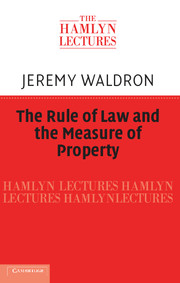
The Rule of Law and the Measure of Property
When property rights and environmental legislation clash, what side should the Rule of Law weigh in on? It is from this point that Jeremy Waldron explores the Rule of Law both from an historical perspective - considering the property theory of John Locke - and from the perspective of modern legal controversies. This critical and direct account of the relation between the Rule of Law and the protection of private property criticizes the view - associated with the 'World Bank model' of investor expectations - that a society which fails to protect property rights against legislative restriction is failing to support the Rule of Law. In this book, developed from the 2011 Hamlyn Lectures, Waldron rejects the idea that the Rule of Law privileges property rights over other forms of law and argues instead that the Rule of Law should endorse and applaud the use of legislation to achieve valid social objectives.
eBook