
Catalogue Search | MBRL


Are you sure you want to remove the book from the shelf?

{{itemTitle}}
536,332
result(s) for
"processing technology"
Sort by:

Digital expectations and experiences in education
For more than three decades, researchers, policy makers and educationalists have all harboured great expectations towards the use of technology in schools. This belief has received a hard knock after an OECD 2015 report has shown that computers do not improve pupil results: Investing heavily in school computers and classroom technology does not improve pupils' performance, and frequent use of computers in schools is more likely to be associated with lower results. Educational technology has raised false expectations! The prevailing view of educational technology has shifted. This book is an attempt to raise questions and start a debate. It presents new research relevant to a better understanding of the challenges and opportunities inherent in educational technology and strategies are discussed in relation to handling these challenges. Rather than presenting ready solutions, the book attempts to provoke debate and to contribute to a firmer grasp on reality.
Book

Preparation and Characterization of Camelina sativa Protein Isolates and Mucilage
Processes for the production of protein isolates from camerlina
Camelina sativa
were developed by modifying the procedure used for other seeds from the Brassicaceae family, such as rapeseed and mustard. The procedure consisted of defatting the seed followed by alkaline extraction at pH 11, ultra- and diafiltration using a 5-kDa membrane, isolelectric precipitation of the proteins at pH 5 and recovery of the acid soluble protein isolates (SPI) after further filtration and drying. Protein yields as precipitated protein isolate and SPI were 10.7 and 11.4%, containing 67 and 42%, respectively. Due to the high concentration of mucilage in camelina, a water-to-seed ratio of 30 had to be used for protein extraction from the hexane-defatted seed and most of the mucilage had to be removed prior to the defatting process. A rapid mucilage extraction process using water at 55 °C was developed. Camelina mucilage absorbs water and oil. Viscosity measurements of dried and redissolved mucilage showed the highest values at natural pH, and the viscosity increased rapidly above 1% solids concentration. It may be a useful product in the food and pharmaceutical industries.
Journal Article


Foodborne Hazards and Novel Technologies in Ready‐to‐Eat Crustaceans
The market for ready‐to‐eat (RTE) crustaceans has been expanding in recent years. Conventional heating (CH) (boiling and steaming) has been used for decades for the processing of RTE crustaceans. However, some disadvantages, such as lack of uniformity of heating, low heat transfer efficiency, and generation of a large amount of wastewater, have been highlighted. To optimize the processing for safe and high‐quality RTE crustaceans, the identification of major hazards is necessary and the interventions of green, sustainable, and novel technologies attract increasing attention. In this review, important biological and chemical hazards in crustaceans are discussed. CH and promising novel thermal and nonthermal processing technologies are reviewed with their basic mechanisms and research advances in RTE crustacean processing. Then, challenges and future work are proposed. Biological hazards, including Listeria monocytogenes, norovirus, Salmonella, and Vibrio spp., are of great concern for raw crustaceans. L. monocytogenes is a persistent hazard that places a burden on crustacean processing environments. Most chemical hazards are caused by indigenous habitats, including heavy metals, biotoxins, pesticides, pharmaceuticals, and personal care products. Thermal technologies such as sous vide, moderate electric field, and microwave are promising in RTE crustacean processing. Individual effects on microbial hazards of nonthermal technologies like high‐pressure processing (HPP) and ultrasound (US) are limited. Synergistic effects of less intensity of nonthermal treatment with thermal processes such as HPP‐ and US‐assisted cooking showed great potential and advantages. However, more research is still needed to scale up their use in an industrial setting. Biological hazards, including Listeria monocytogenes, norovirus, Salmonella, and Vibrio spp., and chemical hazards, including heavy metals, biotoxins, pesticides, pharmaceuticals, and personal care products, are of great concern regarding crustaceans and their consumption. To improve the processing of ready‐to‐eat (RTE) crustacean products, novel thermal technologies such as sous vide, moderate electric field, and microwave can be promising substitutes for conventional boiling and steaming. Combining thermal and nonthermal technologies such as high‐pressure processing and ultrasound can also have great potential to improve RTE crustaceans' safety and quality.
Journal Article


Impact of High Hydrostatic Pressure on the Physicochemical Characteristics, Functional Properties, Structure, and Bioactivities of Tenebrio molitor Protein
This study aimed to explore the influence of high hydrostatic pressure (HHP) treatment on the structure, functional characteristics, and bioactivities of Tenebrio molitor protein. The results showed that HHP induced dissociation of T. molitor protein, exposing hydrophobic groups and reducing particle size, which in turn reduced turbidity. Additionally, 600 MPa treatment significantly reduced the foaming stability and emulsifying activity of T. molitor protein. Treatments at 200 MPa and 400 MPa significantly reduced emulsion stability, whereas 400 MPa treatment significantly increased oil retention. HHP treatment also altered the secondary and tertiary structures of T. molitor protein, as demonstrated by circular dichroism and fluorescence spectra. Furthermore, HHP treatment significantly affected the antibacterial and antioxidant activities of T. molitor protein. This study provides a theoretical framework for using HHP to modify T. molitor protein. Impact of high hydrostatic pressure on the physicochemical characteristics, functional properties, structure, and bioactivities of Tenebrio molitor protein.
Journal Article


Assessing the Analytical Solution of One-Dimensional Gravity Wave Model Equations Using Dam-Break Experimental Measurements
The one-dimensional gravity wave model (GWM) is the result of ignoring the convection term in the Saint-Venant Equations (SVEs), and has the characteristics of fast numerical calculation and low stability requirements. To study its performances and limitations in 1D dam-break flood, this paper verifies the model using a dam-break experiment. The experiment was carried out in a large-scale flume with depth ratios (initial downstream water depth divided by upstream water depth) divided into 0 and 0.1~0.4. The data were collected by image processing technology, and the hydraulic parameters, such as water depth, flow discharge, and wave velocity, were selected for comparison. The experimental results show that the 1D GWM performs an area with constant hydraulic parameters, which is quite different from the experimental results in the dry downstream case. For a depth ratio of 0.1, the second weak discontinuity point, which is connected to the steady zone in the 1D GWM, moves upstream, which is contrary to the experimental situation. For depth ratios of 0.2~0.4, the moving velocity of the second weak discontinuity point is faster than the experimental value, while the velocity of the shock wave is slower. However, as the water depth ratio increases, the hydraulic parameters calculated by 1D GWM in the steady zone gradually approach the experimental value.
Journal Article
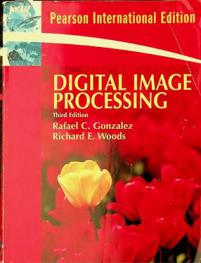
Digital image processing
Completely self-contained-and heavily illustrated-this introduction to basic concepts and methodologies for digital image processing is written at a level that truly is suitable for seniors and first-year graduate students in almost any technical discipline. The leading textbook in its field for more than twenty years, it continues its cutting-edge focus on contemporary developments in all mainstream areas of image processing-e.g., image fundamentals, image enhancement in the spatial and frequency domains, restoration, color image processing, wavelets, image compression, morphology, segmentation, image description, and the fundamentals of object recognition. It focuses on material that is fundamental and has a broad scope of application.
Book

Urban Traffic Monitoring and Analysis Using Unmanned Aerial Vehicles (UAVs): A Systematic Literature Review
Unmanned aerial vehicles (UAVs) are gaining considerable interest in transportation engineering in order to monitor and analyze traffic. This systematic review surveys the scientific contributions in the application of UAVs for civil engineering, especially those related to traffic monitoring. Following the PRISMA framework, 34 papers were identified in five scientific databases. First, this paper introduces previous works in this field. In addition, the selected papers were analyzed, and some conclusions were drawn to complement the findings. It can be stated that this is still a field in its infancy and that progress in advanced image processing techniques and technologies used in the construction of UAVs will lead to an explosion in the number of applications, which will result in increased benefits for society, reducing unpleasant situations, such as congestion and collisions in major urban centers of the world.
Journal Article