
Catalogue Search | MBRL


Are you sure you want to remove the book from the shelf?

{{itemTitle}}
11
result(s) for
"propoganda"
Sort by:

Only Muslim
The French state has long had a troubled relationship with its diverse Muslim populations. InOnly Muslim, Naomi Davidson traces this turbulence to the 1920s and 1930s, when North Africans first immigrated to French cities in significant numbers. Drawing on police reports, architectural blueprints, posters, propaganda films, and documentation from metropolitan and colonial officials as well as anticolonial nationalists, she reveals the ways in which French politicians and social scientists created a distinctly French vision of Islam that would inform public policy and political attitudes toward Muslims for the rest of the century-Islam français. French Muslims were cast into a permanent \"otherness\" that functioned in the same way as racial difference. This notion that one was only and forever Muslim was attributed to all immigrants from North Africa, though in time \"Muslim\" came to function as a synonym for Algerian, despite the diversity of the North and West African population.
Davidson grounds her narrative in the history of the Mosquée de Paris, which was inaugurated in 1926 and epitomized the concept of Islam français. Built in official gratitude to the tens of thousands of Muslim subjects of France who fought and were killed in World War I, the site also provided the state with a means to regulate Muslim life throughout the metropole beginning during the interwar period. Later chapters turn to the consequences of the state's essentialized view of Muslims in the Vichy years and during the Algerian War. Davidson concludes with current debates over plans to build a Muslim cultural institute in the middle of a Parisian immigrant neighborhood, showing how Islam remains today a marker of an unassimilable difference.
eBook

Soviet salvage : imperial debris, revolutionary reuse, and Russian constructivism
In Soviet Salvage, Catherine Walworth explores how artists on the margins of the Constructivist movement of the 1920s rejected \"elitist\" media and imagined a new world, knitting together avant-garde art, imperial castoffs, and everyday life.
Applying anthropological models borrowed from Claude Lévi-Strauss, Walworth shows that his mythmaker typologies—the \"engineer\" and \"bricoleur\"—illustrate, respectively, the canonical Constructivists and artists on the movement's margins who deployed a wide range of clever make-do tactics. Walworth explores the relationships of Nadezhda Lamanova, Esfir Shub, and others with Constructivists such as Aleksei Gan, Varvara Stepanova, and Aleksandr Rodchenko. Together, the work of these artists reflected the chaotic and often contradictory zeitgeist of the decade from 1918 to 1929 and redefined the concept of mass production. Reappropriated fragments of a former enemy era provided a wide range of play and possibility for these artists, and the resulting propaganda porcelain, film, fashion, and architecture tell a broader story of the unique political and economic pressures felt by their makers.
An engaging multidisciplinary study of objects and their makers during the Soviet Union's early years, this volume highlights a group of artists who hover like free radicals at the border of existing art-historical discussions of Constructivism and deepens our knowledge of Soviet art and material culture.
eBook

Tashkent
Paul Stronski tells the fascinating story of Tashkent, an ethnically diverse, primarily Muslim city that became the prototype for the Soviet-era reimagining of urban centers in Central Asia. Based on extensive research in Russian and Uzbek archives, Stronski shows us how Soviet officials, planners, and architects strived to integrate local ethnic traditions and socialist ideology into a newly constructed urban space and propaganda showcase.
The Soviets planned to transform Tashkent from a \"feudal city\" of the tsarist era into a \"flourishing garden,\" replete with fountains, a lakeside resort, modern roadways, schools, hospitals, apartment buildings, and of course, factories. The city was intended to be a shining example to the world of the successful assimilation of a distinctly non-Russian city and its citizens through the catalyst of socialism. As Stronski reveals, the physical building of this Soviet city was not an end in itself, but rather a means to change the people and their society.
Stronski analyzes how the local population of Tashkent reacted to, resisted, and eventually acquiesced to the city's socialist transformation. He records their experiences of the Great Terror, World War II, Stalin's death, and the developments of the Krushchev and Brezhnev eras up until the earthquake of 1966, which leveled large parts of the city. Stronski finds that the Soviets established a legitimacy that transformed Tashkent and its people into one of the more stalwart supporters of the regime through years of political and cultural changes and finally during the upheavals of glasnost.
eBook

The personality cult of Stalin in Soviet posters, 1929–1953
From 1929 until 1953, Iosif Stalin’s image became a central symbol in Soviet propaganda. Touched up images of an omniscient Stalin appeared everywhere: emblazoned across buildings and lining the streets; carried in parades and woven into carpets; and saturating the media of socialist realist painting, statuary, monumental architecture, friezes, banners, and posters. From the beginning of the Soviet regime, posters were seen as a vitally important medium for communicating with the population of the vast territories of the USSR. Stalin’s image became a symbol of Bolshevik values and the personification of a revolutionary new type of society. The persona created for Stalin in propaganda posters reflects how the state saw itself or, at the very least, how it wished to appear in the eyes of the people. The ‘Stalin’ who was celebrated in posters bore but scant resemblance to the man Iosif Vissarionovich Dzhugashvili, whose humble origins, criminal past, penchant for violent solutions and unprepossessing appearance made him an unlikely recipient of uncritical charismatic adulation. The Bolsheviks needed a wise, nurturing and authoritative figure to embody their revolutionary vision and to legitimate their hold on power. This leader would come to embody the sacred and archetypal qualities of the wise Teacher, the Father of the nation, the great Warrior and military strategist, and the Saviour of first the Russian land, and then the whole world. This book is the first dedicated study on the marketing of Stalin in Soviet propaganda posters. Drawing on the archives of libraries and museums throughout Russia, hundreds of previously unpublished posters are examined, with more than 130 reproduced in full colour. The personality cult of Stalin in Soviet posters, 1929–1953 is a unique and valuable contribution to the discourse in Stalinist studies across a number of disciplines.
eBook

Eisenhower's Sputnik Moment
In a critical Cold War moment, Dwight D. Eisenhower's presidency suddenly changed when the Soviet Union launched Sputnik, the world's first satellite. What Ike called \"a small ball\" became a source of Russian pride and propaganda, and it wounded him politically, as critics charged that he responded sluggishly to the challenge of space exploration. Yet Eisenhower refused to panic after Sputnik-and he did more than just stay calm. He helped to guide the United States into the Space Age, even though Americans have given greater credit to John F. Kennedy for that achievement.
InEisenhower's Sputnik Moment, Yanek Mieczkowski examines the early history of America's space program, reassessing Eisenhower's leadership. He details how Eisenhower approved breakthrough satellites, supported a new civilian space agency, signed a landmark science education law, and fostered improved relations with scientists. These feats made Eisenhower's post-Sputnik years not the flop that critics alleged but a time of remarkable progress, even as he endured the setbacks of recession, medical illness, and a humiliating first U.S. attempt to launch a satellite. Eisenhower's principled stands enabled him to resist intense pressure to boost federal spending, and he instead pursued his priorities-a balanced budget, prosperous economy, and sturdy national defense. Yet Sputnik also altered the world's power dynamics, sweeping Eisenhower in directions that were new, even alien, to him, and he misjudged the importance of space in the Cold War's \"prestige race.\" By contrast, Kennedy capitalized on the issue in the 1960 election, and after taking office he urged a manned mission to the moon, leaving Eisenhower to grumble over the young president's aggressive approach.
Offering a fast-paced account of this Cold War episode, Mieczkowski demonstrates that Eisenhower built an impressive record in space and on earth, all the while offering warnings about America's stature and strengths that still hold true today.
eBook

İran-Irak Savaşı’nda kullanılan İran propaganda posterlerinin göstergebilimsel analizi
İran-Irak Savaşı, dünya tarihindeki en kanlı savaşlardan biri olmuştur. 22 Eylül
1980 yılında Irak Devlet Başkanı Saddam Hüseyin önderliğinde Irak Ordusu’nun
İran sınırını geçmesiyle başlayan savaş, 20 Ağustos 1988 yılında ilan edilen
ateşkes ile son bulmuştur. Savaşın sonunda her iki taraftan yüz binlerce kişi
hayatını kaybetmiştir. İran Devrimi’nden bir yıl sonra meydana gelen savaşta
İran, halkını Irak Ordusu’na karşı seferber ederken yoğun bir propaganda faaliyeti
yürüttü. Özellikle bu savaşta İran, kamuoyunda Irak’a karşı destek bulabilmek
için propaganda amaçlı posterleri etkin bir şekilde kullandı. Bu çalışmada, İran-
Irak Savaşı’nda kullanılan propaganda amaçlı posterler içerisinden Chicago
Üniversitesi tarafından belirlenen 8 propaganda afişi, nitel araştırma yöntemleri
içerisinde yer alan göstergebilimsel analiz yöntemine tabi tutularak incelemiştir.
Posterlerin göstergebilimsel analizi Fransız Dil Bilimci Roland Barthes’ın
düzanlam, yananlam ve mit kavramları ışığında yapılmıştır. Elde edilen bulgular
ışığında, İran’ın, ABD ve Irak’a karşı nefret söylemi inşa ederek İran halkını Irak
Ordusu’na karşı seferber etmeye çalıştığı görülmüştür.
Journal Article

The Power and the Glorification
Focusing on a turbulent time in the history of the Roman Catholic Church, The Power and the Glorification considers how, in the fifteenth and sixteenth centuries, the papacy employed the visual arts to help reinforce Catholic power structures. All means of propaganda were deployed to counter the papacy’s eroding authority in the wake of the Great Schism of 1378 and in response to the upheaval surrounding the Protestant Reformation a century later. In the Vatican and elsewhere in Rome, extensive decorative cycles were commissioned to represent the strength of the church and historical justifications for its supreme authority. Replicating the contemporary viewer’s experience is central to De Jong’s approach, and he encourages readers to consider the works through fifteenth- and sixteenth-century eyes. De Jong argues that most visitors would only have had a limited knowledge of the historical events represented in these works, and would likely have accepted (or been intended to accept) what they saw at face value. With that end in mind, the painters’ advisors did their best to “manipulate” the viewer accordingly, and De Jong discusses their strategies and methods.
eBook

Chaucer’s Complaint to His Purse: Sounding a Subversive Note?
This article discusses Paul Strohm’s and Robert F. Yeager’s novel ideas on the import of the envoy to Chaucer’s
Complaint to his Purse
and adds some new suggestions.
Journal Article

Bodily regimes : Italian advertising under fascism
A provocative reading of the use and manipulation of the body in advertising under Italian fascism, Bodily Regimes offers an enlightening look at the relationship between fascism and capitalism. It is unique in its focus on the intertwined relations of race, class, and gender in the construction of the Italian subject
Book
Why America Fights
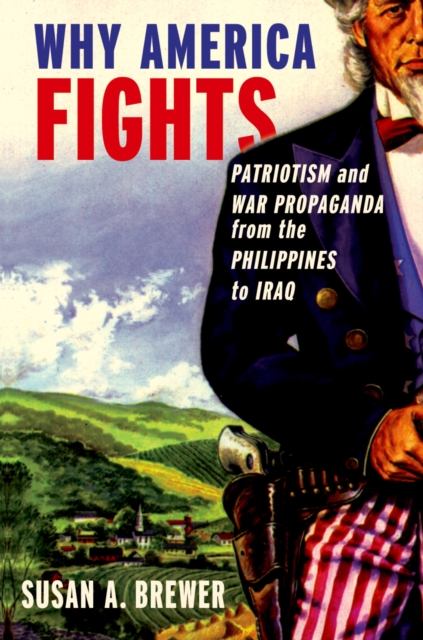
On the evening of September 11, 2002, with the Statue of Liberty shimmering in the background, television cameras captured President George W. Bush as he advocated war against Iraq. This carefully stage-managed performance, writes Susan A. Brewer, was the culmination of a long tradition of sophisticated wartime propaganda in America. In Why America Fights, Brewer offers a fascinating history of how successive presidents have conducted what Donald Rumsfeld calls “perception management,” from McKinley’s war in the Philippines to Operation Iraqi Freedom. Brewer’s intriguing account ranges from analyses of wartime messages to descriptions of the actual operations, from the dissemination of patriotic ads and posters to the management of newspaper, radio, and TV media. When Woodrow Wilson took the nation into World War I, he created the Committee on Public Information, led by George Creel, who called his job “the world’s greatest adventure in advertising.” In World War II, Roosevelt’s Office of War Information avowed a “strategy of truth,” though government propaganda still depicted Japanese soldiers as buck-toothed savages. In the Korean War, the Truman administration delineated differences between “good” and “evil” Asians, while portraying the conflict as a global battle between the Free World and Communism. After examining the ultimately failed struggle to cast the Vietnam War in a favorable light, Brewer shows how the Bush White House drew explicit lessons from that history as it engaged in an unprecedented effort to sell a preemptive war in Iraq. Yet the thrust of its message was not much different from McKinley’s pronouncements about America’s civilizing mission. Impressively researched and argued, filled with surprising details, Why America Fights shows how presidents consistently have drummed up support for foreign wars by appealing to what Americans want to believe about themselves.
eBook