
Catalogue Search | MBRL


Are you sure you want to remove the book from the shelf?

{{itemTitle}}
9,284
result(s) for
"pruning"
Sort by:


Hormones and brain plasticity
One of the most fascinating developments in the field of neuroscience in the second half of the 20th century was the discovery of the endogenous capacity of the brain for reorganization during adult life. Morphological and functional mechanisms underlying brain plasticity have been extensively explored and characterized. However, our understanding of the functional significance of these plastic changes is still fragmentary. This book shows that brain plasticity plays an essential role in the regulation of hormonal levels. The second aim is to propose that hormones orchestrate the multiple endogenous plastic events of the brain for the generation of adequate physiological and behavioral responses in adaptation to and in prediction of changing life conditions. The book starts by introducing the conceptual backgrounds on the interactions of hormones and brain plasticity. It then devotes itself to the analysis of the role of brain plasticity in the regulation of the activity of endocrine glands. It examines different hormonal influences on brain plasticity. Then, it goes on to cover the interactions of hormones and brain plasticity along the life cycle under physiological and pathological conditions.
eBook

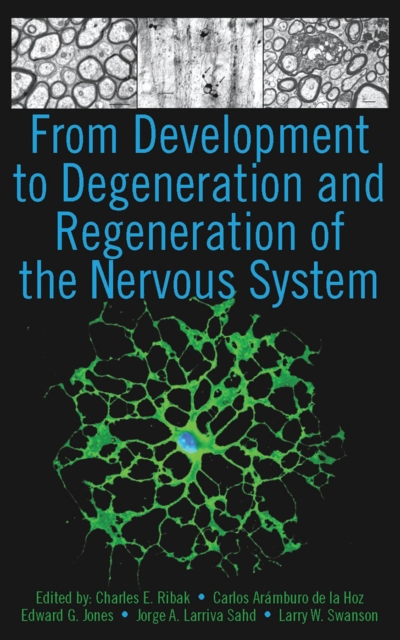
From development to degeneration and regeneration of the nervous system
This book describes current information about the three areas mentioned in the title: neuronal migration and development, degenerative brain diseases, and neural plasticity and regeneration. The chapters in the first section of the book examine the cellular and molecular mechanisms by which neurons are generated from the ventricular zone in the forebrain and migrate to their destinations in the cerebral cortex. This description of cortical development also includes discussions of the Cajal-Retzius cell. Another chapter provides insight about the development of another forebrain region, the hypothalamus. The remaining chapters of the first section examine the clinical relevance of brain development in certain disease states in humans. The second section begins with details about the dopaminergic neurons in the substantia niger and their loss in Parkinson's disease. Two subsequent chapters describe changes in brain aging, including changes in the numbers of myelinated axons. Other chapters in this section describe important cellular and molecular changes found in Alzheimer's disease and human epilepsy. The last section begins with a chapter on how the brain's own stem cells provide newly generated neurons to the hippocampal dentate gyrus and how these neurons become integrated into neural circuitry. Then two chapters examine some of the neuroplastic changes that take place in motor and sensory cortices of awake behaving primates. The concluding two chapters address the issue of regeneration in the injured spinal cord and the factors that may contribute to its success.
eBook


Cerebral Reorganization of Function After Brain Damage
This book integrates neuroscience research on neuroplasticity with clinical investigation of reorganization of function after brain injury, especially from the perspective of eventually translating the findings to rehabilitation. Historical foundation in neuroplasticity research are presented to provide a perspective for recent findings. Leading investigators synthesize their work with research from other laboratories to provide a current update on neuroanatomic features which enhance enuroplasticity and provide a substrate for reorginaization of function. The capacity for recovery from brain injury associated with focal lesions as compared to diffuse cerebral insult is discussed. Interventions such as environmental enhancement and drugs to enhance reorganizatioin of function after brain injury have been studied in animalmodels and in human studies. Methodologies to study neurophysiological measures, trancranial magnetic stimulation, and computational modeling. Implications of neuroplasticity research for innovations in rehabilitation of persons with brain injury are critically reviewed.
eBook


An Apple Tree Branch Pruning Analysis
The torque required to cut branches is an important parameter for designing a robotic end-effector for pruning apple (Malus ×domestica) trees. In this study, the branch cutting torque was measured because it is important for the future development of a robotic pruning end-effector. To measure the branch cutting torque, a force-measuring sensor was integrated with a manual shear pruner. An inertial measurement unit sensor was also used to monitor the angle between the shear blades and the branch. Field tests were conducted for ‘Fuji’, ‘Gala’, ‘Honeycrisp’, and ‘Golden Delicious’ trees, and the cutting torque was calculated for different branch diameters. The results indicated that the branch diameter is one of the most important factors influencing the pruning torque requirements for all tested cultivars. The statistical tests (0.05 significance) revealed that the pruning torque varies significantly for different branch diameters ranging from 6 to 20 mm. It was found that the cutting torque required for the ‘Honeycrisp’ branches was significantly lower than that for ‘Gala’, ‘Fuji’, and ‘Golden Delicious’ branches. ‘Gala’ branches had the highest torque requirements. To cut branches of ‘Fuji’ trees, the required cutting torque for branches placed at the cutter center was higher compared with the cutter pivot. The statistical tests indicated that the difference in required cutting torques for both branch–blade contact points was significant (0.05 level of significance). The cutting torque requirement for a 30° angle (bevel) cut was higher compared with a 0° (straight) cut for ‘Fuji’ apple trees, but the statistical analysis suggested that the difference was insignificant at a level of significance of 0.05. Comparing all test results (four cultivars and cutting settings), the highest cutting torque of 6.98 N⋅m was observed for ‘Fuji’ branches with a diameter of 20 mm for a straight cut with the branch placed at the shear cutter center. Therefore, it is suggested that the robotic pruner should provide a comparable torque for successful cutting. The outcomes of this study are important for the selection of appropriate cutting mechanisms for the future development of a robotic pruning system.
Journal Article

Poodling : on the just shaping of shrubbery
\"Poodling is a vernacular approach to pruning shrubbery: a negotiation between gardener and shrub that pits human aesthetic intention against the genetic forces that guide the plant's natural development. Topiary shears shrubs into a singular form geometric or figur e; poodling, in contrast, treats each branch individually and shapes its leaves or needles into the forms that remain at their ends. In this informed, if light-hearted, telling of the story, noted landscape historian Marc Treib traces the evolution and characteristics of topiary, espalier, and other forms of plant guidance such as poodling, proposing that what began as functional horticultural practices was transformed into a vehicle for artistic expression. Poodling catalogs the forms of pruning we encounter today and their probable origin in Japan during the eighteenth century. Noting the parallels, he compares the forms of poodling (vegetal) with those of the canine species poodle (animal), and the manne rs by which the dog's hair has been clipped. Richly illustrated with photographs by the author taken in many countries over three decades, this is an informative book that everyone can enjoy.\"--Publisher's website.
BOOK

Optimizing MobileNetV3 for multimodal eye gaze and emotion recognition via advanced pruning and quantisation techniques
This study introduces an innovative approach for optimising visual understanding by leveraging MobileNet V3 for eye-gazing, eye-blinks, and emotional expressions recognition. The importance of visual cues, such as gaze direction, blinking patterns, and facial expressions, in various applications, including human-computer interaction and behavioural analysis, is driving the need for efficient and accurate models that operate effectively in resource-constrained environments. MobileNet V3 offers a strong foundation for such tasks due to its lightweight architecture; however, it can be enhanced further to provide even greater performance. To achieve this, we apply advanced model optimisation techniques, including pruning and quantisation, to reduce computational complexity without compromising accuracy. We validate our approach using three distinct datasets: EyeGaze, Emotions, and Closed Eye, which offer diverse visual inputs across different scenarios. The results demonstrate that our optimised MobileNet V3 model accurately detects and analyses eye gaze, blinks, and emotional expressions, making it a robust algorithm for real-world applications. All the codes for reprehensibility and trained models can be found at
our github repository
.
Journal Article