
Catalogue Search | MBRL


Are you sure you want to remove the book from the shelf?

{{itemTitle}}
15
result(s) for
"public medievalism"
Sort by:

Why Study the Middle Ages?
The study of the Middle Ages in every aspect of the modern liberal arts—the humanities, STEM, and the social sciences—has significant importance for society and the individual. There is a common belief that the peoples of the past were somehow exempt from (positive, especially) human nature, had less of a sense of morality (by any definition) than we do now, or were unaware of basic human dilemmas or triumphs. Relegating the Middle Ages to \"primitive\" distances us from close examination of what has not changed in society—or what has, which might not be for the better. Exploring and exploding these (mis)conceptions is essential to experience the benefits of a liberal education.
eBook

Medievalism : a manifesto
Since the inclusion of medieval studies in the modern academy, professional scholars have insisted on distinguishing their work from extra-academic lovers of medieval culture. Richard Utz analyzes the semantic, institutional, and sociopolitical history of the relationship between medieval studies and medievalism. He provides a survey of how scholars' exteriorization of amateur interest in the medieval past narrowed the epistemological range of medieval scholarship and how reception studies, feminism, and postmodernism gradually expanded modern pastist approaches to the Middle Ages. Utz advances specific examples for reconnecting investigating scholarly subjects with their subjects of investigation, and he challenges scholars to make a conscious effort to engage in public scholarship and explore inclusive gestures toward the contributions non-academic lovers of the Middle Ages can offer. His manifesto advocates an active integration of academic medievalists' work within the many other equally valuable artistic and sociopolitical partner contexts of reading the medieval past.
eBook

Visions and ruins
This book is a study of cultural memory in and of the British Middle Ages. It works with material drawn from across the medieval period – in Old English, Middle English and Latin, as well as material and visual culture – and explores modern translations, reworkings and appropriations of these texts to examine how images of the past have been created, adapted and shared. It interrogates how cultural memory formed, and was formed by, social identities in the Middle Ages and how ideas about the past intersected with ideas about the present and future. It also examines how the presence of the Middle Ages has been felt, understood and perpetuated in modernity and the cultural possibilities and transformations this has generated. The Middle Ages encountered in this book is a site of cultural potential, a means of imagining the future as well as imaging the past.The scope of this book is defined by the duration of cultural forms rather than traditional habits of historical periodization and it seeks to reveal connections across time, place and media to explore the temporal complexities of cultural production and subject formation. It reveals a transtemporal and transnational archive of the modern Middle Ages.
eBook

Medievalism
Since the inclusion of medieval studies in the modern academy, professional scholars have insisted on distinguishing their work from extra-academic lovers of medieval culture. Richard Utz analyzes the semantic, institutional, and sociopolitical history of the relationship between medieval studies and medievalism. He provides a survey of how scholars’ exteriorization of amateur interest in the medieval past narrowed the epistemological range of medieval scholarship and how reception studies, feminism, and postmodernism gradually expanded modern pastist approaches to the Middle Ages. Utz advances specific examples for reconnecting investigating scholarly subjects with their subjects of investigation, and he challenges scholars to make a conscious effort to engage in public scholarship and explore inclusive gestures toward the contributions non-academic lovers of the Middle Ages can offer. His manifesto advocates an active integration of academic medievalists’ work within the many other equally valuable artistic and sociopolitical partner contexts of reading the medieval past.
eBook
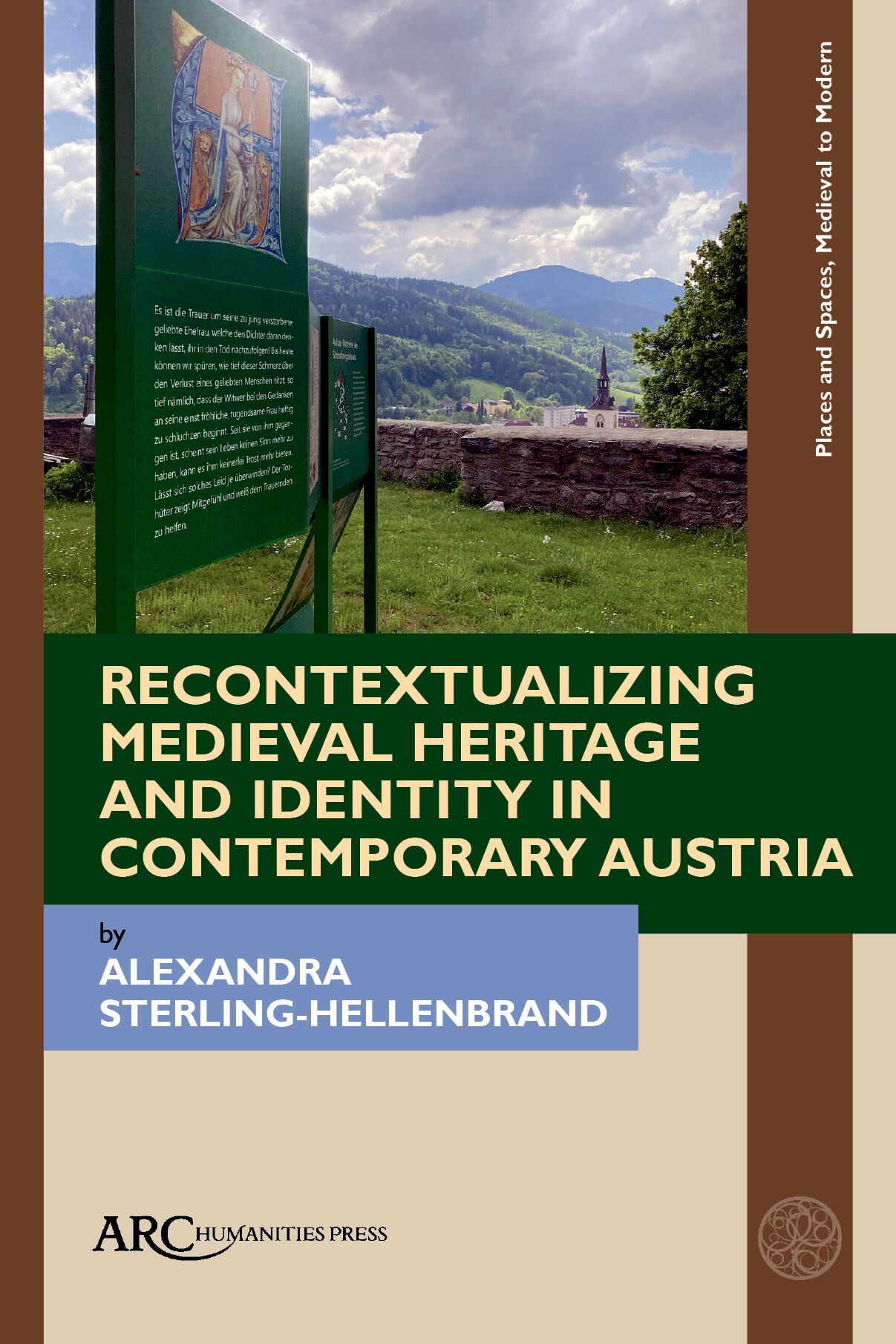
Recontextualizing Medieval Heritage and Identity in Contemporary Austria
This book explores ways in which the medieval narrative past has been re-imagined in contemporary Austria. Focusing on the Styrian Literature Pathways of the Middle Ages, the Nibelung monuments in the cities of Tulln and Pöchlarn on the Danube River, and the Siegfriedskopf at the University of Vienna, it argues that each installation constructively applies medievalism to the process of working through the twentieth-century past. Sterling-Hellenbrand uncovers how medieval texts have been re-created in the Austrian landscape and how public installations make visible the values of the communities that build them. The author demonstrates how these modern installations facilitate an innovative process of engaged remembering: they prompt us to initiate challenging conversations about the past to tell different stories for the future.
eBook

The Unruly Tongue
A cultural history of speech in medieval Italy
The Unruly Tongue , a cultural history of speech in
medieval Italy, offers a new account of how the power of words
changed in Western thought. Despite the association of freedom of
speech with the political revolutions of the eighteenth century
that ushered in the era of modern democracies, historian Melissa
Vise locates the history of the repression of speech not in
Europe's monarchies but rather in Italy's republics. Exploring the
cultural process through which science and medicine, politics, law,
literature, and theology together informed a new political ethics
of speech, Vise uncovers the formation of a moral code where the
regulation of the tongue became an integral component of republican
values in medieval Europe. The medieval citizens of Italy's
republics understood themselves to be wholly subject to the power
of words not because they lived in an age of persecution or
doctrinal rigidity, but because words had furnished the grounds for
their political freedom. Speech-making was the means for speaking
the republic itself into existence against the opposition of
aristocracy, empire, and papacy. But because words had power, they
could also be deployed as weapons. Speech contained the potential
for violence and presented a threat to political and social order,
and thus needed to be controlled. Vise shows how the laws that
governed and curtailed speech in medieval Italy represented broader
cultural understandings of human susceptibility to speech. Tracing
anthropologies of speech from religious to political discourse,
from civic courts to ecclesiastical courts, from medical texts to
the works of Dante and Boccaccio, The Unruly Tongue
demonstrates that the thirteenth century marked a major shift in
how people perceived the power, and the threat, of speech: a change
in thinking about \"what words do.\"
eBook

Medievalisms and Russia
This new monograph devoted to a detailed exploration of the ways in which the medieval past has been wielded to propagandic effect in Imperial, Soviet, and post-Soviet Russia.
From politicians' speeches to popular culture, from Orthodox Christianity to neo-paganism, the medieval Russian past remains crucial in constructing national identity, mobilizing society during times of crisis, and providing alternative models of communal belonging. Frequent appeals to a medieval Slavic past, its heroes and myths, have provided - and continue to provide - a particularly powerful tool for animating imperialist and populist sentiments.
This study explores persuasive - and pervasive - recourse to tropes concerned with the Middle Ages in Imperial, Soviet, and post-Soviet Russia, seeking to explain why an often romanticized medieval past remains potent in Russian politics, society, and culture today.
eBook

“Savage” and “Medieval” in C. S. Lewis’s The Discarded Image
This essay examines C. S. Lewis’s
The Discarded Image
(
1964
), in which he describes the structure of the medieval conception of the universe. C. S. Lewis remains a figure of significant interest and influence. However, his evocation of the Medieval Model is framed by a series of problematic analogies, in which he attempts to recover the “medieval” from its association with the “savage.” Lewis’s references to “savage belief” draw upon ideas out of date at the time of his writing, yet his construction of a pan-Western-European group identity, reflexively opposed to the African as the prototype of “savagery,” has attracted little comment. I explore how this framing of a medieval tradition reflects both his deeper concerns and ongoing mid-century debates on colonization. The essay is thus an occasion to consider why we have yet to move fully beyond the ethnic contours of C. S. Lewis’s Middle Ages.
Journal Article

Half-Remembering and Half-Forgetting? On Turning the Past of Old Norse Studies into a Future of Old Norse Studies
Many Humanities scholars seem to have become increasingly pessimistic due to a lack of success in their efforts to be recognized as a serious player next to their science, technology, engineering, and maths (STEM) colleagues. This appears to be the result of a profound uncertainty in the self-perception of individual disciplines within the Humanities regarding their role both in academia and society. This ambiguity, not least, has its roots in their own history, which often appears as an interwoven texture of conflicting opinions. Taking a stance on the current and future role of the Humanities in general, and individual disciplines in particular thus asks for increased engagement with their own past, i.e., histories of scholarship, which are contingent on societal and political contexts. This article’s focus is on a case study from the field of Old Norse Studies. In the face of the rise of populism and nationalism in our days, Old Norse Studies, with their focus on a ‘Germanic’ past, have a special obligation to address societal challenges. The article argues for the public engagement with the histories of individual disciplines to strengthen scholarly credibility in the face of public opinion and to overcome trenches which hamper attempts at uniting Humanities experts and regaining distinct social relevance.
Journal Article

Digital Medieval Studies-Practice and Preservation
In the last decade, the terms \"digital scholarship\" and \"digital humanities\" have become commonplace in academia, spurring the creation of fellowships, research centres, and scholarly journals. What, however, does this \"digital turn\" mean for how you do scholarship as a medievalist? While many of us would never describe ourselves as \"DH people,\" computer-based tools and resources are central to the work we do every day in offices, libraries, and classrooms. This volume highlights the exciting ways digital methods are expanding and re-defining how we understand, represent, and teach the Middle Ages, and provides a new model for how this work is catalogued and reused within the scholarly community. The work of its contributors offers valuable insights into how \"the digital\" continues to shape the questions medievalists ask and the ways they answer them, but also into how those questions and answers can lead to new tools, approaches, and points of reference within the field of digital humanities itself.
eBook