
Catalogue Search | MBRL


Are you sure you want to remove the book from the shelf?

{{itemTitle}}
1,650,891
result(s) for
"publishing"
Sort by:


Potential predatory and legitimate biomedical journals: can you tell the difference? A cross-sectional comparison
Background
The Internet has transformed scholarly publishing, most notably, by the introduction of open access publishing. Recently, there has been a rise of online journals characterized as ‘predatory’, which actively solicit manuscripts and charge publications fees without providing robust peer review and editorial services. We carried out a cross-sectional comparison of characteristics of potential predatory, legitimate open access, and legitimate subscription-based biomedical journals.
Methods
On July 10, 2014, scholarly journals from each of the following groups were identified – potential predatory journals (source: Beall’s List), presumed legitimate, fully open access journals (source: PubMed Central), and presumed legitimate subscription-based (including hybrid) journals (source: Abridged Index Medicus). MEDLINE journal inclusion criteria were used to screen and identify biomedical journals from within the potential predatory journals group. One hundred journals from each group were randomly selected. Journal characteristics (e.g., website integrity, look and feel, editors and staff, editorial/peer review process, instructions to authors, publication model, copyright and licensing, journal location, and contact) were collected by one assessor and verified by a second. Summary statistics were calculated.
Results
Ninety-three predatory journals, 99 open access, and 100 subscription-based journals were analyzed; exclusions were due to website unavailability. Many more predatory journals’ homepages contained spelling errors (61/93, 66%) and distorted or potentially unauthorized images (59/93, 63%) compared to open access journals (6/99, 6% and 5/99, 5%, respectively) and subscription-based journals (3/100, 3% and 1/100, 1%, respectively). Thirty-one (33%) predatory journals promoted a bogus impact metric – the Index Copernicus Value – versus three (3%) open access journals and no subscription-based journals. Nearly three quarters (
n
= 66, 73%) of predatory journals had editors or editorial board members whose affiliation with the journal was unverified versus two (2%) open access journals and one (1%) subscription-based journal in which this was the case. Predatory journals charge a considerably smaller publication fee (median $100 USD, IQR $63–$150) than open access journals ($1865 USD, IQR $800–$2205) and subscription-based hybrid journals ($3000 USD, IQR $2500–$3000).
Conclusions
We identified 13 evidence-based characteristics by which predatory journals may potentially be distinguished from presumed legitimate journals. These may be useful for authors who are assessing journals for possible submission or for others, such as universities evaluating candidates’ publications as part of the hiring process.
Journal Article

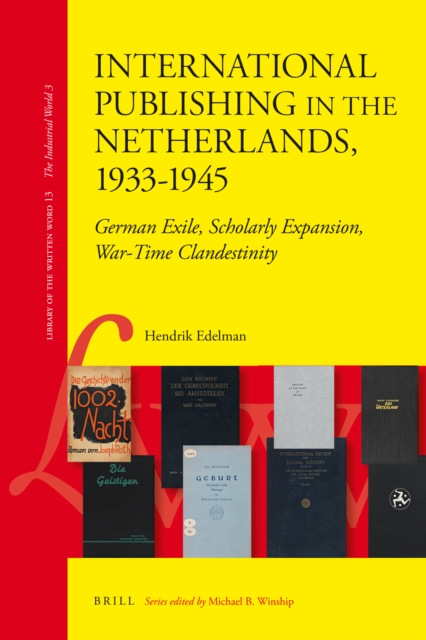
International Publishing in the Netherlands, 1933-1945
International publishing in the Netherlands experienced a remarkable revival after 1933, when the German Nazi government forced many prominent writers and researchers into exile. In a series of bio-bibliographical portraits of major participating Dutch publishers, this book documents the impact of German exile and changes in scholarly publishing.
eBook

Athena unbound : why and how scholarly knowledge should be free for all
\"This expansive history of knowledge and its openness makes a strong and nuanced case for opening scholarly knowledge to the public\"-- Provided by publisher.
BOOK

Orthodox by Design
Orthodox by Design, a groundbreaking exploration of religion and media, examines ArtScroll, the world's largest Orthodox Jewish publishing house, purveyor of handsomely designed editions of sacred texts and a major cultural force in contemporary Jewish public life. In the first in-depth study of the ArtScroll revolution, Jeremy Stolow traces the ubiquity of ArtScroll books in local retail markets, synagogues, libraries, and the lives of ordinary users. Synthesizing field research conducted in three local Jewish scenes where ArtScroll books have had an impact-Toronto, London, and New York-along with close readings of key ArtScroll texts, promotional materials, and the Jewish blogosphere, he shows how the use of these books reflects a broader cultural shift in the authority and public influence of Orthodox Judaism. Playing with the concept of design, Stolow's study also outlines a fresh theoretical approach to print culture and illuminates how evolving technologies, material forms, and styles of mediated communication contribute to new patterns of religious identification, practice, and power. Finalist for the National Jewish Book Award in the scholarship category, Jewish Book Council
eBook

Stop this waste of people, animals and money
Predatory journals are easy to please. They seem to accept papers with little regard for quality, at a fraction of the cost charged by mainstream open-access journals. These supposedly scholarly publishing entities are murky operations, making money by collecting fees while failing to deliver on their claims of being open access and failing to provide services such as peer review and archiving.
Journal Article