
Catalogue Search | MBRL


Are you sure you want to remove the book from the shelf?

{{itemTitle}}
3,016
result(s) for
"race‐ethnicity"
Sort by:


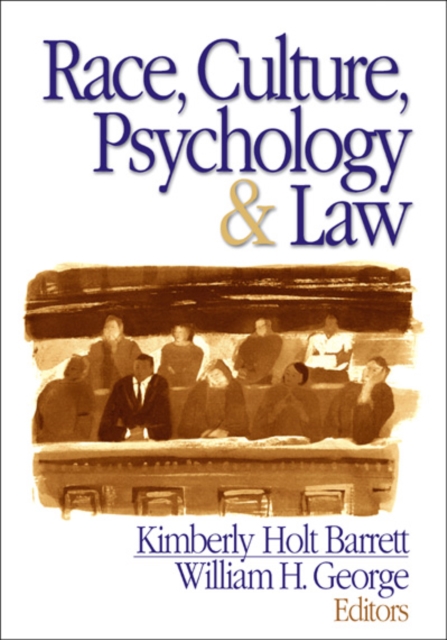
Race, culture, psychology, & law
Race, Culture, Psychology, and Law is the only book to provide summaries and analyses of culturally competent psychological and social services encountered within the U.S. legal arena. The book is broad in scope and covers the knowledge and practice crucial in providing comprehensive services to ethnic, racial, and cultural minorities. Topics include the importance of race relations, psychological testing and evaluation, racial \"profiling,\" disparities in death penalty conviction, immigration and domestic violence, asylum seekers, deportations and civil rights, juvenile justice, cross-cultural lawyering, and cultural competency in the administration of justice.
eBook


Commentary – Structural Racism
Why do racial inequalities endure despite numerous attempts to expand civil rights in certain sectors? A major reason for this endurance is due to lack of attention to structural racism. Although structural and institutional racism are often conflated, they are not the same. Herein, we provide an analogy of a “bucky ball” (Buckminsterfullerene) to distinguish the two concepts. Structural racism is a system of interconnected institutions that operates with a set of racialized rules that maintain White supremacy. These connections and rules allow racism to reinvent itself into new forms and persist, despite civil rights interventions directed at specific institutions. To illustrate these ideas, we provide examples from the fields of environmental justice, criminal justice, and medicine. Racial inequities in power and health will persist until we redirect our gaze away from specific institutions (and specific individuals), and instead focus on the resilient connections among institutions and their racialized rules.
Journal Article


A Teacher Like Me: A Review of the Effect of Student–Teacher Racial/Ethnic Matching on Teacher Perceptions of Students and Student Academic and Behavioral Outcomes
Considerable research has examined the positive educational experiences of students of color assigned to teachers of the same race or ethnicity. Underlying this research is the belief that the cultural fit between students and teachers has the potential to improve a child’s academic and nonacademic performance in school. This comprehensive review examines the extent to which Black and Latino/a students (1) receive more favorable ratings of classroom behavior and academic performance, (2) score higher on standardized tests, and (3) have more positive behavioral outcomes when assigned to a teacher of the same race/ethnicity. Assignment to a same-race teacher is associated with more favorable teacher ratings, although the relationship differs by school level. There is fairly strong evidence that Black students score higher on achievement tests when assigned to a Black teacher. Less consistent evidence is found for Latino/a students.
Journal Article

Racial‐ethnic stratification in work–family arrangements among Black, Hispanic, and white couples
Objective This article builds on work–family scholarship to document racial‐ethnic variation in couples' work–family arrangements, that is, how couples respond to their work and family demands. Background Existing research on the division of labor finds traditional gender norms continue to dictate how couples share paid and unpaid work in the United States. Yet, this narrative relies primarily on the structural conditions and cultural expectations of white and middle‐class women. Black and Hispanic women and men face different labor market opportunities and hold different cultural expectations about gendered responsibilities in families. Method The authors use the 2017–2019 Panel Study of Income Dynamics (https://psidonline.isr.umich.edu) and multi‐group latent‐class analysis to determine typical work–family arrangements for paid work, housework, and care work among U.S. different‐sex racially homogamous Black, Hispanic, and white couples, as well as how the prevalence of these arrangements vary across race‐ethnicity and life‐course stage. Results Black, Hispanic, and white couples respond to their work–family demands through one of six work–family arrangements depending on how partners spend time in adult care, childcare, housework, and paid work. Childcare and paid work emerge as stratifying mechanisms of how couples spend their time. Specifically, racial‐ethnic differences in distribution across work–family arrangement are large and greatest when couples have young children. Implications This article provides support for a couple‐level and life‐course approach to explaining how couples spend their time in work and family domains across racial‐ethnic lines.
Journal Article