
Catalogue Search | MBRL


Are you sure you want to remove the book from the shelf?

{{itemTitle}}
33,544
result(s) for
"regional law"
Sort by:

Emiratization in the UAE Labor Market : Opportunities and Challenges
This book combines classic and recent studies investigating challenges to Emiratization - full employment of Emirati nationals who make up only about 10% of the total workforce - in the United Arab Emirates (UAE). The book offers a comprehensive overview of the events leading to the country's rapid growth and development, as well as important social and cultural issues arising as the country transitioned from an isolated traditional economy to an open globalized one, and explores the specific challenges of incorporating Emiratis in their own vibrant economy. This topic is of interest to scholars, policymakers, and those considering investing or seeking employment in the UAE since it emerged as a Western-friendly, politically stable, and prospering oil-producing country in a region plagued by political, social, and economic turmoil.
Book

The institutionalisation of European spatial planning
The Institutionalisation of European Spatial Planning aims to clarify the enterprise of European spatial planning. The emphasis of the book lies on the need for a better understanding of the process of European integration in general. It particularly points at the emerging middle range theories that used concepts that were showing similarity to those that academics -those writing about planning- were accustomed to, such as networks, discourses and governance. The focus of this book is mostly on the post-European Spatial Development Perspective (ESDP)- the Committee of Spatial Development - from 1999 until now. As it is collection of articles, it has a different gestation process and does not tell a story from A to Z. What this book is about, however, is merely the issue concerning the institutional capacity of the ESDP and whether this has evaporated or not. The fact that this book exists at all suggests it has not.
eBook

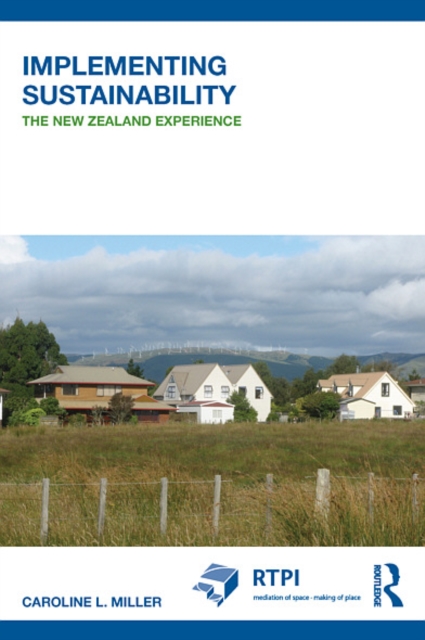
Implementing Sustainability
New Zealand’s Resource Management Act (RMA) was hailed as a radical new approach to planning that would both achieve better environmental outcomes and benefit developers by working rapidly and more efficiently.
This book examines the lessons that can be learned by planning practitioners across the world. It focuses on the realities of implementing the RMA for the planning profession, the community and the political system within which planning must always operate.
Offering a practitioner’s insight, the book looks at those strategies and techniques that have proved successful, and spells out what can be applied to the planning systems of other countries.
1. Introduction – Setting the Scene 2. Implementing Sustainability by Legislation - Institutions and Processes 3. Integrated Management and Regional Planning - Water, Air and Land 4. Urban Planning and the Built Environment 5. Energy and Infrastructure 6. Tangata Whenua and the Resource Management Act 7. The Profession, the Politicians and the Public 8. Conclusions – The Lessons from New Zealand
Caroline L. Miller is a senior lecturer in the Resource and Environmental Planning Programme at Massey University in Palmerston North where her teaching focuses on planning practice. She was a planning practitioner for some 15 years and is a Councillor of the New Zealand Planning Institute from which she received a Distinguished Service Award in 2007.
eBook

Moral rationalism and Sharīʻa : independent rationality in modern Shīʻī uṣūl al-fiqh
\"Moral rationalism and Sharīʻa is the first attempt at outlining the scope for a theological reading of Sharīʻa, based on a critical examination of why the ʻadliyā theological ethics hasn't significantly impacted Shīʻī readings of Shariʻa and how these resources may come to do so.\"-- Provided by publisher.
Book

List of Issues That Require Legal Regulation as Part of the Renewable Energy Regulation in Component States of Federation
The transition to renewable energy is strongly affected by legal regulation. To increase the efficiency of the introduction of renewable energy into the energy systems of component states of federations and accelerate the energy transition, it is necessary to carry out systematic work to improve regional legislation in this area. The purpose of this study was to analyze the current regulatory legal acts on the renewable energy of the regions of a number of countries such as the USA, Germany, India, Switzerland and Russia in order to form a universal list of issues that need regulation at the regional level. The main methods for achieving the objectives set in this study were the comparative legal method and the method of analysis and synthesis. As a result, a number of recommendations were developed describing how legal relations primarily need to be regulated by regional legislation, and examples of different approaches to their settlement were presented. The issues in need of legal regulation were divided into three groups according to the degree of importance of their regulation by the legislation of the component state of the federation. Further development of this study will be aimed at identifying the most effective industrial practices for resolving each of the issues included in the compiled list which will help improve the efficiency of regional legal regulation of renewable energy.
Journal Article

The European Union beyond the polycrisis? : integration and politicization in an age of shifting cleavages
'The European Union Beyond The Polycrisis?' explores the political dynamics of multiple crises faced by the EU, both at European level and within the member states. In so doing, it provides a state-of-the-art overview of current research on the relationship between politicization and European integration. The book proposes that the EU's multi-dimensional crisis can be seen as a multi-level 'politics trap', from which the Union is struggling to escape. The individual contributions analyse the mechanisms of this trap, its relationship to the multiple crises currently faced by the EU, and the strategies pursued by a plurality of actors (the Commission, the European Parliament, national governments) to cope with its constraints.
Book
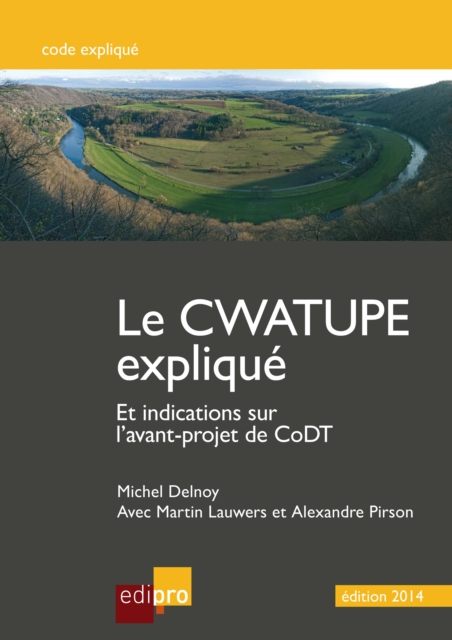
Le Cwatupe expliqué
Une explication du CWATUPE, code belge de l'urbanisme. Le champ d'application du CWATUPE est extrêmement vaste et son contenu ne peut plus être ignoré, tant il concerne tout acteur de la vie économique (architectes, entreprises, autorités publiques, avocats et notaires,...) par les contraintes qu'il impose.Depuis la troisième édition du présent ouvrage, et spécialement au cours de la seconde moitié de la législature 2004-2009, trop de modifications ont été apportées au code que pour pouvoir les résumer en quelques mots.
La législature 2009-2014, beaucoup plus calme, marquée par l''évaluation du code, pourrait bien déboucher sur l''adoption d''un code de développement territorial (CoDT) destiné à remplacer le CWATUPE.L'objectif de cette nouvelle édition est donc d'identifier clairement, dans le cadre de l''explication du code qu''il constitue, non seulement les nombreuses modifications apportées à ce code depuis la troisième édition, mais aussi les principaux changements qui pourraient résulter d''une adoption du CoDT. Pour une adoption du code de développement territorial (CoDT)? À PROPOS DES AUTEURS Michel Delnoy est avocat au Barreau de Liège, professeur invité HEC-ULg et membre du comité de rédaction de la revue Aménagement - Environnement. Il dirige le département de droit administratif du cabinet Bours & Associés, au sein duquel il pratique essentiellement le droit de l'urbanisme et de l'environnement.
Alexandre Pirson est titulaire d'un Master en droit de l'université de Liège depuis 2010 et exerce au cabinet Bours & Associés.
Martin Lauwers détient un Master en droit de l'université de Liège depuis 2009 et exerce également au cabinet Bours & Associés.
eBook

Refashioning secularisms in France and Turkey : the case of the headscarf ban
\"Over the past few years, secularism has become an intrinsic component of discussions on religious freedom and religious governance. The question of whether states should restrict the wearing of headscarves and other religious symbols has been particularly critical in guiding this thought process. Refashioning Secularisms in France and Turkey documents how, in both countries, devout women have contested bans on headscarves, pointing to how these are inconsistent with the 'real' spirit of secularism. These activists argue that it is possible to be simultaneously secular and religious; to believe in the values conveyed by secularism, while still remaining devoted to their faith. Through this examination, the book highlights how activists locate their claims within the frame of secularism, while at the same time revisiting it to craft a space for their religiosity. Addressing the lacuna in literature on the discourse of devout Muslims affected by these restrictions, this book offers a topical analysis on an understudied dimension of secularism and is a valuable resource for students and researchers with an interest in Religion, Gender Studies, Human Rights and Political Science. \"-- Provided by publisher.
Book

Activating Solidarity-Economy Territories: Towards a ‘Differently-New’ Economic Approach: The Case of the Friuli Venezia Giulia Region (Italy)
Since 2012, the University of Udine has been directly involved in research to study the Friuli Venezia Giulia (FVG) solidarity-economy sector, even collaborating to develop the first regional law on the solidarity economy (ESol). Recently, the university has implemented a project to profoundly investigate the practices that can be part of the Regional ESol tissue, based on the indications provided by the Regional Law 4/2017, to delimit and characterise them, know their distribution over the regional territory, and divide them by territorial areas (thinking about the activation of future economic-solidarity communities) and sectors (thinking about the activation of future economic-solidarity chains). After an initial qualitative analysis at the conceptual and values levels, and after building a database of regional ESol realities—useful for further qualitative–quantitative in-depth analysis in the future, too—we mapped and georeferenced the FVG ESol framework, obtaining indications on where to intervene to enhance ESol local supply chains as active laboratories for future bioregional territorial development, and to understand where the activation of local solidarity-based community assemblies is possible, to support local solidarity initiatives as the Regional Law states. The results show a regional picture rich in economic-solidarity realities spread throughout the territory with a wide variety of proposals but still struggling to concretely apply the tools provided by the Regional Law even though they are acting in the microsphere as cells of sustainable and solidarity-based “re-appropriation” and “re-inhabiting” of the territory. In this paper, we want to present the project results by discussing the size and characteristics of the regional solidarity-economic sector and the opportunity inherent in developing a different logic of “doing enterprise”, combining the need to produce wealth with maintaining, preserving, and enhancing our environment, cultivating an economical and productive culture distinct from the one still prevailing today, and making our territories “places of life”.
Journal Article