
Catalogue Search | MBRL


Are you sure you want to remove the book from the shelf?

{{itemTitle}}
1,729
result(s) for
"righteousness"
Sort by:

Outraged : why we fight about morality and politics and how to find common ground
\"In this insightful tour of the moral mind, Gray provides a groundbreaking new framework for our moral foundations that rewrites our understanding of where moral judgments come from, and how we can overcome the feelings of outrage that so often divide us\"-- Provided by publisher.
BOOK
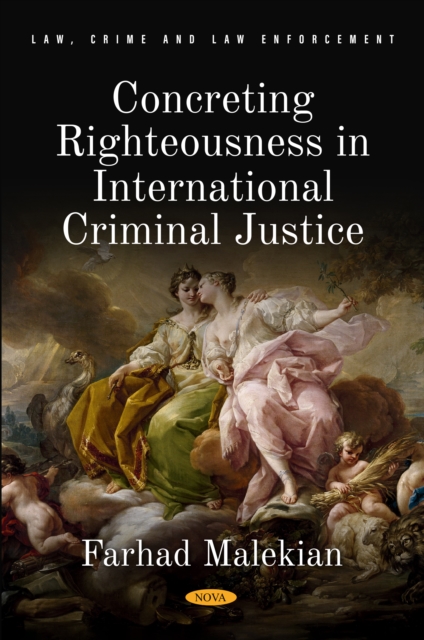
Concreting righteousness in criminal justice
\"The philosophy of being righteous essentially sustains our existence, questioning the sphere of morality in man. It reaches the colossal connotation of the royal essence of our natural virtue-if it exists-which can then institute the soul of all international human rights and criminal conventions. No matter what we include in our arguments and reasoning in relation to the content of justice itself, it is the sugarcoated perception of the improper use of our obligations that undermines its major philosophy. All divisive interpretations of the nature of rights and justice ultimately reveal how fragile our human rights ecosphere is and why there is a lack of criminal accountability for those who commit core international crimes. The truth is that justice is served without using any metaphysics of categorical righteousness. Consequently, the axiomatic merit of justice remains conceptually indistinct, as it cannot face the noble spirit of t
eBook

Christ the Matter and Form of Justification: A New Solution for Reconciling Imputed and Infused Righteousness
Writing from a Reformed perspective, I intend to develop a concept of the duplex iustitia. I will argue that it is possible to affirm that infused righteousness is the sole formal cause of justification, while holding that imputation is its material cause. My goal in doing so will be to enumerate another possible area of agreement so that areas of disagreement can be stated in sharper dynamic clarity and therefore more precisely addressed. First, I will articulate what precisely is at issue in the disagreement between Roman Catholics and the Reformed on the matter of justification’s cause. Here I will discuss the role union with Christ plays in both Roman Catholic and Reformed concepts of justification. From these foundations, I will then argue that a Reformed perspective on justification coheres with the Tridentine affirmation that the sole formal cause is the “righteousness of God by which he makes us just”, while retaining the affirmation that its proper material cause is the imputed righteousness of Christ. In this section, I will defend a version of the duplex iustitia. Third, I will conclude by analyzing how this proposal might move beyond some of the agreements reached in the Joint Declaration on the Doctrine of Justification (JDDF henceforth) of 1999 and the International Catholic-Reformed dialogue document “Justification and Sacramentality” of 2015, while also stating the limitations of my proposal. Finally, I will answer some anticipated objections.
Journal Article

Teologies-etiese perspektiewe op die begrip
Iustitia: Theological-ethical perspectives on the concept of ‘justice’ with particular reference to the position of Augustine and his far-reaching influence. Last year, at a conference of the ‘Kerkhistoriese Genootskap’ of the Nederduitsch Hervormde Kerk van Afrika (NHKA), the theme of ‘geregtigheid’ [righteousness] was investigated from various angles. The author of this article was invited to present on the views of the church father, Augustine, within a broad perspective. The objectives were to explain, illuminate and evaluate the views of Augustine and to focus on their relevance today. The customary methodology was followed: studying Augustine’s main texts about the subject and applying both classic and modern methodologies of Dogmatics. This implied an investigating, interpreting, comparing and evaluating Augustine’s ideas. Attention was also given to developments after Augustine as well as their implications for the South African situation. A short interlude on biblical perspectives was included. The result showed how much Augustine has influenced theology through the ages; how many positive perspectives he has brought forward, but also how many questions his theology has raised. The article concludes with views which clarify the fact that the theme of righteousness is of utmost importance in Christian theology and ethics, and cannot be understood without reference to God in Christ, reference to man and reference to the earth. The article ends with a final eschatological perspective: the concept of righteousness characterises the future hope of a new creation (2 Pt 3:13).ContributionThe main contribution of this article is contained in the last two pages which summarises its essence: Righteousness is imperative and indispensable for meaningful life on earth.The article ends with a final eschatological perspective: The concept of righteousness characterises the future hope of a new creation (2 Pt 3:13).
Journal Article

Paul, the Law and Judaism: Stoification of the Jewish Approach to the Law in Paul’s Letter to the Romans
One of the major issues in Pauline studies of the last decades has been the picture of Judaism painted by Paul especially in his Letter to the Romans. To that end, scholarship first and foremost adduced contemporary Jewish sources without, however, reaching satisfactory results. The present paper, therefore, takes a different approach in that it works out the Stoic influence on Paul’s argumentation. To begin with, the Stoic character of the dilemma of the “I” in Rom 7:14–25, that wills the good, but fails to do so, is demonstrated. Thereupon, it is shown that Paul transfers insights of Stoic psychology not only to the Jewish-Adamitic “I” but also to Israel’s approach to the law that is reached by neither one. Paul in Romans, therefore, can be said to stoify the Jewish approach to the law which especially reflects in the formula “righteousness by works of the law”.
Journal Article

The National Paradigm and Global Paradigm of the Rule of Law in Foreign-Related Affairs
The rule of law in foreign-related affairs in China operates under two paradigms: the national paradigm and the global paradigm. The national paradigm is dedicated to elevating the nation’s rule of law standards, promoting legalization of foreign-related work across all aspects and sectors, and improving legal methodologies in international engagements. It aims to safeguard China’s sovereignty, security, and development interests, protect the lawful rights and interests of Chinese citizens and legal entities overseas and enhance the nation’s rule of law image. The global paradigm demonstrates the sense of responsibility of China for actively participating in global governance, aiming to advance the international rule of law, contribute to world peace and development, and actively promote the building of a human community with a shared future. These are two complementary yet occasionally conflicting paradigms. A nation must firstly ensure its own independence, autonomy and sound development in order to contribute to the realization of the vision of a good global order. The traditional Chinese view of righteousness and interests helps to effectively guide the mutual promotion and restriction of the national paradigm and the global paradigm. With the national paradigm acting as a prerequisite for the global paradigm, we can properly allocate resources and form a structured, rigorous and reliable timeline and roadmap for the rule of law in foreign-related affairs.
Journal Article

The Righteousness of Joseph: Interpreting Matt 1.18–25 in Light of Judean Legal Papyri
This article seeks to explain Matthew's description of Joseph as righteous (δίκαιος) by investigating Matt 1.18–25 within its ancient context, especially Judean practices of marriage and divorce as illuminated by Judean legal papyri from the Dead Sea region in the first and second centuries ce and from the Judean politeuma of Herakleopolis in the mid-second century bce. The examination will demonstrate the importance of these papyri for understanding the narrative in Matt 1.18–25 in its original social setting where honour was a dominant value, especially the extent to which it reveals Joseph to be an exemplar of Matthean righteousness.
Journal Article

“Tap-dancing around the conversation”: difficulties in an intimate deep moral disagreement
We relate recent accounts of Wittgenstein-inspired deep disagreement to polarised understandings of sex and gender, considering their strengths and limitations in clarifying clashes that may sometimes appear in our most intimate sexual relationships. Our starting point is a heated and deeply disruptive argument between a man and a woman in a heterosexual relationship, presented in the lyrics and music video for Kendrick Lamar and Taylour Paige’s song ‘We Cry Together’. We use this example to bring out some of the fixed assumptions about the nature of deep disagreements, seen in Robert J. Fogelin’s account of forms of life, David M. Godden and William H. Brenner’s account of concept determination, Duncan Pritchard’s account of hinge commitments, and Victoria Lavorerio’s account of pictures. Though we find much of the discussion present in these accounts promising, we argue that none are able to grasp the messy, unpredictable, and constantly shifting nature of the (quite ordinary) disagreement in our example. This offers support to scholars who caution against making a priori claims about which topics (e.g. abortion) necessarily evoke deep disagreements, and suggests that we resist attempts to establish, a priori, what deep disagreements
must
look like, and how they
must
be resolved. This enables us to bring out the ways in which pig-headedness and self-righteousness, in our example, do not provide reasons to reject this particular disagreement as “genuinely” deep, but provide a picture of an emotional dynamic on which the depth of this particular deep moral disagreement seems to hinge.
Journal Article

A Character of Righteous Integrity in Light of God’s Reign: The Spirituality of Jesus According to Matthew
This essay examines Matthew’s depiction of both the spirituality demonstrated by Jesus’ actions and words (his own spirituality) and the spirituality he preaches (prescribes/expects of others). Key Matthean themes interweave in this topic. Jesus’ own spirituality and that which he expects of his followers are shaped most profoundly by the apocalyptic expectation of the imminent Reign of God. All practices and attitudes must be aligned with this coming reality. Because of this, the key mark of a true disciple or righteous person is integrity—the congruence of one’s inner character and outer actions, of one’s professed commitments and one’s behaviors. In this, Jesus is the paragon of integrity: everything he does is in alignment with the character of the coming Reign and God’s will. His actions are always a manifestation of his inner character as God’s son and messianic agent within God’s emerging Reign. Those who, like Jesus, manifest a character that is aligned with the realities of the coming age are called righteous and, at the judgment, are allowed to experience God’s Reign. Their attitudes and behaviors have shown that their inner character is in alignment with the character of the Reign of God. By contrast, the scribes and Pharisees are continually upbraided for their hypocrisy and warned that this will cause them to be barred from the Reign. Thus, the spirituality of Jesus in Matthew can be summed up as “spiritual integrity” (which is “righteousness”) shaped by the character of the imminent Reign of God. Jesus exemplifies this and calls his followers to demonstrate their character with integrity as well.
Journal Article