
Catalogue Search | MBRL


Are you sure you want to remove the book from the shelf?

{{itemTitle}}
478,524
result(s) for
"role"
Sort by:

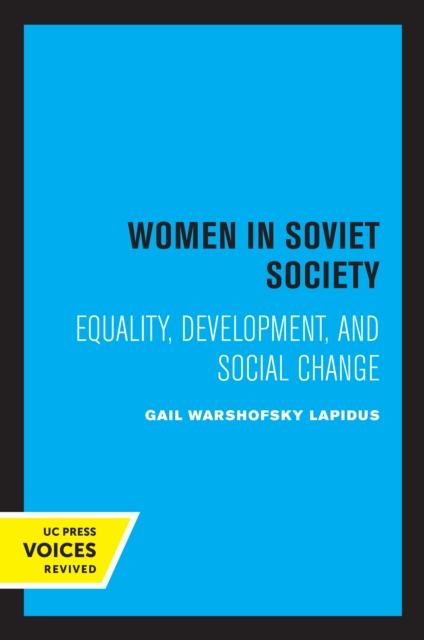
Women in Soviet Society
Women in Soviet Society: Equality, Development, and Social Change reframes one of the twentieth century's most sweeping social experiments: the promise--and limits--of Soviet sexual equality. Gail Warshofsky Lapidus moves beyond celebratory claims and simple indictments to offer a developmental account of how women's roles were mobilized to serve state-building, industrialization, and political consolidation. Anchored in Tocqueville's \"politics of equality\" and engaging Marxist, Leninist, and psychoanalytic debates, Lapidus tracks the tension between revolutionary ideals and institutional realities: the Zhenotdel's early activism; legal \"engineering\" around marriage, divorce, and abortion; the Stalinist synthesis that re-centered family authority while accelerating female labor-force participation; and postwar \"affirmative action, Soviet-style\" in protection laws, childcare, and education. The result is a nuanced portrait of gains and trade-offs--expanded access to schooling and work coupled with occupational segregation, wage penalties, and the enduring \"double burden\" created by underbuilt services and persistent domestic expectations. Structured with exceptional clarity, the book maps women's changing positions across economy, polity, and family, and then situates Soviet experience in comparative perspective. Chapters examine sectoral employment patterns, vertical stratification, and earnings; women's representation in Soviets, the Party, and the elite; demographic trends in marriage, divorce, fertility; and the policy reassessments that recast women alternately as productive and reproductive resources. Lapidus's core argument--that Leninist development instrumentalized equality while also enabling real social mobility--yields a balanced \"balance sheet\" of achievements and dilemmas. Drawing on law, policy, statistics, and contemporary debates,
she shows how modernization, ideological imperatives, and cultural continuities co-produced contradictory outcomes. For scholars of gender, Soviet studies, and comparative development, Women in Soviet Society offers a definitive, empirically grounded analysis that restores complexity to a case too often reduced to slogan or cautionary tale. This title is part of UC Press's Voices Revived program, which commemorates University of California Press's mission to seek out and cultivate the brightest minds and give them voice, reach, and impact. Drawing on a backlist dating to 1893, Voices Revived makes high-quality, peer-reviewed scholarship accessible once again using print-on-demand technology. This title was originally published in 1978. Many titles in the Voices Revived program are also newly available as ebooks, offered at a discounted price to support wider access to scholarly work.
eBook

Cosplay
Cosplay, a blend of costume and play, has taken off in popularity around the world. This volume introduces the history of this creative outlet and discusses how some people have taken the colorful and whimsical hobby and made it into a lucrative business.
Book

Laboring women : reproduction and gender in New World slavery
When black women were brought from Africa to the New World as slave laborers, their value was determined by their ability to work as well as their potential to bear children, who by law would become the enslaved property of the mother's master. In Laboring Women: Reproduction and Gender in New World Slavery , Jennifer L. Morgan examines for the first time how African women's labor in both senses became intertwined in the English colonies. Beginning with the ideological foundations of racial slavery in early modern Europe, Laboring Women traverses the Atlantic, exploring the social and cultural lives of women in West Africa, slaveowners' expectations for reproductive labor, and women's lives as workers and mothers under colonial slavery.
Challenging conventional wisdom, Morgan reveals how expectations regarding gender and reproduction were central to racial ideologies, the organization of slave labor, and the nature of slave community and resistance. Taking into consideration the heritage of Africans prior to enslavement and the cultural logic of values and practices recreated under the duress of slavery, she examines how women's gender identity was defined by their shared experiences as agricultural laborers and mothers, and shows how, given these distinctions, their situation differed considerably from that of enslaved men. Telling her story through the arc of African women's actual lives--from West Africa, to the experience of the Middle Passage, to life on the plantations--she offers a thoughtful look at the ways women's reproductive experience shaped their roles in communities and helped them resist some of the more egregious effects of slave life.
Presenting a highly original, theoretically grounded view of reproduction and labor as the twin pillars of female exploitation in slavery, Laboring Women is a distinctive contribution to the literature of slavery and the history of women.
eBook

Leadership and role modelling : understanding workplace dynamics
This edited volume explores the influence of role modelling as a process in the workplace; in particular, whether it can aid career development, offer psycho-social support, and provide the motivation and means to achieve goals. Chapters examine whether the dynamics of personal identification and self-belief can affect the way that role models are chosen, placing emphasis on geographical diversity and cultural aspects. By including studies of gender and followership in both American and Indian settings, the scholars and practitioners who contribute to this collection outline key aspects of role modelling, and its effect as a developmental tool in the workplace, from the perspective of the individual and organisations. This book is a valuable resource for academics interested in organisations, management, and diversity, as well as practitioners and policy-makers involved in leadership programmes, who will find its collection of both theoretical and empirical findings extremely useful.
Book

The Future of Nursing
The Future of Nursing explores how nurses' roles, responsibilities, and education should change significantly to meet the increased demand for care that will be created by health care reform and to advance improvements in America's increasingly complex health system.
At more than 3 million in number, nurses make up the single largest segment of the health care work force. They also spend the greatest amount of time in delivering patient care as a profession. Nurses therefore have valuable insights and unique abilities to contribute as partners with other health care professionals in improving the quality and safety of care as envisioned in the Affordable Care Act (ACA) enacted this year.
Nurses should be fully engaged with other health professionals and assume leadership roles in redesigning care in the United States. To ensure its members are well-prepared, the profession should institute residency training for nurses, increase the percentage of nurses who attain a bachelor's degree to 80 percent by 2020, and double the number who pursue doctorates. Furthermore, regulatory and institutional obstacles-including limits on nurses' scope of practice-should be removed so that the health system can reap the full benefit of nurses' training, skills, and knowledge in patient care.
In this book, the Institute of Medicine makes recommendations for an action-oriented blueprint for the future of nursing.
eBook

Perspectives in role ethics : virtues, reasons, and obligation
\"Although our moral lives would be unrecognisable without them, roles have received little attention from analytic moral philosophers. Roles are central to our lives and to our engagement with one another, and should be analysed in connection with our core notions of ethics such as virtue, reason, and obligation. This volume aims to redress the neglect of role ethics by confronting the tensions between conceptions of impartial morality and role obligations in the history of analytic philosophy and the Confucian tradition. Different perspectives on the ethical significance of roles can be found by looking to debates within professional and applied ethics, by challenging existing accounts of how roles generate reasons, by questioning the hegemony of ethical reasons, and by exploring the relation between expertise and virtue. The essays tackle several core questions related to these debates: - What are roles and what is their normative import? - To what extent are roles and the ethics of roles central to ethics as opposed to virtue in general, and obligation in general? - Are role obligations characteristically incompatible with ordinary morality in professions such as business, law, and medicine? - How does practical reason function in relation to roles? Perspectives in Role Ethics is an examination of a largely neglected topic in ethics. It will appeal to a broad range of scholars in normative ethics, virtue ethics, non-Western ethics, and applied ethics interested in the importance of roles in our moral life\"-- Provided by publisher.
Book

Sex/Gender
Sex/Gender presents a relatively new way to think about how biological difference can be produced over time in response to different environmental and social experiences.
This book gives a clearly written explanation of the biological and cultural underpinnings of gender. Anne Fausto-Sterling provides an introduction to the biochemistry, neurobiology, and social construction of gender with expertise and humor in a style accessible to a wide variety of readers. In addition to the basics, Sex/Gender ponders the moral, ethical, social and political side to this inescapable subject.
An interview with the author! WOMR - The Lowdown with Ira Wood - Sex an Gender Identity with Anne Fausto-Sterling: http://www.publicbroadcasting.net/womr/.jukebox?action=viewMedia&mediaId=1025429
eBook

Unequal family lives : causes and consequences in Europe and the Americas
\"Across the Americas and Europe, the family has changed and marriage is in retreat. To answer the question of what's driving these changes and how they impact social and economic inequality, progressives have typically focused on the economic causes of changing family structures, whereas conservatives tend to stress cultural and policy roots. In this illuminating book, an international group of scholars revisit these issues, offering competing and contrasting perspectives from left, center, and right, while also adding a third layer of analysis: namely, the role of gender - changes in women's roles, male employment patterns, and gendered family responsibilities - in driving family change across three continents. This book adds richness and depth to our understanding of the relationship between family and economics in the United States, Europe, and Latin America\"--Back cover.
Book

Prostitutes and Courtesans in the Ancient World
Prostitutes and Courtesans in the Ancient World explores the implications of sex-for-pay across a broad span of time, from ancient Mesopotamia to the early Christian period. In ancient times, although they were socially marginal, prostitutes connected with almost every aspect of daily life. They sat in brothels and walked the streets; they paid taxes and set up dedications in religious sanctuaries; they appeared as characters—sometimes admirable, sometimes despicable—on the comic stage and in the law courts; they lived lavishly, consorting with famous poets and politicians; and they participated in otherwise all-male banquets and drinking parties, where they aroused jealousy among their anxious lovers.
The chapters in this volume examine a wide variety of genres and sources, from legal and religious tracts to the genres of lyric poetry, love elegy, and comic drama to the graffiti scrawled on the walls of ancient Pompeii. These essays reflect the variety and vitality of the debates engendered by the last three decades of research by confronting the ambiguous terms for prostitution in ancient languages, the difficulty of distinguishing the prostitute from the woman who is merely promiscuous or adulterous, the question of whether sacred or temple prostitution actually existed in the ancient Near East and Greece, and the political and social implications of literary representations of prostitutes and courtesans.
eBook