
Catalogue Search | MBRL


Are you sure you want to remove the book from the shelf?

{{itemTitle}}
3,244
result(s) for
"roman antiquities"
Sort by:


Materia Magica
This exciting new study draws on objects excavated or discovered in the late nineteenth or early twentieth century at three Mediterranean sites. Through the three case studies,Materia Magicaidentifies specific forms of magic that may be otherwise unknown. It isolates the practitioners of magic and examines whether magic could be used as a form of countercultural resistance. Andrew T. Wilburn discovers magic in the objects of ancient daily life, suggesting that individuals frequently turned to magic, particularly in crises. Local forms of magic may have differed, and Wilburn proposes that the only way we can find small-town sorcerers is through careful examination of the archaeological evidence.
Studying the remains of spells enacted by practitioners, Wilburn's work unites the analysis of the words written on artifacts and the physical form of these objects. He situates these items within their contexts, to study how and why they were used.Materia Magicaapproaches magic as a material endeavor, in which spoken spells, ritual actions, and physical objects all played vital roles in the performance of a rite.
Materia Magicadevelops a new method for identifying and interpreting the material remains of magical practice by assessing artifacts within their archaeological contexts. Wilburn suggests that excavations undertaken in recent centuries can yield important lessons about the past, and he articulates the ways in which we can approach problematic data.
eBook

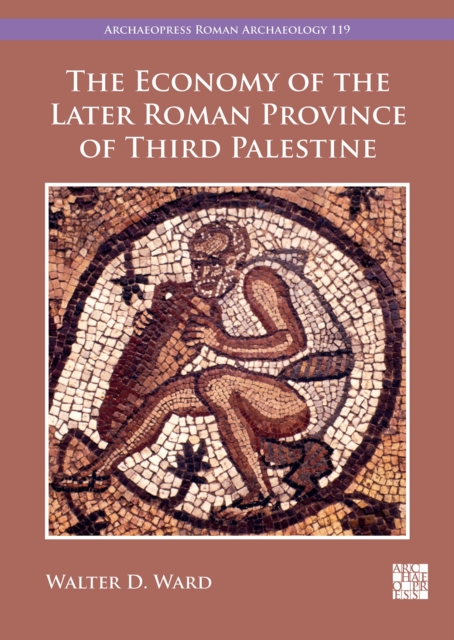
The Economy of the Later Roman Province of Third Palestine
This book provides a comprehensive examination of the evidence
for the economy of the later Roman province of Third Palestine,
which roughly corresponds to southern Jordan, the Negev desert in
Israel, and the Sinai Peninsula. It begins with a discussion of the
historiography and attempts to create modern models (cliometrics)
to explain the ancient economy. After covering this foundational
material, the author uses archaeological data, papyri, and literary
sources to understand agriculture and pastoralism in the largely
arid province, and he examines the limited evidence for the urban
economy and industry, focusing on ceramics and copper production.
The next chapter looks at regional trade in the province by
plotting the finds of four amphorae types and also examines the
trade in fish from the Red Sea through faunal remains and papyri.
The chapter ends with a discussion of the date trade and the
records of a particular caravan described in the Nessana papyri.
The focus then shifts to the role of international trade, including
Red Sea trade through the port of Aila and trade with Mecca. Next,
the economic impact of monasticism and pilgrimage on the province
is appraised. The final chapter critically evaluates the role of
economic modeling and quantification for understanding the economy
of Third Palestine. It argues that the ancient economy was neither
primitive, nor modern, but something unique that should be
approached without introducing contemporary assumptions.
eBook

Roman Period Statuettes in the Netherlands and beyond
The subject of this study is a relatively rare category of artefacts, bronze and terracotta statuettes that represent deities, human figures and animals. They were introduced in the northwestern provinces by Roman troops from the end of the first century BCE onwards. The statuettes have been recovered from military and non-military settlements, the surrounding landscape and, to a far lesser extent, from sanctuaries and graves. Until now, their meaning and function have seldom been analysed in relation to their find-spots. Contrary to traditional studies, they have been examined as one separate category of artefacts, which offers new insights into the distribution pattern and iconographic representation of deities. When studying a group of artefacts, a large research area or a large dataset is required, as well as dateable artefacts and find-contexts. These conditions do not apply to the Netherlands and to the majority of statuettes that are central to this study. Moreover, although the changing appearance of statuettes suggest a transformation of cults, the identities of the owners of these statuettes remain invisible to us. Therefore, the issue of Romanization is not put central here. Instead, the focus is on a specific aspect of religion, known as lived religion, within the wider subject of its transformation in the Roman period: how people used statuettes in everyday life, in the context of their houses and settlements.
eBook

The Ruin of Roman Britain
How did Roman Britain end? This new study draws on fresh archaeological discoveries to argue that the end of Roman Britain was not the product of either a violent cataclysm or an economic collapse. Instead, the structure of late antique society, based on the civilian ideology of paideia, was forced to change by the disappearance of the Roman state. By the fifth century elite power had shifted to the warband and the edges of their swords. In this book Dr Gerrard describes and explains that process of transformation and explores the role of the 'Anglo-Saxons' in this time of change. This profound ideological shift returned Britain to a series of 'small worlds', the existence of which had been hidden by the globalizing structures of Roman imperialism. Highly illustrated, the book includes two appendices, which detail Roman cemetery sites and weapon trauma, and pottery assemblages from the period.
eBook


The Idea of Rome in Late Antiquity
This book approaches the manifestation and evolution of the idea of Rome as an expression of Roman patriotism and as an (urban) archetype of utopia in late Roman thought in a period extending from AD 357 to 417. Within this period of about a human lifetime, the concepts of Rome and Romanitas were reshaped and used for various ideological causes. This monograph unfolds through a selection of sources that represent the patterns and diversity of this ideological process. The theme of Rome as a personified and anthropomorphic figure and as an epitomized notion 'applied' on the urban landscape would become part of the identity of the Romans of Rome highlighting a sense of cultural uniqueness in an era when their city's privileged status was challenged. Towards the end of the chronological limits set in this thesis various versions of Romanitas would emerge indicating new physical and spiritual potentials.
eBook