
Catalogue Search | MBRL


Are you sure you want to remove the book from the shelf?

{{itemTitle}}
16,266
result(s) for
"russian studies"
Sort by:

The texture of culture : an introduction to Yuri Lotman's semiotic theory
\"This book is an introduction to the semiotic theory of one of the most original thinkers of the twentieth century, the Russian literary scholar and semiotician Yuri Lotman. The book offers a new look at Lotman's profound legacy and attempts to demonstrate how Lotman's holistic theory, transcending the traditional boundaries of academic disciplines, offers a genuinely interdisciplinary approach to culture. This study also makes Lotman accessible to a larger audience not limited only to specialists in Slavic studies and semiotics, covering a wide range of topics, from artificial intelligence to the role of an individual in history\"-- Provided by publisher.
Book

Language and Culture in Eighteenth-Century Russia
Victor Zhivov's Language and Culture in Eighteenth-Century Russia is one of the most important studies ever published on eighteenth-century Russia. Historians and students of Russian culture agree that the creation of a Russian literary language was key to the formation of a modern secular culture, and this title traces the growth of a vernacular language from the \"hybrid Slavonic\" of the late seventeenth century through the debates between \"archaists and innovators\" of the early nineteenth century. Zhivov's study is an essential work on the genesis of modern Russian culture; the aim of this translation is to make it available to historians and students of the field.
eBook

Night train to Odessa : covering the human cost of Russia's war
When Russian tanks rolled into Ukraine, millions of lives changed in an instant. Millions of people were suddenly on the move. In this great flow of people was a reporter from the north of Scotland. Jen Stout left Moscow abruptly, ending up on a border post in southeast Romania, from where she began to cover the human cost of Russian aggression. Her first-hand, vivid reporting brought the war home to readers in Scotland as she reported from front lines and cities across Ukraine. Stories from the night trains, birthday parties, military hospitals and bunkers: stories from the ground, from a writer with a deep sense of empathy, always seeking to understand the bigger picture, the big questions of identity, history, hopes and fears in this war in Europe.
BOOK

Pharmapolitics in Russia
Over the last one hundred years, the Russian pharmaceutical
industry has undergone multiple dramatic transformations, which
have taken place alongside tectonic political shifts in society
associated with the rise and fall of the Soviet Union and the
emergence of a post-Soviet order. Pharmapolitics in Russia
argues that different versions of the Russian pharmaceutical
industry took shape in a co-productive process, equally involving
political ideologies and agendas, and technoscientific developments
and constraints. Drawing on interviews, documents, literature, and
media sources, Olga Zvonareva examines critical points in the
history of the pharmaceutical industry in Russia. This includes the
emergence of Soviet drug research and development, the short-lived
neoliberal turn of the 1990s, and the ongoing efforts of the
Russian government to boost local pharmaceutical innovation, which
in turn produced a now widely shared vision of an independent and
self-sufficient nation. The resulting industrial organizations and
practices, she argues, came to embed and transmit particular
imaginaries of the nation and its future.
eBook

The Syntax of Russian
The study of Russian is of great importance to syntactic theory, due in particular to its unusual case system and its complex word order patterns. This book provides an essential guide to Russian syntax and examines the major syntactic structures of the language. It begins with an overview of verbal and nominal constituents, followed by major clause types, including null-copular and impersonal sentences, WH-questions and their distribution, and relative and subordinate clauses. The syntax behind the rich Russian morphological case system is then described in detail, with focus on both the fairly standard instances of Nominative, Accusative and Dative case as well as the important language-specific uses of the Genitive and Instrumental cases. The book goes on to analyze the syntax of 'free' word order for which Russian is famous. It will be of interest to researchers and students of syntactic theory, of Slavic linguistics and of language typology.
eBook

Nina Kaucisvili's contribution to the Studies on Russian Culture and Spirituality
This paper outlines the multifaceted intellectual profile of Nina Kaucisvili (1919–2000), from her cosmopolitan education to the development of her distinguished career as a scholar and professor of Russian literature. Her research and teaching primarily focused on the works of Dostoevskij and Gogol’ from the nineteenth century, and Andrej Belyj from the twentieth, applying the theories of the Russian formalists—particularly those of Jurij Lotman—to the analysis of their writings. A significant phase of her scholarly activity centered on the philosophical and aesthetic works of Pavel Florenskij.Thanks to her exceptional ability to identify innovative research directions and to foster opportunities for scholarly debate with leading international experts, the Slavic Department at the University of Bergamo became a major hub for Russian studies. The international academic community recognized not only her original approach to Russian-Italian cultural relations, but also her efforts to broaden cultural discourse to include twentieth-century Russian spirituality, both within Russia and in emigration.
Journal Article

Theoretical and Experimental Aspects of Syntax-Discourse Interface in Heritage Grammars
InTheoretical and Experimental Aspects of Syntax-Discourse Interface in Heritage Grammars,Tanya Ivanova-Sullivan investigates comprehension and production of anaphoric dependencies in heritage Russian. She explains the representational and processing mechanisms behind the divergent behaviour of the experimental group.
eBook
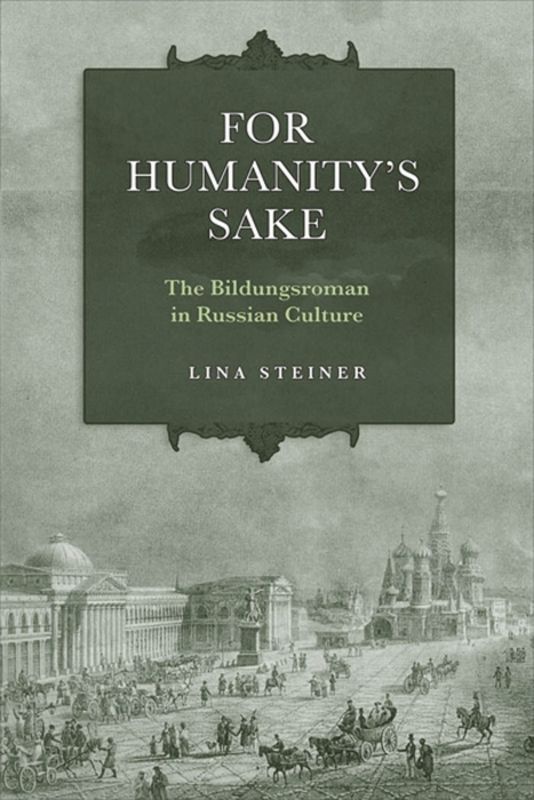
For Humanity's Sake
Positing the classic Russian novel as an inheritor of the Enlightenment's key values — including humanity, self-perfection, and cross-cultural communication —For Humanity's Sakeoffers a unique view of Russian intellectual history and literature.
eBook
Russian Diachronic Linguistics and Philology. Three Decades of Research in Italy (years 1991-2021)
The present paper provides scholars with a critical assessment of research into Russian diachronic linguistics and Russian philology carried out by Italian Slavicists over the last thirty years. This article first examines how Italian scholars have understood and engaged with fundamental issues in the history of the Russian language, which have been at the centre of discussion on an international level. It then explores the advances made in Italian research on historical grammar and emphasises the peculiarity of the approach to textual criticism developed by Italian scholars and its relevance to Russian philology. Finally, the paper discusses major Italian contributions regarding specific issues in Russian diachronic linguistics and philology, which reveal innovative solutions to long-standing problems. While further exploration is necessary in several areas, in qualitative terms, the hitherto accomplished research cannot but be positively assessed.
Journal Article

Slavophile Thought and the Politics of Cultural Nationalism
Susanna Rabow-Edling examines the first theory of the Russian nation, formulated by the Slavophiles in the second quarter of the nineteenth century, and its relationship to the West. Using cultural nationalism as a tool for understanding Slavophile thinking, she argues that a Russian national identity was not shaped in opposition to Europe in order to separate Russia from the West. Rather, it originated as an attempt to counter the feeling of cultural backwardness among Russian intellectuals by making it possible for Russian culture to assume a leading role in the universal progress of humanity. This reinterpretation of Slavophile ideas about the Russian nation offers a more complex image of the role of Europe and the West in shaping a Russian national identity.
eBook