
Catalogue Search | MBRL


Are you sure you want to remove the book from the shelf?

{{itemTitle}}
10,939
result(s) for
"sadness"
Sort by:


Time and Covid-19 stress in the lockdown situation: Time free, «Dying» of boredom and sadness
A lockdown of people has been used as an efficient public health measure to fight against the exponential spread of the coronavirus disease (Covid-19) and allows the health system to manage the number of patients. The aim of this study (clinicaltrials.gov NCT00430818) was to evaluate the impact of both perceived stress aroused by Covid-19 and of emotions triggered by the lockdown situation on the individual experience of time. A large sample of the French population responded to a survey on their experience of the passage of time during the lockdown compared to before the lockdown. The perceived stress resulting from Covid-19 and stress at work and home were also assessed, as were the emotions felt. The results showed that people have experienced a slowing down of time during the lockdown. This time experience was not explained by the levels of perceived stress or anxiety, although these were considerable, but rather by the increase in boredom and sadness felt in the lockdown situation. The increased anger and fear of death only explained a small part of variance in the time judgment. The conscious experience of time therefore reflected the psychological difficulties experienced during lockdown and was not related to their perceived level of stress or anxiety.
Journal Article
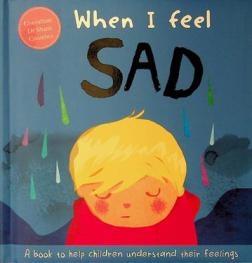
When I feel sad : a book to help children understand their feelings
When I feel sad, I try looking around me at all the bright and colourful things.
Book

The role of emotions reported in the emergency department in four-month chronic pain development: Effects of sadness and anger
This study aims to assess whether the emotions experienced during an urgent health problem represent risk factors for developing chronic pain.
A pain study was carried out as part of a randomized multicentre study on the prevention of post-concussion syndrome and post-traumatic stress syndrome (SOFTER) following emergency hospitalisation. Nine hundred and fourteen patients not suffering from chronic pain at admission provided information on the presence and intensity of eight emotions (anger, fear, regret, sadness, relief, contentment, joy, and interest) during their stay at the emergency department. Four months later, they were called to assess if chronic pain had developed. The predisposition to experience these emotions prior to the emergency room was questioned at this occasion.
Four months after their admission to the emergency department (ED), 30 % of the patients described experiencing chronic pain. Adjusted for patient's perception of own health, intensity of acute pain, reason for visit and level of education at the time of admission, sadness (OR = 1.5 95 % CI = [1.1–2.2]) and anger (OR = 1.6 95 % CI = [1.1–2.5]) declared in the ED were predictive of pain status at four months. By taking into account patient pre-disposition to feel each of these two emotions, we observed a significantly higher risk of chronic pain at four months among patients pre-disposed to anger who declared a relatively strong anger during their time spent in the ED (OR = 2.90, IC = 1.12–7.52).
This study shows that the emotional state of patients admitted to the ED must be taken into consideration in order to detect people likely to experience chronic pain and therefore offer personalised preventive treatment. Further studies will be necessary to better comprehend the role played by emotions in the development of chronic pain.
Journal Article


Depression and loneliness of older adults in Europe and Israel after the first wave of covid-19
Epidemic control measures that aim to introduce social distancing help to decelerate the spread of the COVID-19 pandemic. However, their consequences in terms of mental well-being might be negative, especially for older adults. While existing studies mainly focus on the time during the first lockdown, we look at the weeks afterward in order to measure the medium-term consequences of the first wave of the pandemic. Using data from the SHARE Corona Survey, we include retired respondents aged 60 and above from 25 European countries plus Israel. Combining SHARE data with macro-data from the Oxford COVID-19 Government Response Tracker allows us to include macro-indicators at the country level, namely the number of deaths per 100,000 and the number of days with stringent epidemic control measures, in addition to individual characteristics. The findings show that both macro-indicators are influential for increased feelings of sadness/depression, but that individual factors are crucial for explaining increased feelings of loneliness in the time after the first lockdown. Models with interaction terms reveal that the included macro-indicators have negative well-being consequences, particularly for the oldest survey participants. Additionally, the results reveal that especially those living alone had a higher risk for increased loneliness in the time after the first COVID-19 wave.
Journal Article

Bear feels sad
\"Bear spends the day missing his friends until they reunite\"-- Provided by publisher.
BOOK

Sadness, but not all negative emotions, heightens addictive substance use
Do negative feelings in general trigger addictive behavior, or do specific emotions play a stronger role? Testing these alternative accounts of emotion and decision making, we drew on the Appraisal Tendency Framework to predict that sadness, specifically, rather than negative mood, generally, would 1) increase craving, impatience, and actual addictive substance use and 2) do so through mechanisms selectively heightened by sadness. Using a nationally representative, longitudinal survey, study 1 (n = 10,685) revealed that sadness, but not other negative emotions (i.e., fear, anger, shame), reliably predicted current smoking as well as relapsing 20 years later. Study 2 (n = 425) used an experimental design, and found further support for emotion specificity: Sadness, but not disgust, increased self-reported craving relative to a neutral state. Studies 3 and 4 (n = 918) introduced choice behavior as outcome variables, revealing that sadness causally increased impatience for cigarette puffs. Moreover, study 4 revealed that the effect of sadness on impatience was more fully explained by concomitant appraisals of self-focus, which are specific to sadness, than by concomitant appraisals of negative valence, which are general to all negative emotions. Importantly, study 4 also examined the topography of actual smoking behavior, finding that experimentally induced sadness (as compared to neutral emotion) causally increased the volume and duration of cigarette puffs inhaled. Together, the present studies provide support for a more nuanced model regarding the effects of emotion on tobacco use, in particular, as well as on addictive behavior, in general.
Journal Article

I'm sad
Flamingo learns that it is okay to be sad sometimes and that her friends, the little girl and Potato, will stand by her no matter how she feels.
Book

Effects of Sad and Happy Music on Mind-Wandering and the Default Mode Network
Music is a ubiquitous phenomenon in human cultures, mostly due to its power to evoke and regulate emotions. However, effects of music evoking different emotional experiences such as sadness and happiness on cognition, and in particular on self-generated thought, are unknown. Here we use probe-caught thought sampling and functional magnetic resonance imaging (fMRI) to investigate the influence of sad and happy music on mind-wandering and its underlying neuronal mechanisms. In three experiments we found that sad music, compared with happy music, is associated with stronger mind-wandering (Experiments 1A and 1B) and greater centrality of the nodes of the Default Mode Network (DMN) (Experiment 2). Thus, our results demonstrate that, when listening to sad
vs
. happy music, people withdraw their attention inwards and engage in spontaneous, self-referential cognitive processes. Importantly, our results also underscore that DMN activity can be modulated as a function of sad and happy music. These findings call for a systematic investigation of the relation between music and thought, having broad implications for the use of music in education and clinical settings.
Journal Article