
Catalogue Search | MBRL


Are you sure you want to remove the book from the shelf?

{{itemTitle}}
12,607
result(s) for
"san francisco"
Sort by:

Fodor's 25 best. San Francisco
\"Compact and affordable, Fodor's 25 Best San Francisco is a great travel guide for those who want an easy-to-pack guidebook and map to one of the most exciting cities in Northern California,\"--Amazon.com.
Book

Cooking up a revolution
On Labor Day in 1988 two hundred hungry and homeless people went to Golden Gate Park in search of a hot meal, while fifty-four activists from Food Not Bombs, surrounded by riot police, lined up to serve them food. The riot police counted twenty-five served meals, the legal number allowed by city law before breaking permit restrictions, and then began to arrest people. The arrests proceeded like an assembly line: an activist would scoop a bowl of food and hand it to a hungry person. A police officer would then handcuff and arrest that activist. Immediately, the next activist in line would take up the ladle and be promptly arrested. By the end of the day fifty-four people had been arrested for “providing food without a permit.” These arrests were not an aberration but part of a multi-year campaign by the city of San Francisco against radical homeless activists. Why would a liberal city arrest activists helping the homeless? In exploring this question, the book uses the conflict between the city and activists as a unique opportunity to examine the contested nature of urban politics, homelessness, and public space, while developing an anarchist alternative to liberal urban politics, which is rooted in mutual aid, solidarity, and anti-capitalism.
eBook

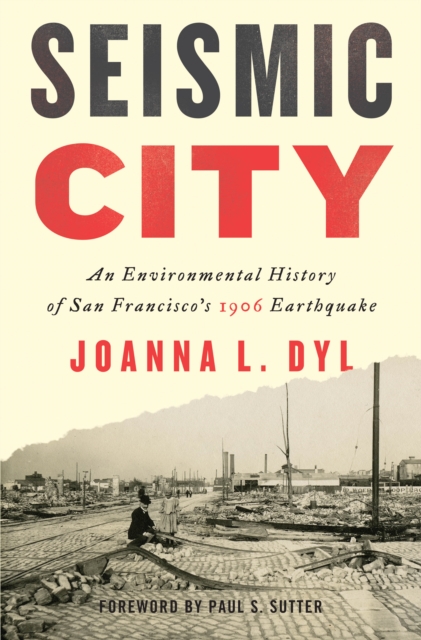
Seismic City
On April 18, 1906, a 7.8-magnitude earthquake shook the San Francisco region, igniting fires that burned half the city. The disaster in all its elements — earthquake, fires, and recovery — profoundly disrupted the urban order and challenged San Francisco’s perceived permanence.The crisis temporarily broke down spatial divisions of class and race and highlighted the contested terrain of urban nature in an era of widespread class conflict, simmering ethnic tensions, and controversial reform efforts. From a proposal to expel Chinatown from the city center to a vision of San Francisco paved with concrete in the name of sanitation, the process of reconstruction involved reenvisioning the places of both people and nature. In their zeal to restore their city, San Franciscans downplayed the role of the earthquake and persisted in choosing patterns of development that exacerbated risk.In this close study of the 1906 San Francisco earthquake, Joanna L. Dyl examines the decades leading up to the catastrophic event and the city’s recovery from it. Combining urban environmental history and disaster studies, Seismic City demonstrates how the crisis and subsequent rebuilding reflect the dynamic interplay of natural and human influences that have shaped San Francisco.
eBook


Down by the bay
San Francisco Bay is the largest and most productive estuary on the Pacific Coast of North America. It is also home to the oldest and densest urban settlements in the American West. Focusing on human inhabitation of the Bay since Ohlone times, Down by the Bay reveals the ongoing role of nature in shaping that history. From birds to oyster pirates, from gold miners to farmers, from salt ponds to ports, this is the first history of the San Francisco Bay and Delta as both a human and natural landscape. It offers invaluable context for current discussions over the best management and use of the Bay in the face of sea level rise.
eBook


Taking the Land to Make the City
The history of the United States is often told as a movement westward, beginning at the Atlantic coast and following farmers across the continent. But cities played an equally important role in the country’s formation. Towns sprung up along the Pacific as well as the Atlantic, as Spaniards and Englishmen took Indian land and converted it into private property. In this reworking of early American history, Mary P. Ryan shows how cities—specifically San Francisco and Baltimore—were essential parties to the creation of the republics of the United States and Mexico. Baltimore and San Francisco share common roots as early trading centers whose coastal locations immersed them in an international circulation of goods and ideas. Ryan traces their beginnings back to the first human habitation of each area, showing how the juggernaut toward capitalism and nation-building could not commence until Europeans had taken the land for city building. She then recounts how Mexican ayuntamientos and Anglo American city councils pioneered a prescient form of municipal sovereignty that served as both a crucible for democracy and a handmaid of capitalism. Moving into the nineteenth century, Ryan shows how the citizens of Baltimore and San Francisco molded landscape forms associated with the modern city: the gridded downtown, rudimentary streetcar suburbs, and outlying great parks. This history culminates in the era of the Civil War when the economic engines of cities helped forge the East and the West into one nation.
eBook

Frommer's easyguide to San Francisco
\"A brilliant wit once said that, to most Americans, even though they have never been there, San Francisco is their favorite town. The existence of that belief is the strongest proof of the glorious vacation experience that awaits the visitor to that city by the Bay ,that Paris of the West , a diverse, beautiful and cosmopolitan city that excites millions of visitors each year. It is truly the favorite town of America, and none agrees more than our author. Here is her thoroughly revised 256-page tribute to a massively popular destination.\"--Publisher's description.
Book

Making Immigrant Rights Real
More than half of the 41 million foreign-born individuals in the United States today are noncitizens, half have difficulty with English, a quarter are undocumented, and many are poor. As a result, most immigrants have few opportunities to make their voices heard in the political process. Nonprofits in many cities have stepped into this gap to promote the integration of disadvantaged immigrants. They have done so despite notable constraints on their political activities, including limits on their lobbying and partisan electioneering, limited organizational resources, and dependence on government funding. Immigrant rights advocates also operate in a national context focused on immigration enforcement rather than immigrant integration. InMaking Immigrant Rights Real, Els de Graauw examines how immigrant-serving nonprofits can make impressive policy gains despite these limitations.
Drawing on three case studies of immigrant rights policies-language access, labor rights, and municipal ID cards-in San Francisco, de Graauw develops a tripartite model of advocacy strategies that nonprofits have used to propose, enact, and implement immigrant-friendly policies: administrative advocacy, cross-sectoral and cross-organizational collaborations, and strategic issue framing. The inventive development and deployment of these strategies enabled immigrant-serving nonprofits in San Francisco to secure some remarkable new immigrant rights victories, and de Graauw explores how other cities can learn from their experiences.
eBook