
Catalogue Search | MBRL


Are you sure you want to remove the book from the shelf?

{{itemTitle}}
1,759
result(s) for
"settler colonialism"
Sort by:

Colonizing Palestine
Among the most progressive of Zionist settlement movements,
Hashomer Hatzair proclaimed a brotherly stance on
Zionist-Palestinian relations. Until the tumultuous end of the
British Mandate, movement settlers voiced support for a binational
Jewish-Arab state and officially opposed mass displacement of
Palestinians. But, Hashomer Hatzair colonies were also active
participants in the process that ultimately transformed large
portions of Palestine into sovereign Jewish territory. Areej
Sabbagh-Khoury investigates this ostensible dissonance, tracing how
three colonies gained control of land and their engagement with
Palestinian inhabitants on the edges of the Jezreel Valley/Marj Ibn
'Amer.
Based on extensive empirical research in local colony and
national archives, Colonizing Palestine offers a
microhistory of frontier interactions between Zionist settlers and
indigenous Palestinians within the British imperial field. Even as
left-wing kibbutzim of Hashomer Hatzair helped lay the groundwork
for settler colonial Jewish sovereignty, its settlers did not
conceal the prior existence of the Palestinian villages and their
displacement, which became the subject of enduring debate in the
kibbutzim. Juxtaposing history and memory, examining events in
their actual time and as they were later remembered, Sabbagh-Khoury
demonstrates that the dispossession and replacement of the
Palestinians in 1948 was not a singular catastrophe, but rather a
protracted process instituted over decades. Colonizing
Palestine traces social and political mechanisms by which
forms of hierarchy, violence, and supremacy that endure into the
present were gradually created.
eBook
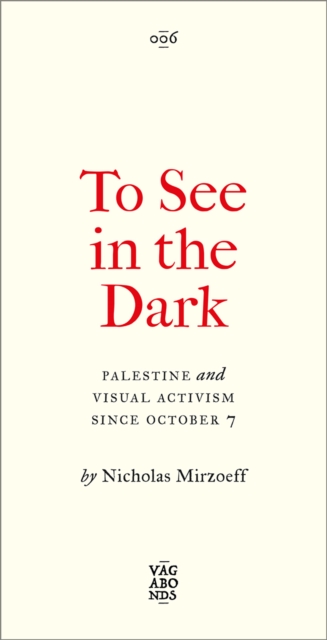
To See In the Dark
'Timely and clearly written, To See In the Dark is a manifesto to solidarity' - Stephen Sheehi, co-author of
Psychoanalysis Under Occupation
To see Palestine is to see the world. Since October 7th 2023, the forces of racial capitalism and settler colonialism have become all too visible in Israel's genocidal war on Gaza.
In T
o See In the Dark , Nicholas Mirzoeff explores how images, and especially video, viewed outside Palestine enabled a dramatic switch in public opinion, leading to a global uprising against the genocide.
In this groundbreaking analysis, he connects the personal and the political through his own anti-Zionist Jewishness and its histories of violence. The result is a new collective and anti-colonial way of seeing, intersecting online and embodied experience.
eBook

Encountering Palestine
Encountering Palestine: Un/making Spaces of Colonial
Violence , edited by Mark Griffiths and Mikko Joronen, sits at
the intersection of cultural and political geographies and offers
innovative reflections on power, colonialism, and anti-colonialism
in contemporary Palestine and Israel. Organized around the theme of
encountering and focusing on the ways violence and struggle are
un/made in the encounter between the colonizer and colonized, the
essays focus on power relations as they manifest in cultural
practices and everyday lives in anti/colonial Palestine. Covering
numerous sites in Gaza, the West Bank, East Jerusalem, and Israel,
Encountering Palestine addresses a range of empirical
topics-from marriage and queer aesthetics to policing, demolition,
armament failure, and violence. The contributors utilize diverse
theoretical frameworks, such as hyperreality, settler capitalism,
intimate biopolitics, and politics of vulnerability, to help us
better understand the cultural making and unmaking of colonial and
anti-colonial space in Palestine. Encountering Palestine
asks us to rethink how colonialism and power operate in Palestine,
the ways Palestinians struggle, and the lifeways that constantly
encounter, un/make, and counter the spaces of colonial violence.
eBook

The Best Land
In Susan A. Brewer's fascinating
The Best Land , she recounts the
story of the parcel of central New York land on which she grew
up. Brewer and her family had worked and lived on this
land for generations when the Oneida Indians claimed that it
rightfully belonged to them. Why, she wondered, did she not know
what had happened to this place her grandfather called the best
land. Here, she tells its story, tracing over the past four hundred
years the two families-her own European settler family and the
Oneida/Mohawk family of Polly Denny-who called the best land
home.
Situated on the passageway to the west, the ancestral land of
the Oneidas was coveted by European colonizers and the founders of
the Empire State. The Brewer and Denny families took part in
imperial wars, the American Revolution, broken treaties, the
building of the Erie Canal, Native removal, the rise and decline of
family farms, bitter land claims controversies, and the revival of
the Oneida Indian Nation. As Brewer makes clear in The Best
Land , through centuries of violence, bravery, greed,
generosity, racism, and love, the lives of the Brewer and Denny
families were profoundly intertwined. The story of this homeland,
she discovers, unsettles the history she thought she knew.
With clear determination to tell history as it was, without
sugarcoating or ignoring the pain and suffering of both families,
Brewer navigates the interconnected stories with grace, humility,
and a deep love for the land. The Best Land is a beautiful
homage to the people, the place, and the environment itself.
eBook

Criminalising Palestinians: History and borders in the construction of the Palestinian threat
This article investigates the role of the Israeli border in the process of criminalising Palestinians. Defining Israel in contrast to the Arab 'terrorists', waiting to attack, necessitates a grand, looming settler- colonial border and the sequestration of an entire population behind a manufactured prison. The justification for this form of border 'control' is made possible by the historic truths established by the West in the colonial era. The paper outlines this understanding of Arabs as a 'bestial', 'bellicose' group that thrives in conflict situations. It moves on to note that the consequence of this characterisation is the global, all-encompassing understanding of the Arab threat. It finally narrows the border wall down as an Israeli tool of segregation, justified by understandings of a racialised, 'threatening Arab'. The Israeli 'defence' of its borders will be reimagined from a Southern perspective as an oppressive system of segregation justified by the ways in which Arabs have historically been constructed.
Journal Article

Unsettling Brazil
Analyzes favela, quilombola, and indigenous communities' responses to settler colonialism in urban Brazil.Based on ethnographic research and her experiences growing up in Brazil, the author tells the stories of communities in Rio de Janeiro, São Paulo, and Belo Horizonte Unsettling Brazil offers a powerful account of five urban Indigenous and.
eBook

Epistemic Justice and the Postcolonial University
Across the world, universities are grappling with the colonial
legacies that have shaped them. That struggle is especially vital
in South Africa where the Rhodes Must Fall and Fees Must Fall
movements have catalysed decolonial activism and discourse against
the legacy of apartheid in higher education. This collection asks
what epistemic justice might look like in teaching, learning and
research across multiple academic disciplines. Each author writes
from first-hand experience of teaching at the University of Cape
Town, an institution that was and remains a key site of complicity
with and resistance against settler colonialism, apartheid, and
their ongoing oppressions. The contributors trace power relations
that are embedded in various teaching and learning spaces at UCT,
asking critical questions about the kinds of subjects and objects
of knowledge that are produced by their disciplines. Further, they
explore new ideas, texts, and intellectual and pedagogical
practices that can help academics interrogate, challenge and
transform the dominant power relations in the South African
academy. Collectively, these chapters work to imagine new subjects
of knowledge in the postcolonial university through an ethic of
epistemic justice. At a time when debates on decolonisation have
gained urgency in academic, civic and public spaces, this
interdisciplinary collection serves as a valuable archive
documenting and reflecting on a turbulent period in South African
higher education. It is an important resource for academics looking
to grasp debates on decoloniality both in South Africa, and in
university and teaching spaces further afield. Calling for
concerted and collaborative work towards greater epistemic justice
across diverse disciplines, the book puts forward a new vision of
the postcolonial university as one that enables excellent teaching
and learning, undertaken in a spirit of critical consciousness and
reciprocity.
At a time when debates on decolonisation have gained urgency in
academic, civic and public spaces, this interdisciplinary
collection by authors based at the University of Cape Town, South
Africa, serves as a valuable archive documenting and reflecting on
a turbulent period in South African higher education. It is an
important resource for academics looking to grasp debates on
decoloniality both in South Africa, and in university and teaching
spaces further afield. Calling for concerted and collaborative work
towards greater epistemic justice across diverse disciplines, the
book puts forward a new vision of the postcolonial university as
one that enables excellent teaching and learning, undertaken in a
spirit of critical consciousness and reciprocity.
eBook

Violence, Imagination, and Resistance
For some time, scholars have devoted considerable attention to the law as a force of repression, one that replicates and enforces structural inequalities through violence and legally sanctioned modes of punishment. But it is the means by which the law functions as a tool of governmentality that occupies the contributors to this volume. Through the exploration of how to deconstruct law’s power, how to expose the violence the law produces, and finally how to identify modes of resistance that have transformative potential, these essays contribute to the ongoing interrogation of settler colonialism, racism, and structural violence in Canada.
eBook

California and Hawai'i Bound
Beginning in the era of Manifest Destiny, U.S. settlers, writers,
politicians, and boosters worked to bind California and Hawai'i
together in the American imagination, emphasizing white settlement
and capitalist enterprise. In California and Hawai'i Bound
Henry Knight Lozano explores how these settlers and boosters
promoted and imagined California and Hawai'i as connected places
and sites for U.S. settler colonialism, and how this relationship
reveals the fraught constructions of an Americanized Pacific West
from the 1840s to the 1950s. The growing ties of promotion and
development between the two places also fostered the promotion of
\"perils\" over this transpacific relationship, from Native Hawaiians
who opposed U.S. settler colonialism to many West Coast Americans
who articulated social and racial dangers from closer bonds with
Hawai'i, illustrating how U.S. promotional expansionism in the
Pacific existed alongside defensive peril in the complicated
visions of Americanization that linked California and Hawai'i.
California and Hawai'i Bound demonstrates how the settler
colonial discourses of Americanization that connected California
and Hawai'i evolved and refracted alongside socioeconomic
developments and native resistance, during a time when U.S.
territorial expansion, transoceanic settlement and tourism, and
capitalist investment reconstructed both the American West and the
eastern Pacific.
eBook
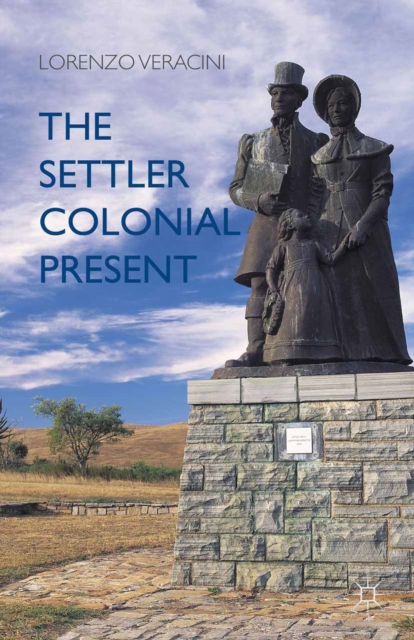
The Settler Colonial Present
What is Settler Colonialism? explores the ways in which settler colonialism as a specific mode of domination informs the global present. It presents an argument regarding its extraordinary resilience and diffusion and reflects on the need to imagine its decolonisation.
eBook