
Catalogue Search | MBRL


Are you sure you want to remove the book from the shelf?

{{itemTitle}}
176
result(s) for
"sexual frustration"
Sort by:

Femcel Discussions of Sex, Frustration, Power, and Revenge
Although male incels have received a great deal of scholarly attention in recent years, there has been almost no research on femcels (involuntarily celibate women). After collecting data from more than 24,000 femcel posts, we drew from a recently developed sexual frustration theory and conducted qualitative analyses of approximately 1200. Overall, our findings suggest that (1) femcels struggled with multiple types of sexual frustration; (2) they frequently discussed the gender dynamics of both sex and power; (3) they were more interested in their own frustrations than men’s frustrations; and (4) despite some notable exceptions, they exhibited less support for aggression, violence, and crime than what has been reported about male incels. Although some femcels referenced their anger, hatred, or desires for revenge, this antipathy may have been rooted in their concerns about how to find a suitable intimate partner while avoiding the threat women often face from violent men. Despite this challenge, most femcels who wanted to enhance their situation or increase their power sought to do so through legal means (e.g., self-improvement, group mobilization, or challenging the patriarchy) and did not express violent intent. Further research on femcels, and the evidence-based strategies that could help them, would be a significant contribution to society.
Journal Article

Celebrity Infidelity and Sex Crimes: An Empirical Investigation of Cheating, Sexual Harassment, Sexual Assault, and Solicitation
Although celebrity infidelity and sex crimes have received much attention in recent years, there has been almost no criminological research on these behaviors among a large sample of celebrities. For this study, we closely analyzed infidelity, sexual harassment, sexual assault, and solicitation of sex workers among 200 of the most famous celebrities in America. Overall, our quantitative results strongly suggest that (1) celebrity men are far more likely to commit sexual transgressions than celebrity women, (2) celebrities who cheat on their romantic partner have a substantially increased risk of also committing sexual harassment, sexual assault, and solicitation, and (3) celebrity men are much more likely to engage in infidelity than men in the U.S. general population. Our results also provide some support for the possibility that celebrity women may be more prone to infidelity than the average American woman and celebrity men may be more likely to commit sexual harassment, sexual assault, or solicitation than the average American man. We interpret these findings in the context of sexual frustration theory, given that celebrities may experience more sexual temptations than the average person and some may feel more entitled to have their sexual demands met.
Journal Article

Development and validation of the sexual distress scale: results from a collectivistic culture
Background
Literature lacks a comprehensive measure of sexual distress that could be applied to both clinical and non-clinical populations, regardless of the gender and relational status of the respondents. The current study, therefore, developed and validated Sexual Distress Scale (SDS).
Method
The development and validation of the SDS involved two consecutive studies with a total of 656 participants (men = 300, women = 356; M
age
=22 years) from Pakistan. The studies included exploratory factor analysis (EFA), confirmatory factor analysis (CFA), and assessments of convergent and divergent validity.
Results
The SDS demonstrated high reliability in both the studies (α = 0.911 & 0.946). Item-total correlations ranged from 0.670 to 0.878 (
p
< 0.01). EFA revealed a single-factor structure consisting of 8 items. CFA confirmed this structure, projecting a good comparative fit index (CFI = 0.913). The scale’s convergent validity was established through significant positive correlations with depression (
r
= 0.845,
p
< 0.01), anxiety (
r
= 0.847,
p
< 0.01), and stress (
r
= 0.786,
p
< 0.01). Divergent validity was established through significant inverse correlations with life satisfaction (
r
= -0.972,
p
< 0.01) and emotional expressivity (
r
= -0.935,
p
< 0.01). Compared to women, men experienced significantly higher levels of sexual distress (
p
< 0.01; Cohen’s
d
= 0.448).
Conclusion
The study bridges a substantial knowledge gap in the measurement of sexual distress. The findings highlight the impact of sexual distress on psychosocial health. The study opens avenues for further research and targeted interventions in sexuality, especially within the collectivistic cultures.
Journal Article
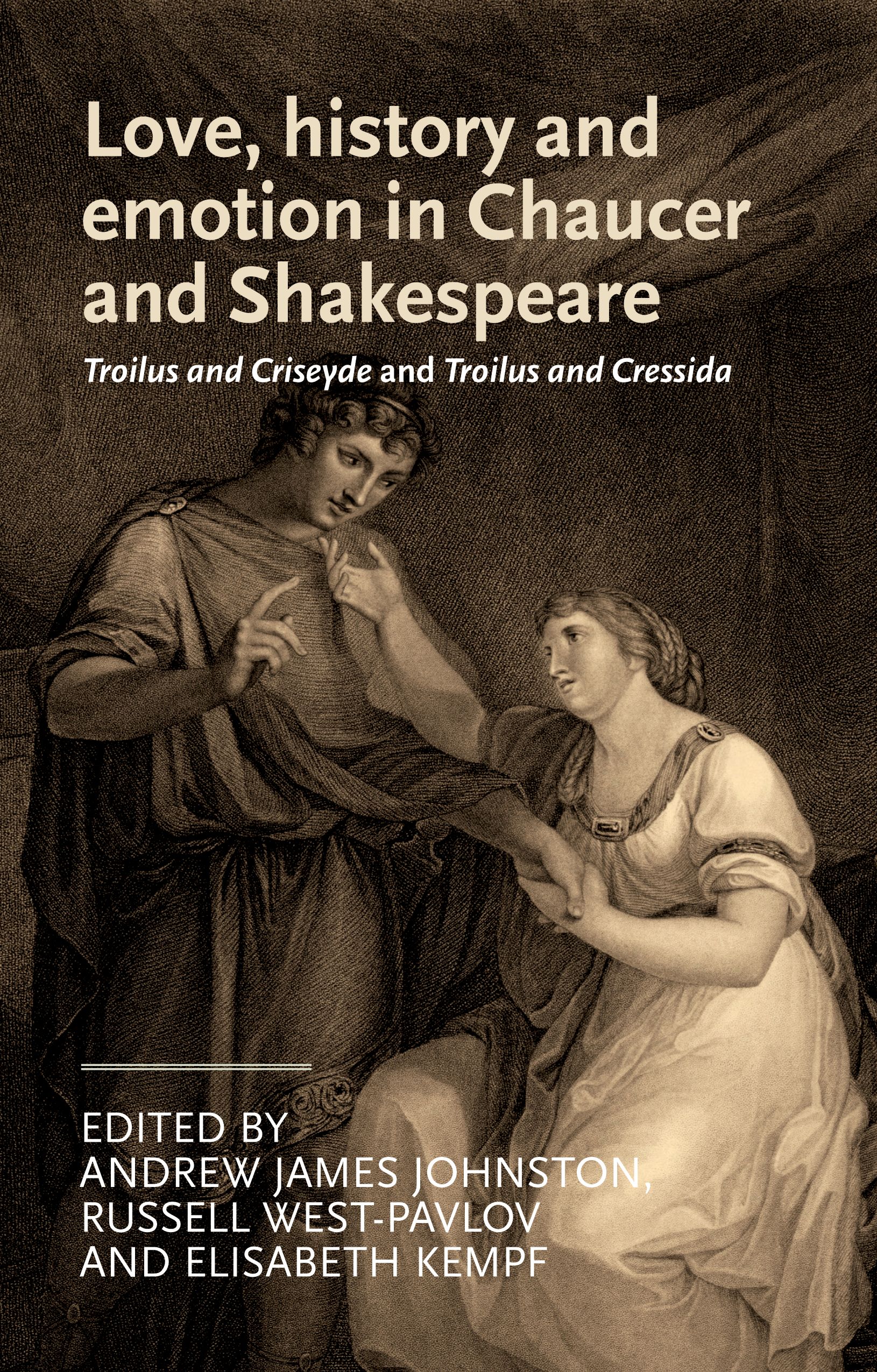
Love, history and emotion in Chaucer and Shakespeare
This collection of essays explores medieval and early modern Troilus-texts from Chaucer to Shakespeare. The contributions show how medieval and early modern fictions of Troy use love and other emotions as a means of approaching the problem of tradition. As these texts reflect on their own traditionality, they highlight both the affective nature of temporality and the role of affect in scrutinising tradition itself. Focusing on a specific textual lineage that bridges the conventional period boundaries, the collection participates in an exchange between medievalists and early modernists that seeks to generate a dialogic encounter between the periods with the aim of further dismantling the rigid notions of chronology and periodisation that have kept medieval and early modern scholarship apart.
eBook


Sexual frustration, religiously forbidden actions and work efficiency—a case study from the Pakistan perspective
A unique dimension of employee efficiency is reported in this paper. Sexuality in the work place, as well as rendezvous and romance in this context, have already received some attention from researchers but the topic is underexplored, most probably due to differences between Western culture and Asian culture. The primary focus of the study was to investigate the role played by religion in determining an employee’s sexual behavior, and in asking them to act within certain limits? The socio-economic circumstances, norms, customs, and obsession with social status that lead to delayed marriages push people into a corner, leaving them with the possible option of religiously forbidden actions where sexual desire is concerned. After indulging in such actions, regret and remorse create sexual frustration in employees, and this sexual frustration compromises their efficiency in the workplace. Ordinal regression and manipulations in syntax of ordinal regression were used to measure this concept. The study revealed that religiously forbidden actions and sexual frustration significantly diminishes the efficiency of some employees, whereas married and female employees are less sexually frustrated and thus are more efficient in the workplace.
Journal Article

Same-sex love in Muslim cultures through the lens of Hindustani Cinema
This paper tries to explore same-sex love in Muslim cultures in India as represented in Hindustani cinema. My focus will be on Muslim female same-sex love which is generally not touched upon. Female same-sex love and male same-sex love is widely discussed and debated upon. The recent film Dedh Ishqiya (Bhardwaj, 2014) is taken as a case study to examine female same-sex love in a Muslim context. Other films will be dealt in periphery. The influence of language, place and peer group is to be checked. Amradparashti or male same-sex love is discussed in comparison to female same-sex love for which no particular term in North India is used that frequently.
Journal Article
Love, history and emotion in Chaucer and Shakespeare
This collection of essays explores medieval and early modern Troilus-texts from Chaucer to Shakespeare. The contributions show how medieval and early modern fictions of Troy use love and other emotions as a means of approaching the problem of tradition. As these texts reflect on their own traditionality, they highlight both the affective nature of temporality and the role of affect in scrutinising tradition itself. Focusing on a specific textual lineage that bridges the conventional period boundaries, the collection participates in an exchange between medievalists and early modernists that seeks to generate a dialogic encounter between the periods with the aim of further dismantling the rigid notions of chronology and periodisation that have kept medieval and early modern scholarship apart.
eBook

Life before Frieda
This chapter begins by describing the deep impression made on Lawrence by Schopenhauer’s essay on `The Metaphysics of Love’, with its reduction of all love to a sexual, or more precisely reproductive instinct. When Lawrence discussed this essay with Jessie Chambers, it helped him recognise that he was less sexually attracted to her than to her brother Alan (see The White Peacock). Lawrence’s growing awareness of his bi-sexuality did not prevent him from deciding that he wanted to write about sex in more detail than previous English novelists, and from feeling increasingly frustrated, therefore, by his complete lack of personal experience. This build-up of sexual frustration became one of his major early subjects, especially as two of the more familiar methods of relief — masturbation and prostitution — were closed off to him. In desperation, he turned back to Jessie and cruelly recorded the failure of what was his first experience of sexual intercourse in the chapter of Sons and Lovers unfairly entitled `The Test on Miriam’. It was his almost immediately subsequent liaison with a dissatisfied married woman from his home town which helped him to describe his protagonist’s relations with Clare Dawes in that novel.
Book Chapter