
Catalogue Search | MBRL


Are you sure you want to remove the book from the shelf?

{{itemTitle}}
7
result(s) for
"ship-to-ship transfer"
Sort by:

Detecting Ship-to-Ship Transfer by MOSA: Multi-Source Observation Framework with SAR and AIS
Ship-to-ship (STS) transfer has become a major concern for maritime security and regulatory authorities, as it is frequently exploited for smuggling and other illicit activities. Accurate and timely identification of STS events is therefore essential for effective maritime supervision. Existing monitoring approaches, however, suffer from two inherent limitations: AIS-based surveillance is vulnerable to intentional signal shutdown or manipulation, and remote-sensing-based ship detection alone lacks digital identity information and cannot assess the legitimacy of transfer activities. To address these challenges, we propose a Multi-source Observation framework with SAR and AIS (MOSA), which integrates SAR imagery with AIS data. The framework consists of two key components: STS-YOLO, a high-precision fine-grained ship detection model, in which a dynamic adaptive feature extraction (DAFE) module and a multi-attention mechanism (MAM) are introduced to enhance feature representation and robustness in complex maritime SAR scenes, and the SAR-AIS Consistency Analysis Workflow (SACA-Workflow), designed to identify suspected abnormal STS behaviors by analyzing inconsistencies between physical and digital ship identities. Experimental results on the SDFSD-v1.5 dataset demonstrate the quantitative performance gains and improved fine-grained detection performance of STS-YOLO in terms of standard detection metrics. In addition, generalization experiments conducted on large-scene SAR imagery from the waters near Panama and Singapore, in addition to multi-satellite SAR data (Capella Space and Umbra) from the Gibraltar region, validate the cross-regional and cross-sensor robustness of the proposed framework. The effectiveness of the SACA-Workflow is evaluated qualitatively through representative case studies. In all evaluated scenarios, the SACA-Workflow effectively assists in identifying suspected abnormal STS events and revealing potential AIS inconsistency indicators. Overall, MOSA provides a robust and practical solution for multi-scenario maritime monitoring and supports reliable detection of suspected abnormal STS activities.
Journal Article

Comparative Study of RANS Models for Simulating Turbulent Flow and Heat Transfer in Corrugated Pipes
Corrugated pipes are extensively used in engineering applications that require flexibility and enhanced heat exchange, such as drainage and compact heat exchangers, and recently as inner layers in cryogenic flexible hoses for offshore liquid ship-to-ship transfer. The great flexibility of these hoses makes them well-suited for deployment in dynamic and harsh marine environments. However, the corrugated geometry also induces flow separation, elevated turbulence, and intricate heat transfer behaviors. This study focuses on the flow and heat transfer characteristics in corrugated pipes with various geometries, addressing the current lack of systematic comparative studies on the performance of different Reynolds-Averaged Navier–Stokes (RANS) models in such configurations. Despite their limitations in accuracy compared to high-fidelity methods, RANS models remain the workhorse for engineering analysis due to their computational efficiency. This study employs several RANS models to simulate flow and heat transfer in three corrugated pipe geometries—sinusoidal (Sin), C-type, and U-type—over a Reynolds number range of O(104) to O(105) and assesses their performance against high-fidelity Large Eddy Simulation benchmarks. The results show that prediction accuracy decreases with increasing corrugation depth, with the most significant errors in trough regions where reverse flow dominates, and that the choice of turbulence model has a strong influence on the predicted flow and heat transfer behavior. Among all models, the k−ϵ models overall provide the most consistent and accurate predictions for friction factor, velocity distribution, and Nusselt number, while the k−ω models perform the worst. The Reynolds Stress Model improves friction factor prediction accuracy at high Reynolds numbers and provides marginally better accuracy in mean Nusselt number prediction, but its advantages are limited relative to its substantially higher computational cost. The Standard k−ϵ model with Enhanced Wall Treatment demonstrates robust and balanced performance across geometries and flow regimes, making it a practical choice for engineering use. This work provides engineers and researchers guidance for choosing RANS models that balance accuracy and computational efficiency in simulations of LNG ship-to-ship transfer, compact heat exchangers, and other industrial systems that employ corrugated pipes.
Journal Article

A Survey on the Design and Mechanical Analysis of Cryogenic Hoses for Offshore Liquid CO2 Ship-to-Ship Transfer
With the increasing severity of climate change, Carbon Capture, Utilization, and Storage (CCUS) technology has become essential for reducing atmospheric CO2. Marine carbon sequestration, which stores CO2 in seabed geological structures, offers advantages such as large storage capacity and high stability. Cryogenic hoses are critical for the ship-to-ship transfer of liquid CO2 from transportation vessels to offshore carbon sequestration platforms, but their design methods and mechanical analysis remain inadequately understood. This study reviews existing cryogenic hose designs, including reinforced corrugated hoses, vacuum-insulated hoses, and composite hoses, to assess their suitability for liquid CO2 transfer. Based on CO2’s physicochemical properties, a conceptual composite hose structure is proposed, featuring a double-spring-supported internal composite hose, thermal insulation layer, and outer sheath. Practical recommendations for material selection, corrosion prevention, and monitoring strategies are provided to improve flexibility, pressure resistance, and thermal insulation, enabling reliable long-distance tandem transfer. A mechanical analysis framework is developed to evaluate structural performance under conditions including mechanical loads, thermal stress, and dynamic responses. This manuscript includes an introduction to the background, the methodology for data collection, a review of existing designs, an analysis of CO2 characteristics, the proposed design methods, the mechanical analysis framework, a discussion of challenges, and the conclusions.
Journal Article
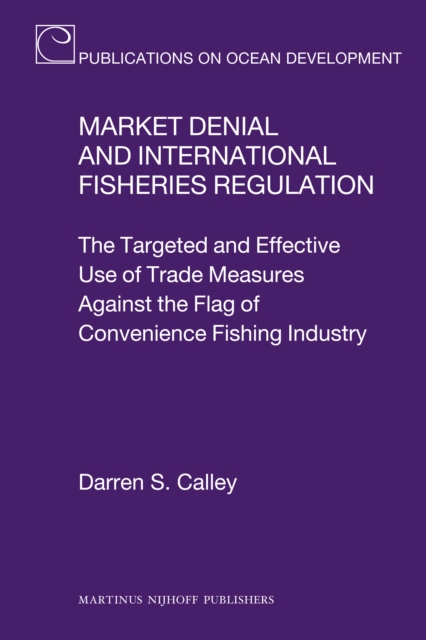
Market denial and international fisheries regulation: the targeted and elective use of trade measures against the flag of convenience fishing industry
Flag of convenience fishing seriously undermines efforts to protect the marine environment. To counter this threat, Market Denial and International Fisheries Regulation rests on the logic of the most basic tenet of economics: if no market exists for a product then producers will cease to produce. Denying market access to the flag of convenience fishing fleet should significantly reduce instances of illegal, unreported and unregulated (IUU) fishing. In areas beyond national jurisdiction not only is market denial the most effective means of undermining the IUU fleet, it is, for most practical purposes, the only way to do so. To what extent, however, do the laws of the sea and international trade allow groups of States to close their markets to non-compliant fishing vessels?
eBook

Market Denial and International Fisheries Regulation
Resting on the simple logic of market economics, this book considers the ways in which groups of States can lawfully and effectively deny market access to the flag of convenience fishing industry.
eBook
Ship-Borne Transfer Alignment under Low Maneuver
The transfer alignment processes of the ship-borne weapon and the shipboard aircraft are limited by ship0s maneuver, for large ship, it is hope that the transfer alignment can be executed just under the circumstances of sea wave without any intentional ship0s maneuver. Attitude plus angular rate matching and velocity plus attitude matching as the two possible methods which can give accurate estimations of misalignments between MINS and SINS just under swaying maneuver are studied in this paper. Simulation results show that under the circumstance of sea waves and parameters of ships dynamic deformation, attitude plus angular rate matching filter can give better estimations of misalignment angles than velocity plus attitude matching filter. In addition, the estimation accuracy of attitude plus angular rate matching filter is barely affected by sea condition.
Journal Article