
Catalogue Search | MBRL


Are you sure you want to remove the book from the shelf?

{{itemTitle}}
68,066
result(s) for
"social order"
Sort by:


The effects of observing punishment on consumers’ decisions to punish other companies during industry-wide crises
Industry-wide crises, characterized by multiple companies within an industry allegedly engaging in similar misconduct, lead to disruptions in the social order. During such crises, one or a few of the involved companies often attract more media attention and receive punishment ahead of the others. Will such punishments take the heat off other involved companies or increase their risk of further punishment? This research shows that the observation of these punishments increases consumers’ intent to punish other involved companies. Observing one involved company get punished signals that the involved companies are indeed at fault, thereby increasing consumers’ certainty in blame attribution. Subsequently, consumers increase their motive to restore social order and their intent to punish other involved companies. Four theoretically and managerially relevant moderators have been identified and tested. Seven studies involving secondary data and experiments with both hypothetical and real behavioral outcomes support the proposed effects.
Journal Article


Twilight of the Elites
A passionate account of how the gulf between France's metropolitan elites and its working classes are tearing the country apartChristophe Guilluy, a French geographer, makes the case that France has become an \"American society\"-one that is both increasingly multicultural and increasingly unequal. The divide between the global economy's winners and losers in today's France has replaced the old left-right split, leaving many on \"the periphery.\"As Guilluy shows, there is no unified French economy, and those cut off from the country's new economic citadels suffer disproportionately on both economic and social fronts. In Guilluy's analysis, the lip service paid to the idea of an \"open society\" has emerged in France as a smoke screen meant to hide the emergence of a closed society, walled off for the benefit of the upper classes. The ruling classes in France are reaching a dangerous stage, he argues; without the stability of a growing economy, the hope for those excluded from growth is extinguished, undermining the legitimacy of a multicultural nation.
eBook

Thucydides and Political Order : Concepts of Order and the History of the Peloponnesian War
\"The analysis of Thucydides as a joint effort of both ancient historians and political scientists found a welcome audience in the context of Cold War scholars in the 1980s and 1990s. Since the close of the Cold War, however, there has been little in the way of a concentrated scholarship renewing this interdisciplinary dialogue. This book, the first of two monographs exploring Thucydides, consists of contributions by world-class scholars on political order, using the framework of the Peloponnesian War to explore the historiography and political development of the ancient world. Analyzing both the original source material of the Athenian order as well as various interpretations of such material, this book will appeal to historians and political scientists alike in their re-examinations of Thucydides and his world\"-- Provided by publisher.
BOOK

Leveraging Knowledge Networks for Environmental Performance: The Role of Second-Order Social Capital in Manufacturing CSR Initiative
Manufacturing firms face increasing pressure to balance corporate social responsibility (CSR) with environmental performance (EP) while managing complex stakeholder relationships. Despite growing recognition of CSR’s importance for sustainability, the mechanisms through which CSR translates into tangible environmental outcomes remain underexplored, particularly regarding the role of extended stakeholder networks. This study addresses this gap by introducing a theoretical framework examining how CSR initiatives influence EP through the lens of second-order social capital (SOSC), which captures indirect social resources derived from customer and supplier networks. The research framework, grounded in social exchange theory and a resource-based view, develops and validates a comprehensive measurement tool specifically designed for manufacturing industries. Using survey data from 307 middle and senior-level managers in Taiwan’s manufacturing sector and employing the partial least squares structural equation model (PLS-SEM). The empirical analysis reveals that CSR directly and indirectly impacts EP through SOSC. Furthermore, CSR demonstrates a strong positive relationship with SOSC, while SOSC significantly influences EP. The mediation analysis confirms that SOSC serves as a significant intermediary mechanism, explaining how CSR initiatives cascade through extended network relationships to enhance EP. The findings offer practical implications for marketing managers and information systems professionals in designing integrated CSR strategies that effectively utilise customer and supplier relationships to improve EP, particularly in Asian manufacturing contexts where relationship-based business practices are prominent.
Journal Article

Teaching higher-order thinking in social studies: The role of content coverage and intellectual challenge
Purpose:The study aimed at investigating the prevalence and characteristics of classroom practices geared at promoting higher-order social studies thinking, and the potential dilemma for teachers between focusing on explaining knowledge to and intellectually challenging students.Design/methodology/approach:A comparative design using data from naturalistic classroom observations of 80 social studies lessons in Denmark, Norway, and Sweden. We deployed the PLATO observation system to systematically measure intellectual challenge and the conceptual complexity of teacher explanations across the three countries.Findings:We found evidence that many teachers promoted higher-order thinking to varying degrees within and across the three countries. Furthermore, Danish, Norwegian, and Swedish teachers seemed to focus on different teaching practices related to higher-order thinking.Practical implications:These findings provide important empirical knowledge about naturally occurring classroom practices in the Nordic context that may be relevant for teachers to reflect on higher-order thinking in social studies.
Journal Article

NON-GOVERNMENTAL ORGANIZATIONS (NGOs) IN KAZAKHSTAN: HISTORY AND CURRENT STATE OF FUNDING
Šiame straipsnyje analizuojama nevyriausybinių organizacijų (NVO) finansavimo raida ir dabartinė padėtis Kazachstane. Ypatingas dėmesys skiriamas tarptautinių donorų ir valstybės struktūrų sąveikai skirtinguose pilietinės visuomenės vystymosi etapuose. Aptariami pagrindiniai iššūkiai, tokie kaip priklausomybė nuo dotacijų, įstatymų pakeitimai ir mažas privačių aukų lygis. Remiantis dabartinių tendencijų analize, siūlomos rekomendacijos gerinti NVO finansinį tvarumą diversifikuojant finansavimo šaltinius, stiprinant partnerystę su valstybe ir plėtojant socialinį verslumą. Kazachstanas po 2022 m. sausio mėn. įvykių susidūrė su realių ir esminių pokyčių poreikiu, įskaitant sąveikos sunevyriausybiniu sektoriumi srityje. Tačiau vienas iš sudėtingiausių NVO plėtros aspektų, kuris tiesiogiai veikia sektoriaus tvarumą, yra organizacijų veiklos finansavimo klausimas. Tikslui įgyvendinti autoriai panaudojo ir išanalizavo 2018-2021 metų statistinius duomenis, norminius teisės aktus, taip pat anksčiau šia tema atliktų tyrimų rezultatus. Tyrimas parodė, kaip šiandien vyrauja valstybės finansavimas NVO, mažėjant tarptautinių donorų paramai ir silpnai plėtojant kitus alternatyvius šaltinius. Nepaisant esamo valstybės paramos sektoriaus plėtrai poreikio, šiame etape būtina aktualizuoti finansavimo šaltinių diversifikavimą, pačių NVO aktyvinimą, siekiant plėsti organizacijų matomumą, bei kurti realias partnerystes.Reikšminiai žodžiai: NVO (nevyriausybinės organizacijos), valstybės dotacijos, Kazachstanas, pilietinė visuomenė, valstybės socialinė tvarka.
Journal Article

Hybrid statehood - a new perspective on the limits of statehood in (Southern) EU-Europe
Political science research usually locates limited statehood outside the territory of the European Union (EU), although forms of limited statehood are hardly foreign phenomena in some parts of the EU, for example, Southern Italy. To understand these configurations of statehood, we introduce the concept of hybrid statehood as a specific form of societal order, characterized by a complex mixture of elements of European statehood and other forms of social order. It challenges the dichotomous understanding of statehood as either consolidated or limited, putting more emphasis on the interdependent coexistence of societal order, the practices of doing statehood and negotiating societal order, and the impact of historical constellations of societal order in the longue durée. We argue that bridging the gap between political science, history and social anthropology allows for a more in-depth understanding of statehood there. We need to take the challenge of understanding such societies very seriously, considering that Italy and the EU have failed to implement their visions of statehood and societal order for decades. This is even more the case if we consider that such configurations of hybridity will increasingly travel to other parts of the EU due to migration from the southern Mediterranean.
Journal Article
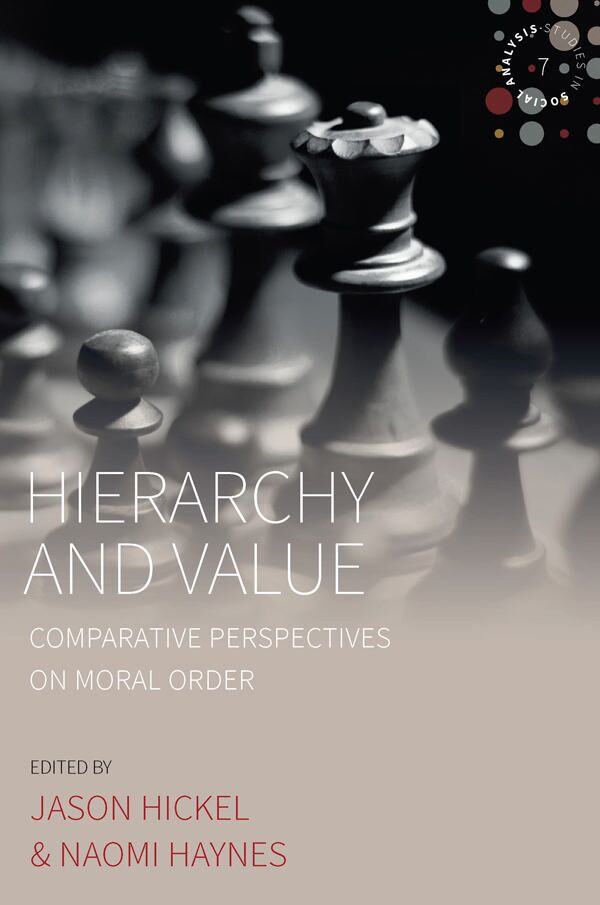
Hierarchy and Value
Globalization promised to bring about a golden age of liberal individualism, breaking down hierarchies of kinship, caste, and gender around the world and freeing people to express their true, authentic agency. But in some places globalization has spurred the emergence of new forms of hierarchy—or the reemergence of old forms—as people try to reconstitute an imagined past of stable moral order. This is evident from the Islamic revival in the Middle East to visions of the 1950s family among conservatives in the United States. Why does this happen and how do we make sense of this phenomenon? Why do some communities see hierarchy as desireable? In this book, leading anthropologists draw on insightful ethnographic case studies from around the world to address these trends. Together, they develop a theory of hierarchy that treats it both as a relational form and a framework for organizing ideas about the social good.
eBook