
Catalogue Search | MBRL


Are you sure you want to remove the book from the shelf?

{{itemTitle}}
719,667
result(s) for
"social relations"
Sort by:


Beyond and Below Racial Homophily: ERG Models of a Friendship Network Documented on Facebook
A notable feature of U.S. social networks is their high degree of racial homogeneity, which is often attributed to racial homophily--the preference for associating with individuals of the same racial background. The authors unpack racial homogeneity using a theoretical framework that distinguishes between various tie formation mechanisms and their effects on the racial composition of networks, exponential random graph modeling that can disentangle these mechanisms empirically, and a rich new data set based on the Facebook pages of a cohort of college students. They first show that racial homogeneity results not only from racial homophily proper but also from homophily among coethnics of the same racial background and from balancing mechanisms such as the tendency to reciprocate friendships or to befriend the friends of friends, which both amplify the homogeneity effects of homophily. Then, they put the importance of racial homophily further into perspective by comparing its effects to those of other mechanisms of tie formation. Balancing, propinquity based on coresidence, and homophily regarding nonracial categories (e.g., students from \"elite\" backgrounds or those from particular states) all influence the tie formation process more than does racial homophily.
Journal Article
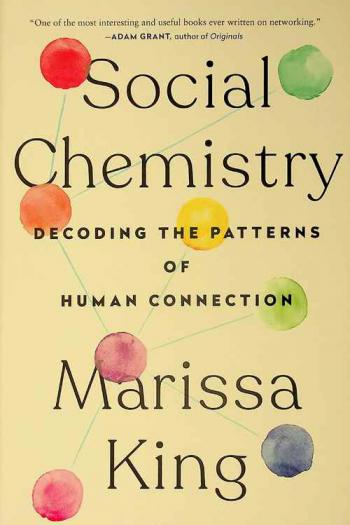
Social chemistry : decoding the patterns of human connection
\"Yale professor Marissa King shows how anyone can build more meaningful and productive relationships based on insights from neuroscience, psychology, and network analytics. Conventional wisdom says it's the size of your network that matters, but social science research has proven otherwise. King explains that the quality and structure of our relationships has the greatest impact on our personal and professional lives. As she shows, there are only three basic types of networks, so readers can see the role they are already playing: Expansionist, Broker, or Convener. This network decoder enables readers to own their network style and modify it for better alignment with their life plans and values. High-quality connections in your social network strongly predict cognitive functioning, emotional resilience, and satisfaction at work. A well-structured network is likely to boost the quality of your ideas, as well as your pay. Beyond the office, social connections are the lifeblood of our health and happiness. The compiled results from seventy previous studies found that loneliness increases the likelihood of early death by 26 percent-an effect equivalent to obesity or smoking fifteen cigarettes a day. Rich stories of Expansionists like Vernon Jordan, Brokers like Yo-Yo Ma, and Conveners like Anna Wintour, as well as personal experiences from King's own world of connections, inform this warm, engaging, revelatory investigation into some of the most consequential decisions we can make about the trajectory of our lives\"-- Provided by publisher.

Searching for a Mate: The Rise of the Internet as a Social Intermediary
This article explores how the efficiency of Internet search is changing the way Americans find romantic partners. We use a new data source, the How Couples Meet and Stay Together survey. Results show that for 60 years, family and grade school have been steadily declining in their influence over the dating market. In the past 15 years, the rise of the Internet has partly displaced not only family and school, but also neighborhood, friends, and the workplace as venues for meeting partners. The Internet increasingly allows Americans to meet and form relationships with perfect strangers, that is, people with whom they had no previous social tie. Individuals who face a thin market for potential partners, such as gays, lesbians, and middle-aged heterosexuals, are especially likely to meet partners online. One result of the increasing importance of the Internet in meeting partners is that adults with Internet access at home are substantially more likely to have partners, even after controlling for other factors. Partnership rate has increased during the Internet era (consistent with Internet efficiency of search) for same-sex couples, but the heterosexual partnership rate has been flat.
Journal Article

The Social Connectedness of Older Adults: A National Profile
For decades, scholars have wrestled with the assumption that old age is characterized by social isolation. However, there has been no systematic, nationally representative evaluation of this possibility in terms of social network connectedness. In this article, we develop a profile of older adults' social integration with respect to nine dimensions of interpersonal networks and voluntary associations. We use new data from the National Social Life, Health, and Aging Project (NSHAP), a population-based study of non-institutionalized older Americans ages 57 to 85, conducted in 2005 to 2006. Results suggest that among older adults, age is negatively related to network size, closeness to network members, and number of non-primary-group ties. On the other hand, age is positively related to frequency of socializing with neighbors, religious participation, and volunteering. In addition, age has a U-shaped relationship with volume of contact with network members. These findings are inconsistent with the view that old age has a universal negative influence on social connectedness. Instead, life-course factors have divergent consequences for different forms of social connectedness. Indeed, some later-life transitions, such as retirement and bereavement, may prompt greater connectedness. We conclude by urging increased dialogue between social gerontological and social network research.
Journal Article

Social Exchange and Micro Social Order
This study uses an affect theory of social exchange (Lawler 2001) to investigate how and when network structures generate \"micro social orders.\" Micro social order entails recurrent interactions, emotional reactions, perceptions of a group, and affective sentiments. The core theoretical argument is that micro orders, involving behavioral, cognitive, and affective dimensions, develop and are stronger to the degree that (1) actors engage in highly joint tasks or activities and (2) these tasks generate a sense of shared responsibility for the interaction outcomes. A laboratory experiment varies different forms of social exchange-negotiated, reciprocal, generalized, and productive-within a network structure, and offers strong support for the core expectation that productive forms of exchange generate the strongest micro order. Conversely, generalized exchange generates the weakest order, with negotiated and reciprocal forms in between. In general, productive exchange bolsters more exchange behavior, more positive feelings, perceptions of cohesion at the network level, and affective attachments to the network as a social unit. This research has broad implications for the conditions under which task activity promotes micro social orders that involve strong person-to-group ties (as opposed to person-to-person ties) and affective sentiments regarding the social unit.
Journal Article

Concepts of international relations, for students and other smarties
\"Concepts of International Relations, for Students and Other Smarties is not a stereotypical textbook, but an instructive, entertaining and motivating introduction to the field of International Relations (IR). Rather than relying on figures or tables, Concepts of International Relations, for Students and Other Smarties piques the reader's interest with a pithy narrative that presents apposite nutshell examples, stresses historical breaks and throws in the odd pun to get the big picture across. While there are other brief, introductory IR titles, Iver Neumann's book remains fully within the academic genre, and is comparatively long on history. It is based on his repeatedly offered introductory lectures to first-year IR students and students from other disciplines looking for an overview course at the LSE. With a relaxed lecturing style, this textbook introduces the long-term historical emergence of concepts such as state (European), state (global), empire, non-state agents, foreign policy, state system, nationalism, globalization, security, international society, great powers, diplomacy, war and peace, balance of power, international law, power and sovereignty, intervention, gender and class. It demonstrates how such phenomena have been understood in very different ways. First, the reader is alerted to how the use of concepts is an integrated part of politics. Secondly, the reader is sensitized to how social change has worked in the past, and is working now. Thirdly, the book demonstrates how historical and social context matters in ongoing international relations\"-- Provided by publisher.
Book

Empirical Analysis of an Evolving Social Network
Social networks evolve over time, driven by the shared activities and affiliations of their members, by similarity of individuals' attributes, and by the closure of short network cycles. We analyzed a dynamic social network comprising 43,553 students, faculty, and staff at a large university, in which interactions between individuals are inferred from time-stamped e-mail headers recorded over one academic year and are matched with affiliations and attributes. We found that network evolution is dominated by a combination of effects arising from network topology itself and the organizational structure in which the network is embedded. In the absence of global perturbations, average network properties appear to approach an equilibrium state, whereas individual properties are unstable.
Journal Article