
Catalogue Search | MBRL


Are you sure you want to remove the book from the shelf?

{{itemTitle}}
33,164
result(s) for
"special educational needs"
Sort by:

Special educational needs
Special Educational Needs: A New Look by Mary Warnock was initially published by the Philosophy of Education Society of Great Britain in 2005.In this new edition, Warnock has updated her argument, Brahm Norwich has contributed a counter-argument and Lorella Terzi has provided an introduction and afterword, drawing the two debates together.
eBook

Justice and equality in education : a capability perspective on disability and special educational needs
Lorella Terzi offers a philosophical conception of justice and equality in education, examining the demands of disability and special educational needs.
eBook

Staying Mentally Healthy During Your Teaching Career
The mental health of teachers in school is just as important as the well-being of the pupils they support. Recent research reveals some alarming statistics, including that 74% of teachers are unable to relax and have a poor work-life balance. This book examines a range of relevant issues including workload, managing behaviour, developing resilience and managing professional relationships in order to address some of these concerns and provide comprehensive guidance and workable, evidence-informed strategies to support all those teaching in schools and colleges.
eBook
Assessment of stress level in students with special educational needs during distance learning
The study assesses stress levels in students with special educational needs in the context of distance learning. The experiment involved 60 students with special educational needs from two universities, divided into groups of distance and blended learning formats. Assessments were made at the beginning, middle, and end of the semester using standardized techniques and original questionnaires. The results demonstrated higher stress levels in the distance learning group, a strong correlation of stress with technical problems, and a moderate correlation with social isolation and self-organization difficulties. The authors showed the dynamics of stress levels in students during the semester of distance learning. Based on the results, the authors developed recommendations for adapting the digital infrastructure of higher education institutions, creating inclusive online platforms for social interaction, and introducing specialized programs for improving self-organization skills in students with special educational needs. The study proves the multifactorial nature of stress in this group of students in the context of distance education and contributes to the development of effective support strategies.
Journal Article

Assessing the efficiency of teacher education program in Emirati university for preparing pre-service teachers for inclusive education
This study investigates Emirati universities' general education program effectiveness in preparing pre-service teachers for inclusive education. It assesses pre-service teachers' readiness to teach students with special educational needs and disabilities (SEND) after studying two academic subjects in inclusive education and undertaking three practicums. Pre-service teachers' beliefs, knowledge, and experiences in applying inclusion were explored. Mixed quantitative and qualitative research methods were used to conduct this study. Data for the study were gathered through an online survey, which was developed by the author after gaining feedback from four experts in the field. To validate the results of the survey, semi-structured interviews were conducted with some research participants who completed the survey. The study involved 53 female pre-service teachers specializing in early childhood education, predominantly in their fourth year or internship, all having completed two inclusive education courses. Recruitment was conducted through WhatsApp internship groups and email. The study was conducted at a federal university in the UAE with two campuses. This university was selected because of its strong commitment to inclusive practices for students compared to other universities in the UAE. The results show a positive impact on beliefs but dissatisfaction with inclusion knowledge. The program lacked real classroom-inclusive training, affecting readiness. Based on the findings, we recommend four-year education with diverse inclusive topics and ample teaching practice to improve pre-service teacher preparation.
Journal Article
Teachers' perceptions of using peer-mediated instruction and intervention for supporting children's social skills and play between children in inclusive preschools
Enabling peer play for preschool children with low social skills requires targeted measures for their social development and learning and interactions between them and their peers. Play Time/Social Time (PT/ST) is a peer-mediated instruction and intervention (PMII) with that purpose. This case study explored how four preschool teachers perceived the opportunities and obstacles of PT/ST, and how PMII compared to their current practices in inclusive Swedish preschools. Multiple data were collected: an intervention rating profile (IRP), audio-recorded coaching sessions, logbooks, checklists, and a group interview. The IRP revealed that the teachers rated PT/ST as highly feasible. Through qualitative analysis, we interpreted three themes demonstrating their perceptions: Special educational situations, Conditions for applications, and Professional reflections and learning. Concerning opportunities, the teachers perceived that PT/ST contributed to social skills progress and increased peer play for the target children. They also perceived that PT/ST contributed to their current practices when used regularly and responsively by clarifying learning content, procedures, and goals for social skills and play. Obstacles to PT/ST reflected situational thresholds for simultaneous play between the target children and peers and organisational conditions that complicated applications of PT/ST. Implications for inclusive preschool practice and research are discussed.
Journal Article

The Irregular School
Should disabled students be in regular classrooms all of the time or some of the time? Is the regular school or the special school or both the solution for educating students with a wide range of differences?
Inclusive education has been incorporated in government education policy around the world. Key international organisations such as UNESCO and OECD declare their commitment to Education for All and the principles and practice of inclusive education. There is no doubt that despite this respectability inclusive education is hotly contested and generates intense debate amongst teachers, parents, researchers and policy-makers. People continue to argue over the nature and extent of inclusion.
The Irregular School explores the foundations of the current controversies and argues that continuing to think in terms of the regular school or the special school obstructs progress towards inclusive education. The book contends that we need to build a better understanding of exclusion, of the foundations of the division between special and regular education, and of school reform as a precondition for more inclusive schooling in the future. Schooling ought to be an apprenticeship in democracy and inclusion is a prerequisite of a democratic education.
The Irregular School builds on existing research and literature to argue for a comprehensive understanding of exclusion, a more innovative and aggressive conception of inclusive education and a genuine commitment to school reform that steps aside from the troubled and troubling notions of regular schools and special schools. It will be of interest to all those working and researching in the field of inclusive education.
eBook
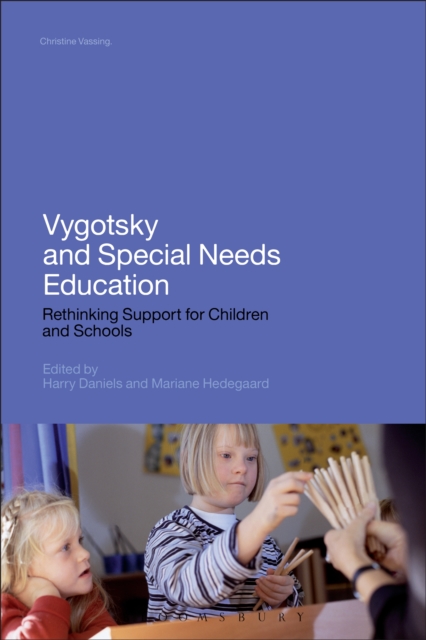
Vygotsky and special needs education
This is an international guide to using Vygotsky's theories to support children and schools in special needs education.After Piaget, Vygotsky is perhaps the most important educational theorist of the twentieth century.Support for schools and pupils with additional needs has been theorised in a number of ways over the last 100 years and much.
eBook

Restorative Practice and Special Needs
Restorative Practice (RP) is an effective approach to discipline that has the potential to transform behaviour by focusing on building and restoring relationships. This practical guide explains how to implement restorative approaches with young people with special needs in educational or residential settings.
The book explores how RP is being used in general terms and through a number of case studies looks at how RP needs to be adapted for those with additional needs including Autism Spectrum Disorder, ADHD, Foetal Alcohol Spectrum Disorder, Intellectual Disability and communication difficulties. It includes guidance on particular issues such as staff facing crises, the issue of physical restraint and additional support parents require.
The book will be of interest to restorative practitioners, educational professionals including headteachers, teachers and SENCOs in both special education and mainstream schools and residential care leaders and staff.
eBook

Leading on Inclusion
Leading on Inclusion: Dilemmas, debates and new perspectives critically examines the current theory and legislative context of special educational needs and disability, and explores the enduring issues and opportunities that will affect future practice in all schools.
The central theme throughout the book asks the inevitable question 'What happens next?' and the expert team of contributors, drawn from a pool of teachers, academics and researchers, consider wide-ranging issues such as:
the voice of young people
whole school development and planning for inclusion
educational change within the context of inclusion
the pros and cons of multi-professional working
inclusive and ethical research
international perspectives on inclusion, SEN and disability
the development of teacher education and the notion of 'joined up' thinking.
This forward-thinking and rigorously researched book will be essential reading for students, teachers undertaking school-based training, SENCOs, inclusion managers, higher education tutors and anyone with a professional interest in the future for inclusive education.
eBook